Tuesday, 7 July 2009

khan you believe it?


The sun had set over the desert, signalling that our journey had taken us a full day. As our taxi driver pulled into the town, the near absence of street lights meant that we got only brief glimpses of our new surroundings. People strolling through the darkness would come into the range of our headlights for a second then disappear again; fragments of old mud-brick walls would loom up and then fade; rubble on the streets would appear suddenly, and we’d swerve to avoid it. This was exciting, tantalising … and a tiny bit scary.

As we stopped outside our hotel, we could see only silhouettes of the town in front of us – a softly illuminated minaret, the outline of a dome that was a little darker than the sky around it, and the shapes of low, square buildings. Turning off the engine, the driver pointed to a disheveled, overweight man lying sideways on some street furniture, looking a bit like a homeless person resting on a park bench. “That’s your hotel manager”, he said.

On the way here from the local airfield, our driver, Bahatir, had overtaken almost every other vehicle in sight, which had ranged from donkeys to Chevrolets. We knew we’d be seeing more of Bahatir, because he’d asked us about our onward travel plans, and we’d subsequently arranged to meet him again in three days’ time. He’d agreed to drive my father, my uncle and I across a six-and-a-half-hour stretch of desert for US$100, to our next destination after this.

As we were unloading our bags from the taxi, I asked Bahatir for his number so we could call him to confirm the pick-up. He responded with a question: “Do you have the Lonely Planet?”

“Er, yes.”

“Well, if you
  have the
  Lonely Planet,
  you have
  my number.”
 
He wasn’t lying.

And that, in a nutshell, was our introduction to the ancient Silk Road city of Khiva.

This word “ancient” is one of those (like “literally”) which sees far too much use nowadays, but in this case I’m definitely not exaggerating. A fortified citadel, built in an oasis near the rugged frontier separating Uzbekistan from Turkmenistan, Khiva celebrated its 2,500th birthday a few years back. And to be honest, it looks its age.

Mind you, nearly all of the original city is long gone. The walls, for example, are about sixth generation; they were first built in the 3rd century BC, but everyone from Chingiz Khan* to The Red Army has queued up over the millennia to try and destroy them, and some have succeeded. The desert itself has also engulfed the walls a couple of times, forcing Khiva’s inhabitants to start almost from scratch. But despite the reconstructions, you definitely get the feeling that this place has been around more or less forever, and will probably outlast a few more empires before it finally sinks into the sand.

The old city is an incredible network of avenues and alleyways, absolutely packed with historical sites. The Four Ms (mosques, madrassas, minarets and mausoleums) are here in huge abundance, along with some tumbledown dwellings and the palaces of the Khans who ruled this place for five hundred years or so up until the 1920s. And the whole place positively drips with history. Past rulers have included Tamerlane (one of those guys who you don’t hear much about in the West, but who had the third biggest empire in the world in his day), the Kungrad Sufi dynasty, and the caliph of Arabia. Then of course you had the khans – descendents of Chingiz – and later, the Tsars and their Bolshevik successors.

Politics and religion aside, there are also echoes here of the amazing scientific revolution that spread throughout the Middle East and adjacent areas in early medieval times. For example, the mathematician Al-Khorezm was a native of Khiva, and you might notice a resemblance to the word “algorithm” in his name. That’s because he was the guy who basically invented algebra (and yes, you can feel free to hate him for it if you want, but hey … obviously not a stupid man!). So algorithms are named after him.

Just a little more historical blah, then I’m done. I wanted to mention that, under the Khans, Khiva became the centre of the slave trade in Central Asia, which was rather brutal (almost as brutal as putting your wife into a sack with a wild cat, then beating the sack with big sticks – which, incidentally, was the penalty for adultery here at around the same time). The Khanate forces tended to bring back great herds of people from their various campaigns, including many thousands of Russians. These people were sold here at the market.

As it turned out, this provided Russia with a perfect excuse to move on the Khanate in the late 19th century, before the British (who also had their eye on it) could do likewise. So indirectly, it was slavery that ensured Khiva, and the surrounding area of Khorezmia, would become part of the USSR. Had things worked out just a little bit differently, this part of Uzbekistan would probably have been a British colony, and instead of enjoying a leisurely game of nardiy** in the streets at night, guys here would be playing cricket.

Lucky for them the Russians got here first – I mean, throwing women into sacks with angry cats is pretty damn cruel, but condemning an entire culture to cricket is just downright inhumane ;-)

So yeah, that’s the guts of what we managed to pick up in two days. We spent the first day walking around by ourselves, just going “wow” and “ooh” and “Hey, look at that!”. Then on Day Two we scored ourselves a guide, who led us through the Four Ms, the palaces, the local harem and a sackload of other places that left us open-mouthed.

Amongst all of this serious historical stuff, we had plenty of time to explore the amazing architecture, relax in some cool outdoor restaurants, and say “hello” to about fifty thousand Uzbek children (see below.) We even found real, ground coffee, which was quite a feat in this dyed-in-the-wool tea culture. Needless to say, our first sip of coffee for days was a blissful moment!

And what was the coolest thing I saw in Khiva? Hard to say. I’m still digesting it all, and actually I’ve re-written this entry three or four times, trying to give a sense of how it felt to be there, but falling short each time.


Probably the best place to start is the silliest, so let’s try that. One thing I loved about Khiva was the fact that you could stand around admiring the ancient mud-brick walls of an Islamic fortress while crappy old Soviet cars drove past. As many of you know, Anthony says a big “yay!” to the crappy old Soviet cars; the only things I’ve bothered to become a ‘fan’ of on Facebook are Bill Bailey and Lada, and I’m proud to be associated with both :-) So that was really cool … it was like a living collage of elements from different cultures that you previously thought of as being completely separate.

What else? Oh yeah, the tapchan. I have to tell you about that – it may be the greatest piece of furniture ever invented.

See, the weather in Khiva – as you could probably have guessed – is frighteningly hot. Walking around without a hat for just one morning, I got such a bad case of sunburn that I was concerned it might have permanently scarred me … and that was on a mild day! Bahatir (the taxi guy) told us that, four days before we arrived, the temperatures had hit 50C. We were dealing with 35-40, and only just coping. At one point, it got so bad that I actually bought a baseball cap to protect myself … and wore it! Now that’s desperation, wouldn’t you say?

Anyway, in conditions like these, people tend to spend a lot of their evening time outside. So as you walk around town you find beds in the street, and there are more on the rooftops. But the tapchan is much cooler than a conventional bed; it’s a platform raised about 40cm off the ground, large enough to accommodate a whole family and strewn with silk rugs (a specialty of this area) and cushions.

A lot of families in Khiva have one outside their lounge room, with an electrical cord running out to power the TV and a small dining table in the middle. So they recline together on their tapchan, chatting and watching football or soaps or whatever, as bats and insects swoop and dive around them. And let me tell you, these things are amazingly comfortable. I sat on one tonight whilst having snacks and coffee with my father and uncle***, and after an hour on the tapchan, I was so relaxed that I could’ve been fined for it in some of the world’s more uptight countries. And so I’ve decided: if I ever have a house with a yard (which is doubtful, admittedly), I’m definitely placing an order for one of these things. They’re just awesome.

Two more things to mention, and then I’m done. First, the Uzbek people. They’re quite devout Muslims, from what I can see, and of course we Westerners are socialized to think that many devout Muslims harbor a certain antipathy towards the West. Come here for a week, and you’ll see how absurd that is. I’ve never had so many people randomly say “hello” to me on the street as I’ve had in Uzbekistan. Ask someone for assistance here, and they’ll do everything in their power to help you get what you need. Of course they often don’t succeed, ‘cause there are certain things which are just a lot more difficult here than in other places – like getting money, for example. (At one point we wandered into the National Bank of Uzbekistan and were told “Sorry, we have no more money today.” Two cash machines were sulking in a corner, unplugged, and the tellers were all standing around going “Hmmm, what now?” It was a real Central Asia Moment.)

And the police, who I was warned about so sternly by Lonely Planet and other ‘authorities’? Well, they’re definitely curious about foreigners, and also rather ‘enterprising’, let’s say. They have a habit of standing near the entrances to off-limits areas of historical sites – like the section of the Emir’s palace in Bukhara that was bombed by the Red Army in 1920. It’s basically rubble now, and rightfully barred from the public, because there are deep shell craters and no barriers around the high walls. But for 2,000 Uzbek Som (about US$1.50) you can ‘bribe’ a policeman to let you in, for a truly spectacular view of the city that you can’t get anywhere else. As far as their scary reputation, though, I’d have to say it’s just more Western paranoia. Crack a little joke with a policeman, and suddenly he’s flashing his gold teeth and wishing you many grandchildren.

So yeah … the Uzbek people get my ‘thumbs up’. Very relaxed, down-to-Earth, and just nice. The only downside: they’re nowhere near as pretty as the Kazakhs. Less than a week outside Almaty, and I’m already missing the princesses.

*sigh*

Oh ^deer^ … so superficial.

The final thing I wanted to mention is something totally incidental, but nonetheless very cool i.m.o. In Khiva our guide took us to the mausoleum of a local hero called Pahlavan Mahmud. After the tour, as we were sitting in the mosque and watching the Imam pray for a married couple who had come in, something caught my eye. About three feet to the left of the Imam, a cat lay sleeping on the plush, carpeted floor. The Imam seemed to know he was there, and obviously didn’t mind.

I asked our tour guide about this, and she told me that The Prophet was often accompanied by a cat when he prayed, so now every Mosque has a cat that hangs out with the Imam during ceremonies.

This struck me as cool for three reasons. First, it’s a cat in a house of worship, and the presence of a cat anywhere is a good thing. Second, the kitty was totally uninterested in all the human business – as cats are wont to be – and far more intent on his nap. This seemed to me the perfect reminder that, while we humans are going about our rituals, there’s a whole world out there that continues doing its thing regardless of what we believe or don’t believe. And third, Imams are sustained by the food that people bring them, and some of that food goes to the cat. As our guide tells it, Mosque kitties are very spoiled indeed. I like that :-)

So … if I had to choose a ‘favourite’ among the five major world religions, right now it would be Islam. Nothing to do with the theology, of course – I mean, I try to respect all religions except Catholicism, Scientology and the other clearly insane ones, but at the same time I know that none of them have anything relevant to say to me personally. No, I just like the fact that Imams spoil their cats. To me, that seems a very appropriate thing for a ‘spiritual’ person to do.

(Later postscript: after my friend Ally read this, she told me that Muslims believe the 'M'-shaped stripes on a tabby cat's head come from Mohammed. They're echoes of the Prophet's fingertips, where he used to stroke his tabby. How cool is that?)

Anyway, we left Khiva a couple of days ago, and took the aforementioned drive across the desert. That was an experience in itself. Probably the highlight was the bridge which took us across the Amur-Darya river. It was an extremely makeshift-looking construction, with steep ramps at either end and various sections imperfectly fitted together, each at a slightly different angle to the horizontal. I asked Bahatir about the bridge, and he told me “The Red Army built this out of old pontoons, to get their tanks to Afghanistan”. Er … wow.


I’m currently in Bukhara – another ancient city of decaying mosques and madrassas, darked-skinned desert folk with oodles of gold in their mouths, and more outmoded Soviet automotive technology than you could shake a can of leaded petrol at. Being here, and in Khiva even more so, has re-kindled my enthusiasm for Central Asia. In the last week or so, I feel as though I’ve had a little ‘wake-up call’. By that, I mean that what I’ve seen so far in Uzbekistan seems like a first taste of the diversity that exists in this part of the world. In that respect, getting out of Almaty for a while was probably the most sensible thing I’ve done in ages, ‘cause I was never going to see much of that diversity while I stayed put in one city. Wish I’d done it earlier.

Incidentally, one of the smaller but more well-restored madrassas in Bukhara is called Mekhtar Ambar. It’s over a thousand years old, an elegant two-storey hexagonal structure with low, elongated rooms ranged around a central courtyard, with a shaded stone terrace on the rooftop. I mention this one specifically because it also happens to be our hotel. I’ve never stayed in a former ‘academy of Islam’ before. It’s pretty damn cool.

Tomorrow we take the golden road to Samarkand. Truthfully, I’m finding it difficult to believe that we’ll really be there in less than 24 hours – it’s one of those city names that has a slightly fantastical ring, and it seems unlikely that the place actually exists and functions the way normal cities do. But we’ll see.

I’ll keep you updated as much as possible in this land of unreliable internet access. Meanwhile, take care and avoid pushy taxi drivers :-)

Anthony.


(*Known in the West as “Genghis Khan” for some reason. I’m not sure why we can’t seem to cope with the real pronunciation of his first name – it isn’t difficult!)

(**The Central Asian equivalent of backgammon – extremely popular here.)


(***How my father and uncle came to be here with me in Uzbekistan is another story in itself. I’ll tell you about some other time.)

Monday, 24 March 2008

transit therapy #5

going peripheral

I want you to do something for me: go grab a map of the world and find Kazakhstan. It's the big country underneath the central part of Russia, shaped a bit like a fish with its head nuzzling the northern tip of the Himalayas and its tail splashing in the Caspian Sea.

Now, trace a few routes away from KZ to other parts of the world, and tell me what you notice. Yes, exactly: it's right in the frikkin' middle! Starting from inside the fish, you can strike out into China, eastern Asia, Russia, the Indian sub-continent, eastern Europe, the Middle East and northern Africa, and in each case your path radiates away from a central point on the map.

Being at the centre is interesting; you sense occasional echoes of the times when the Silk Road ran through here, bringing exotic influences from all corners. However, if you've ever been in an earthquake, on a large passenger aircraft or in a protracted family dispute, you know that sometimes the centre is exactly where you don't want to be. Sometimes what you really need is to be as close as possible to the Absolute Periphery – out of sight, out of everyone else's way and, if possible, near an exit.

That was the feeling that gripped me five or six weeks ago, when I found myself evacuating Budapest to explore the forests, lakes, caves, alpine villages etc. etc. of Slovenia. However, before going entirely peripheral, I wanted to acquaint myself with its modest little capital, the 'Beloved City' of Ljubljana.


1: CAPITAL "L"

At first glance, there isn't an awful lot about Ljubljana that couldn't be found in dozens of other small cities around Europe. Which, to be honest, suits me fine. I love the small Euro-city vibe; you get the cute architecture, the café culture, the cobble stones, relaxed ambience and so forth, but without the "We are the boiler room of civilisation – come to us on your buses, tiny tourists, and witness our inestimable historical importance" attitude that infects the bigger cities on da Continent.

Ljubljana doesn't advertise itself too much; it just gets on with its usual low-key thing – attractive, green, studenty and (therefore) quite Bohemian. The Boho aspect of the city was a real breath of fresh air for me, since I haven't found anything in Almaty that resembles an 'alternative scene' yet. You do spot a few piercings and the occasional metalhead, but that's about it.

By contrast, Ljubljana is awash with purple and green hair dye, baggy pirate shirts, Doc Martins, dreadlocks, body art, long-haired men, short-haired women, those funny hats that look like tea cosies, teens in goth/metal make-up and a variety of off-beat fashions.

It was so nice to be back among the freaks!

The Boho folk even have their own street: a zig-zagging lane near the Ljubljanitsa River called Trubarjeva Cesta, where you can visit head shops, jazz shops, funky little cafés and even ... wait for it ... a falafel restaurant! I was lucky enough to stumble onto Trubarjeva on my first night in Ljubljana, and believe me, my taste buds have rarely been more grateful. You can't get falafel anywhere in my adopted home town :-(

(Brief aside: a few months ago I was in the food court of Almaty's Mega shopping mall – or 'The Glittering Turd', as I like to call it – and I noticed a shop actually called 'Falafel'. Eyes lighting up, I went up to the counter and ordered their namesake dish, but was met with blank stares all 'round. The staff didn't seem to understand that what I was asking for was in fact a real food that exists on Earth. And yet there they all were, standing directly berneath a gleaming sign that said "Falafel" in cyrillic letters, suitably stylised to look Arabic. Appalling.)

Anyway, I hung out for a couple of days in The Beloved City, doing a bit of the tourist thing and just absorbing the general vibe. The centre of town, which follows the curve of the river, is virtually deserted at night but comes to life during the day, as outdoor café tables and market stalls sprout
everywhere beside the calm green waters of the Ljubjanitsa. It's definitely one of those "Mmmm, Europey ..." type places. And the whole thing proceeds under the quiet auspices of the Julian Alps, which sprawl across the far horizon inviting you to join them when you're done exploring the capital.

Of course, what you often don't get in these smaller cities is anything resembling decent nightlife. Ljubljana's limitations in this regard are compensated for by a surprisingly healthy 'underground'. On my second night in the capital there was a triple-billed Black Metal gig in town, with international bands. On the same night I was taken by some locals to a newly-opened warehouse club called Planet Rogue (definite goth/industrial hangout) and then on to the Metelkova artists' squat, which is notorious enough that I'd already read about it before coming to Slovenia.

Local authorities have been trying to close down this freaks' haunt for years, but somehow it keeps rolling on. The night (and morning) when I was there was seemingly typical; in the main rooms, DJs played hardcore electronica for a crowd of hippies, goths, ravers and assorted folk, while darkened outer hallways hosted small gatherings of Ljubljana's alternative crowd – talking, canoodling and, I suspect, imbibing things they could be arrested for. Surrounded by a vacant lot where people stepped over trenches and sat on uprooted cement blocks to chat and smoke, the whole place felt a little structurally unsound ... which seemed somehow appropriate.  

I spent several hours at Metelkova observing the intriguingly diverse crowd. At the bar I was served Red Bull by a Jamaican-looking woman with an enormous profusion of curls, who later came and chatted with the New Romantic girlie standing next to me in a long grey riding coat and white high-collared shirt, looking like she'd fallen out of an Ultravox film clip. Then their friends turned up in tie-dyed smocks and ripped cardies, and they transferred themselves onto the dancefloor.

Meanwhile, my new best friend – a guy whose house I'd been taken to earlier to chill out between venues and listen to him talk about the imminent collapse of the global monetary system – bounced joyfully up and down while telling me why the world is going to end on December 21st, 2012.

To illustrate his sincerity (and because I was the only Australian-born resident of Kazakhstan he'd ever met, and hence a bit of a novelty), he gave me a little keepsake. It was a tiny brass boot of the kind you often see on charm bracelets. He told me I mustn't ever lose it, or the consequences would be dire for both of us. So far I haven't.


2: SWEET DREAMS, MR. FOX ...

The first semester of uni began a few weeks back, so among other things I've resumed my German studies. A few days ago I was looking at some German idioms online, and found this one: "Dort, wo sich die Füchse gute Nacht sagen" ("Out there, where the foxes say good night to each other"). In English we'd simply say "in the middle of nowhere", which I think is a pretty cool phrase – but the German one is far more poetic, don't you think?

The first time I ventured outside Ljubljana, to say that I went to where the foxes say good night would be a slight exaggeration – but only slight. My first destination was Lake Bled, which is actually quite famous in its way. Anyone who's familiar with Slovenia knows about Bled, and it's even been called "the most beautiful spot in Europe" by one or two enthusiastic travel writers and bloggers. Still, as I got off the coach and dragged my Big Red Bag up the hill to the hostel, it definitely felt like I'd taken another sizeable step away from the hustle and bustle and towards the Absolute Periphery of things.

It helped that the road to the hostel was lined with sleepy-looking cottages, their yards strewn with stuff you could probably use on a farm, each one containing a tied-up watchdog assiduously guarding its owner's chickens. (Live fowl always seem to add that sense of "Ooh, we're really in the sticks now!", don't they?)

It was actually a postcard image of Lake Bled, on the edge of the Julian Alps in far north-western Slovenia, that first piqued my interest in this country. I remember looking at it, thinking "Whoa, where the Hell is that?", reading the caption on the back and immediately deciding that I would, at all costs, go there. Then I researched a bit and realised that Bled was just the tip of the glacier. Before long, my LP guide to Central Europe was dog-eared on almost every page of the Slovenia section. And yet, whenever I think of Slovenia, Lake Bled is the first image that pops into my brain.

So now that I was finally here, I had to get to the lake as soon as possible. I checked in to my top-floor room in the Alpine lodge that served as a hostel, spent a couple of minutes admiring the exposed beams and the mountain view from my window, and then set off.

The lake isn't huge by any means, and I was told that a walking circuit would take about an hour if I didn't stop. But this turned to be an entirely useless piece of information, because when you walk around Lake Bled, you do stop. It's one of those places where you're compelled to find a seat or a grassy spot and take it all in for a bit, then walk some more, sit some more and so on.

In the centre of the lake is a tiny island with several elegant old church buildings on it, and on one shore a bare cliff-face towers for several hundred metres, topped by a medieval fortress. Behind that ... alps a-plenty. At every point around the lake, these three features change their orientation to one another, and at dusk the whole scene is reflected in what I'm tempted to call the mirror-black waters. It's utterly breathtaking. I found it necessary to mentally pinch myself a few times as I strolled along in quiet awe, a little less than certain that I was actually here after all this time.

The only drawback of Lake Bled is that it's undeniably a place custom-designed for short holidays of the 'romantic getaway' kind. As I ambled around its shorelines (both in the cooling twilight and again the following morning, to see it in the daytime) most of the other humans I came across were hand-fast couples, gazing dreamily at each other and/or the scenery, and looking thoroughly invincible in their happiness. And I have to admit that, being the bitter old loner that I am, I did send a few uncharitable thoughts their way.

(Bastards!)

Meanwhile, although the village itself is quite a pretty place, it isn't what you'd call action-packed. So after fulfilling my little 'see the lake that makes other lakes envious' ambition, I headed further into the Alpine hinterland – another step closer to where I might get lucky and hear some of the local vulpine* population exchanging their night-time pleasantries.

Working out how to get onesself around rural Slovenia turned out to be quite a challenge (though less problematic than trying to do the same in former Soviet countries), and I ended up spending a good deal less time taking in mountaintop panoramas than I'd hoped for. That was ok, though, because the route from Bled to the Julian peaks took me through some wonderfully wild terrain.

Out here in the Slovenian never-never, I knew I was entirely 'lost to the world'. A brief stop in a village called Bohinjska Bela really brought it all home. As I stood there admiring the modest cottages and outhouses, nestled at the bottom of rugged cliffs with Alps towering in the distance, I just knew that I was standing in a spot where no-one I know had ever stood before, and where it would take a mammoth effort to find me if I decided not to be found.

This was what I'd fled Almaty for: at last I'd managed to disappear, completely off the the radar and a world away from what I usually (albeit loosely) refer to as "my life". It was, at last, Transit Therapy in its pure, undiluted form. About time!


3: ROCK AIN'T DEAD

After the Julian Alps, the next imaginary bullet point on my itinerary was the township of Postojna. Near the town, I'd been told, were two quite unique attractions. The first was a limestone cave you could enter by train. (Slovenia's karst caves – the largest and most lavishly decorated in Europe – were among the things that had drawn me to this country.) The second was Predjamski Grad, a castle built into a sheer cliff-face, and apparently quite a sight to see.

Here's the thing, though, about the preposition "near": it really isn't the most precise word ever coined. Example: I live "near" a supermarket (meaning that it's five minutes' walk from my house). At the same time, about a week ago I met a guy from Urumqi in far-western China, which (as you'll see if you refer back to your world map) could reasonably be described as being "near" Almaty. But no way would I want to actually walk there.

Such was the case in Postojna. The caves were more or less walking distance, but the castle (located just beyond the village of Predjama) definitely wasn't. And the local tourist office's advice? "If you have a few hours you could hike there; otherwise, maybe you can hitch."

"So there's no public transport?"
"No."
"To one of your country's most well-known landmarks?"
"No."
"Ok then, I'll try to flag down a car".

At this point I'd like to pause and thank the people of Almaty for helping me lose my ridiculous fear of hitch-hiking, deeply ingrained in my psyche while I was growing up in Paranoid Delusional Land (a.k.a. Australia). Since I took up residence in The Big K, I've travelled in more cars owned by other people than I had during the rest of my life up to that point. And yet, not once has my driver strangled me, tied me inside a garbage bag sealed with packing tape, thrown me into the boot and dumped my body in a National Park. Not even a little bit.

I mean, of course you have to be careful and selective, and I am – not to mention ideologically picky. (I never accept a ride from anyone in an SUV; the fuckers aren't getting a single Tenge from me to help run their planet-choking deathtraps!) But if anyone tries to tell you that hitching is unsafe, my advice is to inform them that there are plenty of countries where it's a standard means of transport, and the murder rates in those countries are unaffected by this fact.

You could then suggest the following: maybe the problem is that the people in their country are either a bunch of serial-killing psychos, or (far more likely) just socially conditioned to fill their minds with imaginary sources of fear and suspicion.

Or maybe not. Depends how adversarial you're feeling that day :-)
  
Anyway, I hitched about 3/4 of the way to the castle and walked the rest, which was a fair step through the obscure Slovenian back-blocks. Once again I had that great 'disappearing' feeling, but this time it was accompanied by slight nerves for some reason. I think it was a combination of the unsettled weather, the barking dogs, and the nearby eagles who were screeching "Don't you even think about coming any closer to our nest, Sonny Boy!". Not sure.

Predjama village was set in wild, steeply undulating territory, and so eerily quiet as to seem almost deserted. The vibe faintly resembled ten-year-old news reports about Bosnia or Kosovo, but you could also feel echoes of far longer time-spans. Some of the cottages looked truly ancient. I felt quite privileged to be here, in a way, but at the same time I really wanted to hurry on.

And then, rounding a corner, I got my first glimpse of one of the most striking castles I've ever seen.
Cut-and-pasted into a cave mouth half-way up a vertical wall of rock, with an icy natural stream
gushing out from directly beneath it,
the Predjamski Grad almost looked as though it might have grown from an errant spore.

I imagined the tiny seed drifting away from its mother castle, floating blindly towards the cliff, being snagged on the rock face, taking root like an epiphyte* and slowly growing into an adult-sized fortress. It
seemed to me quite a convincing theory as to how such an impressive structure could've found its way to such an unlikely spot.

Inside the castle, I was asked for some money and handed a little guide booklet, the whole transaction proceeding in a very detached, post-Soviet manner. At first glance it didn't look like much: a couple of sandstone rooms with workmen milling about, doing restoration work of one sort or another. But as I ventured further into the innards of the building, I was increasingly blown away.

The folk who built this place had been remarkably clever: rooms were simple, but ingenious in the way they used existing rock formations as part of their architectural framework. At times you couldn't easily tell where Nature gave way to construction, or even at what point 'inside' became 'outside'. 

After marvelling at this for a while and ingesting every word of the booklet I'd been given, I realised that I'd have to take off soon if I wanted to make it back to the caves in time for the one-and-only afternoon tour. So again, I trekked through Predjama village, hoping to hitch a ride somewhere along the way. Then, without warning ... a bus!

Evidently the tourist office actually had no clue at all about the real transport situation, 'cause there it was, undeniably heading back in the direction I wanted to go, and averting my rather urgent need to find a lift on a deserted back-road with almost no cars on it.

(I took this up with Tourist Info when I got back to town, and they just said "Yes, but that's a school bus". Okay, whatever.)

At this point I'd already seen one remarkable sight that day, and I wouldn't have been overly concerned if the Postojnska Jama (caves of Postojna) had been on the average side of average. An hour later, though, I was taking a five-minute subterranean train journey through chamber after chamber filled with some of the most intricately decorated limestone I'd ever seen, thinking "Wait a second, stop the train! Surely you're going past all the good bits!"

I was wrong. We were going to the good bits.

The Postojnska Jama were huge and ornate and just beyond belief. As the train ground to a halt, I found myself in a cavern that resembled the Grand Hall of a large railway station - except that it was completely natural (apart from the tracks of course). The roof was absolutely teeming with stalactites, the walls decorated with translucent shawls. This in turn led to an even larger chamber – not quite as decorative but still extremely impressive – where you could see signs pointing you to a tour guide who spoke your language.

Most of you know how much I love limestone caves, so I think you'll believe me when I say that, as I wandered toward the "English" sign, my mouth was hanging open, my legs were shaking slightly and I was swearing under my breath. This place was un-frikkin'-believable, and I was completely in awe. It was larger, grander and more beautiful than any cave I'd previously visited, or even imagined visiting.

So we toured the Postojnska Jama, I took loads of photos (knowing that only a small % would turn out), went "Wow!" a lot, and got into quite an interesting discussion with the tour guide about earthquakes.

(I seem to have developed a talent for choosing earthquake-prone locations lately – as partly evidenced by the fact that I live in one.)

Then finally, after passing my seventeen-millionth stalactite for the day, we saw the other thing I'd trekked here for: the Proteus Anguinus or 'human fish'.

These odd little guys were also on my extensive 'things that must be seen whilst in Slovenia' list. More salamanders than fish really, their folk name comes from the fact that they have a remarkable feature on the ends of their forelegs: tiny hands that look eerily human.

The weirdness doesn't end there, though. Because they live in complete darkness, Proteus are blind and their eyes are regressed, yet for some reason they've evolved photosensitivity – not just in their eyes but in their skin as well. Bring them out into the sun, and they tan. Not sure why, but the idea of a salamander getting a suntan just tickles me.
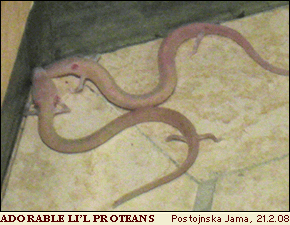
The Proteus' other senses, meanwhile, are amazingly well-developed. They have a Jacobson's Organ (the contraption in snakes' heads that allows them to 'taste' the air), and they get a really detailed world picture by detecting stuff we can't – chemical variations in organic compounds, vibrations beneath the Earth's surface and so on. Also, they're the only known animal whose gills never regress as they grow up, meaning that you can basically see their lungs hanging off their bodies like little fins. And lastly – as pointed out by my lovely Kazakh colleague Assel while I was showing her my holiday snaps – when Proteus nuzzle up together, they make a cute little heart shape :-)

Given their multi-faceted strangeness, it probably won't surprise you hugely to learn that Proteus have no cousins. They're in a genera all of their own. And they only live in the Mediterranean Karst caves – i.e. Slovenia, a little bit of Croatia and the area around Trieste in Italy (though you can see an artist's impression of them on a public fountain in Venice). In other words, they're freaks. But as I mentioned before, being in the company of freaks is something I tend to treasure, especially when I haven't seen any for a while.

The speleobiologists at Postojna catch a couple of these guys every month, throw them into a marble tank and let visitors wander past each day and gawk at them. Then, at the end of their month-long shift, the little Proteus are returned to the comforting darkness of their underground river and two more are caught. Were it not for this project, there'd be pretty much no chance of humans ever laying eyes on one. So meeting two of them was ... well, it was just very cool.


4: A MULTIPLICITY OF DENOUEMENTS

The last part of my Slovenia Plan entailed a brief visit to the city of Maribor, which is a reputedly elegant red-roofed marvel. Unfortunately, said plan was trampled on by the weirdness of train schedules. I thought I had an extra day-and-a-half up my sleeve, but when I returned to Ljubljana and looked at the timetables, I had the following unpleasant realisation: "Oh no, I have to leave tonight!". Not the most climactic end to my holiday, but I wasn't too bothered. The last week had been more or less a dream come true, and I certainly had no reason to complain.

And so it was back to Budapest briefly to meet up with Scott, then another flight through Moscow (and another surreal Sheremetyevo ordeal), before landing in KZ on a frosty February morning to resume my everyday existence.

Within ten minutes of returning we found ourselves caught up in the 'Almaty experience' once again.

It began when a taxi driver tried to scam us out of 6,000 Tenge (US$50) and we had to exit his cab on a highway, amid much heated discussion (mostly between the driver and Scott – I was feeling strangely philosophical about it all). Then another guy picked us up, shoved our bags into his 98% unroadworthy van and thoroughly charmed us on the way home with his amiable chatter, all for a bargain basement price. It was both sides of the KZ coin encapsulated in a one-hour journey, and a more fitting 'welcome back' could scarcely have been arranged.

So ... was it good to be 'home'? Actually I wasn't entirely sure, but there were certainly moments when it felt that way. Looking out the window of the friendly guy's van and seeing the snowy peaks of the Zailiysky Alatau towering over the city's outskirts provided a few tingles, and there were definitely people I was looking forward to seeing after my time away.

In any case, I did feel strongly that the therapy had worked. I had a perspective on things that I'd been lacking before, and it seemed to be helping.

And then four weeks passed. I got back into the routine of things, was re-acquainted with the office politics and the bad food, the school was raided by police (again), I got into my studies ... basically life resumed.

There have been times when looking back on the whole Transit Therapy adventure has appeared to offer some real insight, and other times when it's seemed like just another convoluted circuit to get me back to exactly where I was before. Either way, though, it did allow me to cross one more travel ambition off my ridiculously long list ... and that can't be a bad thing :-)

To conclude: as I said in the email, I hope you've enjoyed my little 'mini-series' of rants. It seems to have borne some strange fruit. For example, a close friend from Sydney has written a song about my moment of crazed exhiliration in the Lada. (Thanks Benji - very gratifying!)

Meanwhile, another good friend has tried out that particular form of therapy (i.e. the former Soviet republic urban death-ride) for himself in Uzbekistan, with reportedly good results. So ... if you haven't done so yet, be sure to put it on your list of things to do before you die. I promise I'll be there with you in spirit ;-)

Bye!


(*Sorry for the $10 words, btw. I'm not showing off, honest! I just love the word "vulpine", and it isn't one that you get to use every day. Same with "epiphyte" which, btw, is the generic name for any plant that grows above ground, attaching itself to a host as a parasite would, but deriving its sustenance non-parasitically from moisture &/or nutrients in the surrounding atmosphere. There: aren't you glad you know that? Who needs 'Word of The Week' websites when you've got me, eh?)

Thursday, 14 February 2008

transit therapy #4

Bored-a-pescht (a.k.a. Towards The Beloved)
   
Relative to my normal routine I've had quite a lot of 'thinking time' lately, so these last few entries have been more ruminatious (a word I just made up) than usual. I hope you're enjoying them, and sincerely apologise if you're not. Promise I'll get back to the usual "Hey, look at the cool stuff!" format soon, combined with the usual dysfunctional travel stories that bring so much Schadenfreude to so many.

(Well, to a few anyway.)

Meanwhile, bear with me while I continue ruminating just a little longer.

Let me start with something I've said before in The Manor, but which bears repeating here for context's sake: in September 2007, when I first arrived in Almaty, I really wasn't sure that I'd made a wise choice. There were quite a few moments when I honestly wondered whether I should just admit my mistake and get on a plane outta there, without further delay.

The thing is, though, I've gradually learned that when you move to a new place you're always going to have these doubts during the early days. Auckland was a case in point: if you'd asked me how I felt about it, say, a week after my arrival, the answer would've been something like "Let's hope it gets a whole lot better, 'cause right now I'm having a truly shit time." And as you probably know, I grew very fond of Auckland, to the point where leaving it was bitterly disappointing. And being the romantic optimist that I am – or at least, that I've recently been told I am – I still dream of returning one day.

The point, however, is this: when you arrive in a new place with the intention of settling there, you've got not only time but also money on your side. Ties with your previous employer have been cut, so your only immediate means of earning a living is to perservere in your newly-adopted home. And with the prospect of money coming in, you just try to ride out the stresses of the first few weeks, then see how you feel about the new environs once you've had a chance to meet a few people and discover a few cool things.

That's what happened to me both in Auckland and in Almaty, and I'm sure it'll happen again if I decide to move in July when my contract runs out.

When you're travelling, though, the situation is a bit different. If you're on a tight budget (which I always seem to be), you don't have time to invest in places that initially come across as ugly or bland or unfriendly, or where the 'vibe' isn't right for you. Therefore, if you find yourself in a place like that, sometimes you have to make a snap decision: do I stay and  hope that my first impressions were a bunch of big fat liars, or do I move on to somewhere else that stands a better chance of engaging me?

I realise that none of this is particularly shocking information. The surprising thing for me, though, is that I now have to add Budapest to the list of places that failed the test.

I really was expecting to be impressed by this city. Why? Well, apart from anything else, every person I've ever met who's been there has loved it. I know they loved it, because they've told me at some length about how total phantastisch it is, and assured me that I was certain to fall for its charms. And I believed them.

I'm a little shocked, therefore, to be sitting here now in a rickety train carriage about two-and-half hours outside the Hungarian capital, and heading away from it as rapidly as I can.

I should probably be feeling disappointed about this whole not-warming-to-the-Budally-Peschtian-vibe issue, but actually I'm not so bothered. There are several reasons for this.

For one thing, I think there's a certain poetry in my present situation. I mean, here I am on St. Valentine's Day, heading towards a city whose name translates roughly into English as 'Beloved'. That's pretty poetic, right? Okay, so the fact that I'm going there alone takes away from the romance a bit – but hey, I never said it was a perfect world (or if I did, I was probably pointing at a computer running Windows at the time, so you should've known I was being sarcastic).

The other reason for my lack of disappointment is that I've actually been planning to visit The Beloved City – known in its native language as 'Ljubljana' – for about six or seven years now. Ditto the country which surrounds it. Many of you have no doubt heard my rants on this subject: I'd say things like "It's my #1 must-see country!" or "I make plans to go there every frikkin' year, and somehow it never works out".

Well, here's the good news: give me another six hours or so, and you'll never have to endure those rants again.

With Budapest inspiring me about as much as a pork milkshake, and my #1 must-see country looming just over the border, whispering "Hey Anthony, here I am – you can come and get me if you want me!", it was all too much of a temptation. After a restless night in the hostel, tossing and turning and wondering if I should give it more time, I woke up this morning and said to Scott "Listen, I've made my decision. If there's a train to Ljubljana today, I'm on it."

I asked Scott if he wanted to join me, and he said "Maybe, I'll think about it". He thought, and he thought, and he thought ... and eventually the time rolled around when I had to get in the taxi and go. Consequently, he's still thinking and I'm now travelling solo – which to be truthful is how I usually like it.

So then ... here I am, alone on St. Val's, on a train and on a Mission. I'm tired, I'm stressed (because it's a nine-hour journey and there's no smoking carriage), and due to a problem exchanging Kazakh Tenge for, say, any other goddam currency on Earth, I'm really not sure my money will last.

The truth is, none of that matters when you've got the travel bug in your system. I could scarcely be more excited if I was going to the Moon.

I'll let you know how things pan out in my #1 must-see country (a.k.a. Slovenia) when this winding little tale is yet again

(to be) continued

Tuesday, 12 February 2008

transit therapy #3

time-trapped in the twilight lounge

So, when we left the narrative (if you could call it that), Mr Scott and I were looking for a way out of the post-New Year doldrums. Some decisions were made, which led me to my present situation.

Being in quite a different headspace now, it's a little difficult to reconstruct the exact motives and thought-processes involved ... but in any case, both of us realised (consciously or otherwise) that some Transit Therapy was needed. No doubt that's at least part of the reason why I'm not writing to you from my usual rickety desk in Almaty tonight. Instead, as I type this, I'm sitting in Sheremetyevo Terminal C, looking out over the tarmac in the last place I thought I'd be any time soon – namely, my old home town of Moscow.

Weird old thing, life ... don't you think?

With eleven hours to fill in here at the inescapably dire Sheremetyevo airport, I must say I could do with a good flashback. How about you?

*cups hand over ear*
*hears nothing*

Ok then, I guess it's up to me. In which case ... let's flash!

Despite the aforementioned haziness, I do remember a few weeks back thinking "I need to get out of Almaty for a while". And then, almost before I knew it, the two of us were sitting in the back of a taxi with a disturbingly cross-eyed Kazakh man, rocketing along the highway towards the airport (and using both sides of it – I mean, why waste a whole 50% of the road?).

A couple of hours later I was in an airport shuttle, heading out from Gate One towards my plane and thinking more or less the following thoughts:

"So here I am, about to take my first trip with an airline that 98% of the people I've met during my life have never heard of, flying towards a city which I was glad to escape from with all my limbs, for a holiday I can't really afford in a country I know absolutely nothing about, and I can't actually remember deciding to do this."

And then, the follow-up thought:
"Sometimes it really is good to be me."*

Obviously the Transit Therapy was beginning to work.

Flashing even further back now: when Scott and I left our flat in Almaty we didn't actually have tickets to Budapest (our eventual destination this week). We'd bought them online and were supposed to pick them up at an Aeroflot office in the city of origin, but – surprise! – the Aeroflot office proved impossible to find. Later we discovered that, despite there being several addresses for said office on various websites, it doesn't in fact exist.

At Almaty airport, we therefore faced an unenviable situation: we were about to enter Russia with no visas and no proof of our intention to leave again. This is not the kind of thing that generally endears you to Russian authorities.

We pleaded for someone to call ahead and arrage to meet us at Sheremetyevo with our tickets, and after some time the check-in staff relented and helped us. So, as our Air Astana** flight landed in Moscow five hours later, there was an announcement on-board: "Will Mr. Cook and Mr. Benson please meet with our crew?" It was the first time I'd ever been named on a public address system inside an aircraft, and it was odd.

We were met on the tarmac by an extremely polite airline guy, given our tickets and then whisked in a private bus to our transit lounge. I'd imagined said lounge would be a gleaming, soulless shrine to the wonders of duty free shopping (with maybe an Irish pub thrown in), but instead we were taken to where we are now: a vastly improbable office-cum-lounge room type thingie with a tiled floor and a view of the tarmac.

If you can imagine the common room of a large youth hostel crossed with a slightly deco-flavoured pub bathroom – and if you can imagine sharing this space with uniformed airport officials (one of whom just bummed a cigarette from Scott) – then you're on the right track. Throw in a bit of hospital reception, and you're getting closer. Finally, add to this picture the delightful tendency of female airport officials in the Russian-speaking world to improvise on their uniforms, adding stiletto heels, split skirts, fishnets and other vampish touches to the ensemble. Ok; now you're nearly there.

So anyway, I'm lying on a soft and comfy sofa in this little corner of the Twilight Zone, looking across at the one and only shop. It's called 'Moscow Duty Free', and it's closed. Not just closed, in fact, but empty. The smoothly-curved shelves are completely unstocked, there's no cash register, no light fittings in the ceiling, and a bar across the door. Next to another of the comfy lounges sits an airline meal tray, looking profoundly out of place at zero feet above sea-level, with plastic wrap across the top and a few stray mouthfuls of cabbage salad remaining in one of its plastic containers.

Behind me there's an empty cardboard box which initially contained our 'supplies' for the next 11 hours. It was full of fruit juice, bottled water, vodka and fizzy drinks, all bequeathed to Scott and myself by a group of Lithuanian businessmen who departed the lounge soon after we arrived. Unfortunately one of the Russian guards decided he liked the look of these items, so he basically walked up and took everything we had, shooting us a cocky look that said "Let's see you try and stop me, visa-less foreigners!". Meanwhile, in front of me a wide-screen TV is showing a Naked Gun movie, badly dubbed into Russian.

Still, at least the lounges are plush. My body clock is on Almaty time (i.e. it feels like about 3am), so I'm sure to need a little shut-eye soon.

As I fall asleep tonight, I'm probably going to contemplate the strange feelings that stirred in me as our aircraft approached Moscow. Those of you who've been reading this blog for a while will remember that, after living there for almost a year, I definitely wasn't sorry to leave. I had some great experiences in Moscow and met some wonderful people who I miss quite a lot, but unfortunately it was just an inhospitable and difficult place to live as a foreigner. On the day when the taxi took me to the airport and I left the city, I remember looking out of the window and thinking "Wow ... I survived!" And I still don't know how some of the gentler souls I met there (Hi Astrid and Sasha!) manage to live in such a harsh environment.

And yet, as we flew in, I couldn't escape the feeling that, from the air, Moscow is probably the second most beautiful city I've ever seen. (The prettiest without a doubt is Bahrain, which looks like an enormous, glittering coral reef from above.) Then, once we'd landed, I spoke to several friendly folk at the airport and watched the chicardniye Muscovites going by as they made their way towards passport control. It was so strange! I suddenly found myself wanting to follow them out into their grand metropolis, just to lay eyes on it one more time. Weirdness.

Maybe as my experiences with Russian people start to add up (first in Moscow, then Sydney and now Almaty), I'm becoming a little bit Russified in my outlook. Or else I'm just beginning to appreciate a bit more of the 'whole picture'. Certainly a lot of things that used to annoy me about russkaya kul'tura have slowly come to make sense over the past few years, and I've even begun to like some of them.

This in turn leads me to think that maybe, if I went back to Moscow now, I'd have a different experience. I still don't believe it'd be the place for me (it's too big for one thing, and possibly even more dangerous for foreigners than it used to be, with ultra-nationalist organisations flourishing and literally getting away with murder nowadays), but I suspect I'd find more to appreciate than I did in 2005-6. Maybe I just wasn't ready the first time around.

And that's three maybes in one train of thought, which as we all know = one kto znayet?***. Certainly not me.

Ok, enough of these musings – focus, Anthony! I just need to survive one night in Sheremetyevo's Twilight Lounge, and I'll be in Budapest by lunchtime tomorrow. You'll be sure to hear from me at some point while I'm there. Until then ... do svidaniya!

Anthony.

continue here


* Plagiarised from Buffy the Vampire Slayer, but nonetheless heartfelt.

** See, I told you you'd never heard of it!

*** "Who knows?"

Monday, 11 February 2008

transit therapy #2

timely reminders (a.k.a. killer headwear)

Ok, so what was I saying? Oh yes: down and dejected in a foreign land blah-de-blah, but preparing to say something upbeat about the whole situation.

*rolls eyes*

Well, I guess I've locked myself in to this course now, so fine ... let's continue with it.

What I'm about to tell you fits loosely under the heading of "When badness happens, try to do something life-affirming". However, a lot of people seem to associate this word 'life-affirming' with things like going on meditation weekends, reading inspirational literature, having friends around for dinner, spoiling yourself with hot oils etc. etc. ... basically all the feelgood stuff.

Personally – at least for the purposes of this rather silly blog entry – I'm opting for a more literal interpretation of the term. I say that, when life has you by the wrinklies, the best thing to do is something which affirms

a) that you are, in fact, alive;
b) that being alive is a LOT different (and preferable) to the
    alternative; and
c) that the line between them is easy enough to cross, so you might 
    as well make the most of being on this side of it while you can.

That might not seem hugely innovative, but it's a new idea for me. Or at least it's one that's been percolating in my brain for years but has only just become coherent.

It all fell into place about three weeks ago, via an affirmation technique which I can't guarantee will work for anyone else, but which I encourage you all to try anyway for the sheer demented fun of it. It's quite simple, and a lot better for your heart-rate than chanting "I am a unique and special human being" until the logical bits of your brain are too numb to argue.

Here's what you do:

First, take yourself off to an outpost of the former Soviet Union, where the traffic conditions are as about as sane as a Japanese Advertising Executive sprinkling cocaine onto his soba noodles.

Second, after a quiet drink with some colleagues, step out onto the road and hail a taxi to take you home. (A brief memory-jog: this will mean a private car, since official taxis are few and far between here, and not to be trusted anyway.)

Third, to maximise your pleasure – or your terror, depending on whether or not you enjoy dicing with death as much as the next person – ensure that your taxi is an old Lada being driven by a tall, lanky and not overly sane-looking Russian guy in his mid-20s, with a huge shapka* towering about nine inches over his head. Agree a price with his surly front-seat passenger, climb in the back and hold on. You're about to get a timely reminder that your corporeal, non-dead status really does matter to you.

To give you some background on how I came to discover this wonderful form of therapy: in Almaty, getting from A to B is a much more significant part of daily life than it has been in the other cities I've lived in. I work in three different schools, and have to go to and fro by whatever means possible. It's a city perpetually on the move; roads are always full and a little chaotic, and The Great Commute offers memorable vignettes of life in KZ's former capital.

The Commute can make you angry – as when ticket machines were installed on trolleybuses last month, and conductors stood next to their new toys bellowing instructions at passengers as though they were disobedient prisoners in a forced labour camp. It can make you smile – like the taxi ride I had about six weeks ago, during which my middle-aged driver and his travel companion gently criticised the Australian government for refusing Almaty Zoo's request to have a kangaroo delivered to Kazakhstan. It can disturb you – as when, while sitting on another trolleybus one day, I was roused from my thoughts by the *thud* of another passenger falling from her seat and hitting the floor, head first and unconscious. And it can even open doors (the metaphorical kind) – as when you get a driver who's interested in learning English and he/she asks you for private lessons.

Or, it can be completely 'normal', dull and uneventful. You just never know.

Anyway, back to my Russian driver. This guy could've walked straight off the set of a gritty German or Scandinavian drug-culture flick. Impossibly thin, grungy leather jacket, wild look in his eyes, he balanced a cigarette skilfully on his bottom lip as we roared through the streets of Almaty, occasionally swerving to avoid potholes and other moving vehicles. I could see he was approaching this real-life situation the way teenaged boys approach a game of Grand Theft Auto – not so much with safety in mind as with the thrill of the ride.

Sharing the taxi with me was a French Canadian teacher (and fellow beret-wearing freak**) called Nico. Now, I have to tell you that this man is no shrinking violet; he's the only person I know who's brave enough to actually ride a frikkin' bicycle in Almaty, and he continues to do so even after having been hit by a car once already. Still, as the Orthodox religious icons dangling from Shapka Man's rear-view mirror swayed wildly to and fro, I could see that Nico was nervous. And rightly so – we were quite possibly going to die.

Meanwhile, and unexpectedly, yours truly found himself absolutely relishing this manic death-ride. Nought-to-lose, recently skewered in the emotional nethers, squished into a tiny uncomfortable metal box and blasted by hot air and terrible pop music, I was feeling the most exhilirated I'd felt in ages. It was, in a word, awesome.

At one point, the rightly-concerned Nico put an arm on our driver's shoulder and said (in English) "Hey man, slow down!". The driver responded with an uncomprehending "Shto?" ("What?") and I translated, trying not to burst out laughing at the whole situation. Suddenly I felt that my decision to reject the normal lifestyle of a western 30-something man – the one where he basically acquires his own domicile with matching mortgage, fills it with plush chairs and works hard on becoming pointlessly affluent, suburban and sedentary – had been the best decision I'd ever made. Because ... because ... well, because of a dozen reasons, but all of them summed up by the fact that I was right there in that car, right there at that moment, fumbling for the words to translate a request that was clearly going to be followed for no more than five polite seconds. So this was where my life had thus far led me; how random, and how fabulous!

I know this may sound a little condescending, but as we continued our Petit Prix I just had to think to myself "You know, I feel SO sorry for anyone who's never been catapulted through the slums of an outlying former-Soviet city by a chain-smoking, shapka-wearing Russian stick figure in a creaky old Lada!"

In other words, I was having the life-affirming moment. I realised that, if I died in this car, it would be better than having stayed at home with my plush chairs. And if I didn't, that meant I could take the less-travelled road a little further. Or something like that, anyway.

Of course, there are limits to what one 15-minute ride in a taxi can do for you, and before long I was back in the doldrums ... though not quite as far down as I had been before. Luckily I had my flatmate Scott to commiserate with. He'd been enduring a pretty awful time himself throughout January, and both of us had found the week-long New Year holiday (when the school had closed) a strangely depressing time. As a result, both of us were heading into 2008 feeling deflated and uninspired.

As we talked about how to claw ourselves out of this ditch, the idea of 'transit therapy' began to surface (though we didn't name it at the time – I did that later). Scott started talking about taking a break from KZ, meeting up with friends in other places and taking some 'real' time off. I don't remember the exact moment when it happened, but before long we'd pretty much decided to take our next cue from King Arthur's Knights of The Round Table (or at least from The Monty Python versions of same). We'd decided, in short to "Run away! Run away!"

Lucky we did, really, or I'd have no topic for Part Three of this ridiculous ramble.


to be continued even more ... 


LATER POSTSCRIPT 

Ooh, isn't this exciting? Don't think I've never had a later postscript before!

Just wanted to say how thrilled I am to know that my little rants have prompted some true creativity. My good friend Mr Benji, of the electronic band Freefall, recently sent me their new composition 'Shapka Deathride', inspired by the entry you've just read. It's great! Thank you, Benji ... I feel flattered ))) 


* Shapka: those furry hats you've seen either
   a) in documentary footage about Russia/The USSR; or
   b) in James Bond films; or
   c) in Russia or the former USSR itself, if you've been there.

**Now that I think of it, there was some great headwear in the Lada that night! We must've looked pretty damn stylish to passers-by - at least from the neck up.


Sunday, 20 January 2008

transit therapy #1

tedious exposition scenes

So ... you went to the other side of the Earth to discover a land of vast steppes and mountains, closed to the world for 150 years and even now somewhat shrouded in mystery. Unpacked your big red bag, found your way to the local supermarket, met your new colleagues, and began the inevitable months of settling in, adjusting and acclimatising.

As winter closed its grip on your new home, you perservered through the -20C nights, walking home from work along icy, sometimes unlit streets and wrapping up to compensate for the dodgy heating in your less-than-functional Soviet-era flat. You survived uni exams, power cuts, a confrontation with angry street dogs, and numerous deathrides in rattle-trap cars with half-crazed boy racers at the wheel, as well as spending Christmas Day as an illegal immigrant. Not even trying on clothes in an outdoor market in -15C killed you.

Finally, you reached the point where people in the street began mistaking you for a local – not all the time, but often enough to be noticeable. You crossed a threshold, on the far side of which you spend more time giving directions than asking for them. And just quietly, you're really pleased with yourself.

Not to a deluded extent, mind you – I mean, there's never any doubt that you're still an Absolute Outsider and that, if you want this feeling to go away, you've got years of work ahead of you yet (and even then it might not). But still, you've seen other ex-pats get on a plane and run back to the apron strings of the Motherland when things get tough, and so far you've avoided doing so. Instead, you've dug in and shown your sternest stuff. Now you're seeing the first (albeit very minor) signs that it's beginning to pay off.

So imagine how disappointed you'll be when subsequent events prove that, in actual fact, you're still the same pathetic schmo* you've always been. I mean, logically you know it's going to happen, right? Things can't possibly be going this smoothly ... or if they are, it must be a sign that Fate is about to intervene and rip out your heart through your ribcage, stretch it across a chopping block and flatten it like a tender steak under the nasty, pointy veal mallet of life. And yes, score one for the pessimist – it is that time, and Fate does step in. Result: you get cruelled.

Thanks, Fate.

I'm not going to tell you who or what brought my "Everything's more or less on track" feeling to an end last week. It was a combination of things, really. What I am going to tell you is this: when the Big Smackdown happens in a far-flung foreign land, it's even more difficult than usual to know how you should handle it. The usual dark, reverberating well of self-pity is deepened by the fact that no-one here really 'gets' you yet, so whatever your problem, empathetic shoulders are in short supply. Plus there's the whole "I've just met these people – I don't want them to know how pathetic I am!" issue, which tends to make you a little nervous about exposing your vulnerabilities.

(And yet, here I am writing about this on my blog. Silly man!)

Anyway, at a certain point you realise that the saddest thing isn't so much that bad stuff has happened, but rather that you've been affected so much by it. All the progress you made seems to have evaporated, and you start wondering if you could possibly be any less resilient, resourceful, self-reliant etc. (all the qualities you were congratulating yourself on not so long ago). Suddenly you're thinking the most suitable lifestyle choice might be to move to a new, uninhabited city, set yourself up as Mayor there, and name it "Schmotown".

So what – other than the Mayoral option – can you do? Well, if you can forgive me for using one of the most overwrought literary devices in the galaxy, I'll tell you in just a little while, because this entry is

... to be continued     
                                                             
(hehe)


(* For those who haven't seen it before, "schmo" is New York Jewish English. It means sth like "loser".)

Saturday, 10 November 2007

the slow reveal


When you've no hot water in your flat, your day-to-day rhythm inevitably changes. Filling a bath is the work of perhaps three or four hours – boiling kettle after kettle and saucepan after saucepan, dumping each new load into the tub, trying to perceive a noticeable increase in depth, re-filling the vessels to get the next load underway and so on. Each rise in the water level tends to punctuate your morning, dividing everything else into discrete intervals so that you can see precisely what you've managed to accomplish since, say, an hour earlier. It's quite an interesting process.

Don't get me wrong, though: after nine days of the boil-and-fill routine, the sudden sputtering of your hot water taps is almost cause enough for a party! In fact, thinking back to early October (when our hot water was cut), I did decide to celebrate on the evening after it returned, sharing a bottle of sovyetskoe shampanskaye (literally, "soviet champagne") with my flatmate. And even though I had a lesson the following morning, the weeknight indulgence felt entirely justified :-)

If you've yet to experience life without hot water, picture yourself waking up one morning to discover that you can have your first shower for nine frikkin' days. You'd be in heaven, believe me. You'd lather and scrub yourself to within an inch of your life, emerging from your flat looking like a tomato, but ridiculously well-disposed toward almost everyone and everything: "Hey there, neighbourhood dogs!", you'd say. "Mornin', local loitering folk!" "How're ya doin', Mr. Invisible Speed-Hump, over whom I trip almost every day!" ... and so on.

It's a wonderful, almost giddy feeling.

Continuing on (and trying to regain the dignity lost when you stumbled over Mr. Hump), you pass the old bar heater buried in the park behind your block – an icon of soviet-style domestic life, which someone has transformed into urban sculpture by submerging it waist-high in dirt.

A little further, and you're walking beside the dusty courtyard where a group of babushkas frequently sit around an old picnic table, chilling out and playing cards with one or two elderly gents from the adjacent buildings. Holding your camera down at your side, you try (not for the first time, nor the second nor the third)
to snap them surreptitiously from a distance, without the aid of the viewfinder to help you take aim. Chances are you're just going to end up with a few more pictures of dirt, but your mood is so buoyant today that photographic roulette seems like a pretty fun thing to try.

A couple of minutes later you're on Ulitsa Gagarina, your nearest main road. Looking right – and assuming it's a clear morning – you're thrilled to see mountains towering majestically at the end of the street. Better enjoy them while you can: they'll be gone in a couple of hours, completely erased from view by the build-up of petrol fumes in the air.

Heading around the corner, you pass an attractive woman of about thirty who's washing her BMW on the footpath. She's wearing skin-tight designer jeans with jewel-encrusted decorative stitching across the back, PVC boots with stiletto heels and dangly diamond earrings. Completing the ensemble is a low-cut slinky black top, which she almost falls out of as she leans forward to buff the rear bumper with a soft foamy sponge. Being from a western country, you naturally expect a large yellow phone number to appear in front of her at any second, obscuring the naughty bits and inviting you to exchange some text messages with a computer program pretending to be the car-wash woman. It doesn't.

Soon you arrive at the bus stop on the intersection of Gagarina and Timiryazeva, where buses of various shapes and sizes fight their way through the throng of ancient Ladas, shiny Mercedes and SUVs to compete for your business. Some of the buses have decorative sun-visors made from curtain material draped across their front windscreens, hung with tassles and looking a bit like belly dancers' veils. Most have cracks in their windscreens, and the occasional one has tape and clear plastic over a missing window – all evidence of past collisions.

As each bus pulls over, a conductor leans out of the window (or occasionally swings out of the centre door, holding on to a railing) and 'sprukes' the bus route to prospective passengers. The one you need goes something like "Timiryazeva-pa-Atakent-ee-Ramstor-Centralni-Stadion-Abai-Furmanova-Zelyoni-Bazaar!!!!", all run together into a single, epic word.

You're listening for the "Furmanova" part of that, so when you hear it you quickly cram yourself onto the bus and get your 40 Tenge ready for the conductor. He might take it now, he might take it later, or he might leave it to you to pay him as you get off. And you most likely won't get a ticket, though it's not entirely unknown; probably depends on how honest he's being about the daily take.

So that's your day so far. You're about two hours in – almost half of which was spent in the shower – and it's another ten or eleven hours until your work day ends half-way across town from where it began, and you hail the 'taxi' (i.e. private car) which will bring you home.

Welcome to my new(-ish) life in Almaty.

I have to say, when this whole adventure started two months ago, I really wasn't sure if it was for me. My first couple of weeks in Kazakhstan had me swinging on the mental pendulum. I swung repeatedly from "Wow, it's just amazing to be here!" to "Oh my gods, what have I done?" and back, passing through "Yeah, it's okay I s'pose" and a few other points along the arc.

I've since discovered, though, that there quite a lot to appreciate about The Big K, and as it slowly reveals itself to me I'm enjoying it more and more. I mean, those crazy days like the one I described above are exhausting but extremely fun. Just like in Japan and Korea, your "huh?" sense is always being stimulated by one thing or another, and (as you've probably guessed) I love it when that happens. You get that feeling of "This is a truly foreign country – I've got so much to learn about it!"

Having said that, there are definitely familiar elements here. Russian culture is quite prevalent, though it's generally a much softer version of same than I experienced in Moscow. But Kazakhstan is much more than just 'Russia lite'; you're always aware that you're in Asia, and you rarely go for too long without being reminded that this country also marks one edge of the Islamic World. So really it's quite a melting pot – a blend of the three great cultural blocks I mentioned, spiced up by some bonus influences from elsewhere in Asia and Europe.

On the downside, the traffic is a frikkin' nightmare. If I die in Almaty, it won't be over-zealous muggers or corrupt police or xenophobic skinhead types who take me out. I can tell you now what the murder weapon will be: it'll be either a trolleybus or, more likely, an SUV.

My flatmate Scott says that Kazakhs have "a childish attitude towards their cars", and I'm afraid he's right – a disturbingly high number of them drive like drunk P-platers. Car accidents are legion, and seemingly regarded as a normal part of everyday life. And of course, the fact that you can buy a driver's license doesn't help matters much.

Still, at least if you're a fan of old Soviet cars – which I am – there are some Ladas, Moskviches and other Soviet bombs to be spotted among the horrible SUVs and personality-free modenr bubble cars. That's always a bonus )))

Another thing I found off-putting at first was the amount of construction going on. Even in nouveau riche areas like the emerging financial district of Samal, you can find yourself walking through a half-completed pedestrian underpass which is only partially-lit, with exposed electrical wires on the ceilings, rubble strewn across the unsealed pavement and workmen smoking and chatting in a shadowy alcove on one side of the passageway.

As far as I can make out, much of this construction has to do with the changing fortunes of Kazakhstan over the last 16 years. The BBC calls this country "the success story of the former Soviet Union", and there does seem to be quite a staggering boom happening here – along with a lot of people walking around in clothes I could never dream of affording! There's quite a bit of bling on display as well (especially if you consider fancy cars to be one of the principal forms of 'man-bling'), which of course is a sign of newly-acquired affluence. So I guess the years since independence have been productive ones )))

And btw, depending on your mood, even the annoyances and inconveniences can become part of the appeal of a place like this. Exampleton: ul. Gagarina (my nearest main street, as I mentioned before) is a continual roadwork and construction zone, and the chaos of the streetscape there can be strangely enjoyable. At times there's just so much crap lying around that making your way down Gagarina can feel more like climbing than walking, and it's kinda fun to see how the path changes from week to week. Not so great when the whole place is iced over, though. When the ground gets all slippy, you start to notice once again just how many opportunities there are to fall over and impale yourself in this split-level, sharp-cornered, exposed-metal city.

The construction boom also gives rise to some nice little idiosyncracies – like the fairy lights that bathe sections of Ulitsa Auezova and Ulitsa Zhandosova in a festive glow, wrapped jauntily around the giant arms of cranes on the many building sites there. When the great arms move (as they often do at night), you get a free light show. It's just one of those things that tickles my joyful sense of absurdity.

On a purely aesthetic level, though, I definitely wouldn't put Almaty it in the same category as, say, Weimar and Erfurt (former East Germany), or Tallinn, or Tokyo, or Seoul – basically any of the cities I've 'fallen for' as a tourist. I mean, it does contain some beauty spots, but many of them are surprisingly well hidden. You don't come here and immediately go "Wow!" the way people do in Paris or Prague or wherever; you need to hang around for a while and let the slow reveal happen.

If you can excuse the dodgy metaphor, it could almost be said that Almaty likes to perform a little 'civic striptease' for visitors – have a little patience, invest a little time, and you'll probably end up seeing what lies beneath her veils. But like the much classier belly dancer she aspires to be, Almaty's not going to take it all off at once. No matter how much you've paid to come in, you're gonna have to wait for the good stuff.

That's actually true in a lot of ways – not just in terms of locating the pretty parts, but also in uncovering the fine cultural detail, finding the stuff you need, the best food, the best places to go out and so on. In any case, though, it's as I said before: the people, not the place itself, supply the charm. (Except when they get behind the wheel of a car, and some kind of Jek&Hyde transformation renders most of them horn-crazed, risk-addicted and generally sanity-free.)

Before I leave you alone, I just want to mention one very pleasant feature of Almaty's urban face: namely, that it's free of some of the scars which blight most other cityscapes around the world. Like the Golden Arches, for example. Apparently McDonalds did some market research here and concluded that there wouldn't be enough interest in its product, so they decided against opening franchises in Almaty. Consequently, the only arches you'll see here are of the Islamic variety, like those gracing the entrance to Atakent recreation park / conference centre (about ten minutes' walk from where I live).

Personally I think that's something for the Kazakhs to be proud of.

Anyway, those are some of my current feelings about the new digs. They can still bounce around pretty wildly at times, depending on what's happened in the last couple of days. I'm not convinced that I've had my last "Get me out of this place right the Hell now!" moment, but I'm pretty sure that I won't act on it if it happens again; there's just far too much to learn about the Life in The Big K. Last week one of the local teachers told me about her holiday in Turkey, saying that when she first arrived there she felt like "a kitten whose eyes hadn't opened yet". I still feel that way here sometimes, and I'm looking forward to loads more eye-opening moments in the months to come.

Okay, that's plenty for one ramble. Over and out.

Bye!