Wednesday, 27 October 2010

sa-pa, cat cat and the terraces of the hmong


Quick readership survey: hands up if you don't love it when the world suddenly turns around and surprises you by revealing some detail about itself that you'd never previously suspected, heard about or even dreamed of.

Ok, now hands up if you do love that.

Yep, it's as I thought … we're more or less unanimous )))

Of course, it does depend on the kind of detail we’re talking about. I mean, if someone came up to me in a bar tomorrow night and asked “Did you know that the State of Kansas hosts a 5km running race every April, which is one of the most popular in the whole of the USA?”, I wouldn’t be going “Wow, that's amaaaaaazing!!! The world is such an interesting place, isn’t it?”. At least, not unless there was a twist ... as for example, you went on to tell me that competitors are required to throw buckets of pure alcohol over each other before the race, then set themselves on fire at the starting line so that the audience – watching overhead in hot air balloons – could get high on the fumes that rose skyward, as sprinting fireballs sent intoxicating clouds of ethanol into the air. In that case, I'd be reaching for my laptop and getting hold of every single available Youtube video before you could say "sick imagination" ;-) 

Generally speaking, though, I'd consider myself a reasonably big fan of discovering-stuff-you-didn't-know-about-the-world (especially if it's of the weirder variety). It's usually small things, of course; you put the puzzle together piece-by-incredibly-tiny-piece, knowing you’ll never have the full picture but enjoying the process, as here and there little areas resolve themselves into something you can almost make out. However, on the odd occasion you do find something fairly big, and that's ... well, pretty damn cool.

A case in point: this year at uni I've been studying East and South East Asia as a 'language area', looking at the languages spoken in that part of the world and learning about some weird/interesting characteristics that many of them share. You can divide most of these languages into 'families', like the Sinitic (i.e. Chinese) languages, the Tai-Kadai family (including Thai and some other formidably difficult monsters) and so on.

Quite a lot of SE Asian languages are rather obscure, exotic and not yet fully documented, and lots of them have features that seem completely bizarre from a Eurocentric point of view. I s'pose the most famous of these is 'lexical tone' – i.e. where saying a word with different intonation completely changes its meaning.

As luck would have it, last month I moved to a country where the national language has this weird lexical tone thing, and I've enjoyed encountering a few multi-function words in Vietnamese. My favourite is "ga". This little midget of a word turns out to be quite versatile, with a range of meanings from "chicken" to "railway station", depending entirely on the intonation. And because the tonal system is so difficult for foreigners to master, if you try ordering "com rang ga" (rice fry chicken) in a Ha Noi restaurant, you can quite easily end up asking for fried rice with a railway station. Or else you can go the other way, and ask a taxi driver to take you to Ha Noi's Central Chicken.

*pause for giggling*

Really not sure why I find this so funny. I just do.

Sign of immaturity, I guess.

For me, though, the most exotic languages I've come across this year are a family called 'Hmong-Mien'. Like other SE Asian languages, they tend to contain loads of exotic stuff like lexical tone, classifiers* and (for Western folk) virtually unpronouncable consonants with weird descriptions like "retroflex" and "uvular stop". But the main reason why I found them so interesting to learn about was simply this: there are something like 100 languages in the Hmong-Mien family, and I'd never even frikkin’ heard of them before.

I mean, in one sense this isn’t in the least bit surprising: Hmong-Mien languages are mainly spoken by so-called 'hill tribes' in remote parts of Vietnam, Laos etc., so not exactly the kind of thing you’d regularly come across in everyday life. But still, when you consider that 90% of all the languages in Europe fit into just three families (Germanic, Latin and Slavic)**, a whole family of languages is a pretty huge thing to hide from a Word Nerd for so many years.

Imagine my delight, then, when I found myself actually talking to people of the Black Hmong tribe last weekend, as we trekked side-by-side with them through the hills around Sa Pa in northern Viet Nam. It was quite an adventure: I visited their villages (pigs and buffalo were notable features), injured my head on their low rooves, learned a couple of Black Hmong starter phrases (like ka mun qi for “Hello” and o chou for “thank you”), admired their amazing kimono-meets-cowboy traditional clothing, bought a Hmong jacket which I’ll probably never wear, and had my taste buds thoroughly tingled by their delicious apple wine and their sticky rice with lime, salt and peanut paste, barbequed on hot coals inside bamboo bark. Yum!

The down side: the Hmong people haven’t yet mastered the art of the Soft Sell, and I was quite annoyed at times by their pushiness. (Imagine the phrase “Buy some’hing fom miiiiiiiiiii????” being screamed into a megaphone by an angry parrot.) But never mind … you take the good with the bad.


Sa Pa itself, meanwhile, is a far-northern mountain community, just a handful of kilometres from the Chinese border. It’s full of tourists, but the hills and mountains around the town are home to some absolutely jaw-dropping, expletive-producing scenery. It’s certainly the prettiest part of Viet Nam I’ve seen, by a factor of at least two to the power of 25, possibly more.

We caught the overnight train there from Ha Noi, and as the sun rose, we found ourselves in a minibus, ascending along winding roads with the silhouettes of rice terraces creating dramatic shapes around us. In some cases, nearly an entire mountainside seemed to have been carved into terraces, one above the other, hugging the contours of the landscape and forming imaginary Mayan pyramids in the mist.

Later in the day, when the air had cleared, we got a much clearer view of the terraces – a little less mysterious, for sure, but no less
beautiful. Then our chance came to see them up close: we trekked for “five kilometres” (I put that in quote marks because it’s what the travel agent told us, but there’s no way we did less than eight!) down a mountainside to the Hmong villages of Lao Chai and Ta Van at the bottom. It was a stunning walk.


Along the way I had one of those 'movie set moments' that one occasionally gets while travelling. In this case, the thing that inspired it was a couple of Hmong houses hidden amongst impossibly lush vegetation on a river bank, and the movie in question was Apocalypse Now***. I almost expected Robert Duvall to turn up any moment and deliver his "napalm in the morning" line. Guessing I'm not the first traveller who's had that thought ... or indeed the follow-up thought, which was basically "How the Hell did we ever convince ourselves that it was ok to bomb the f!#$%k out of a country that was a) so incredibly poor and b) so incredibly idyllic?

But, y'know, travelling in places that used to be considered 'enemy territory' will do that for ya. Which is one reason why I recommend it ))) 

Anyway ... the journey down the mountain was rather challenging – I got a touch of altitude sickness part-way down and had to stop frequently to prevent my insides from imploding – but the rewards at the bottom more than justified the pain. Long, low wooden houses sat in rice fields half-submerged in muddy water, gardens and yards were strewn with animals and farming equipment, and sheaves of corn hung drying out under wide verandahs.

All this was set against a backdrop of terraces ascending towards cloud-covered peaks, with a river snaking through the whole scene, occasionally breaking into stretches of rapids. This place was definitely like none I'd ever seen before ... so, y'know, that was a good thing )))

The next day we hiked in the opposite direction to another Hmong village, and this time I liked the place even before we got there, on the strength of its name alone.

Unfortunately, although the village of Cat Cat was very cute, and the surrounding scenery once again fantastic, it seemed to Yuliya and I that the whole place had 
been turned into a kind of living museum exhibition. The people of Cat Cat were living what I'm sure more or less amounts to a traditional Hmong lifestyle, but all of it appeared to be done a little self-consciously, in the presence of an unending trickle of tourists wandering through their village and going "Ooooh" at the general Hmonginess of it all.

Actually, the general status of the Hmong around Sa Pa raised interesting questions about the meeting of 'traditional' and 'modern' (which is to say wealthy and industralised) cultures. As I mentioned, Sa Pa is a tourist town full of hotels, restaurants, souvenir shops and the usual palaver. Hmong women hike up to the town every single day in full traditional costume, babies on their backs and daughters alongside. They stride up the slopes, long strands of hemp fibre wound around their wrists, weaving the strands together as they go*** and looking for foreigners to sell stuff to. You get the feeling that a significant % of the female population spends their whole day like this, wandering the hills and speaking English to foreigners.

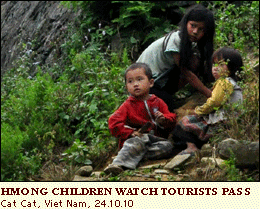
The daughters of these women, meanwhile, grow up surrounded by travellers from all over the world – hearing their stories and their foreign perspectives on life, picking up the slang expressions they use, and getting used to living in 'international company' from a very young age.
Seems to me there are at least two ways to look at all this (and probably some more I haven't thought of). First you could ask whether, and to what extent, such extensive contact with the external world risks corroding the culture of these previously isolated hill folk. Or you could view it from the opposite end and ask: does the need  
to 'Hmong it up' for the tourists, with all the trad clothing and weaving and rice-harvesting and so forth, keep them stuck in a kind of developmental tar pit, in which they can't move their lifestlye forward because it would take away the 'primitivity' which is now their major source of income?

I s'pose the answer depends on how shrewd, tough and determined the Hmong people really are. In my brief encounters with them, they seemed to have all these qualities in spades ... but I guess we'll see what happens.

Btw, just like with the flaming alcoholic runners, there's an added twist here too. Notice that everything I said just now was about Hmong women and their daughters, not men or boys or all of the above. That's because the male folk have no part at all in this interaction with foreigners. Outside the villages, I saw maybe two in two days. They stay at home, presumably tending the rice terraces, feeding the buffalo and what-have-you. So, I mean, where does that leave Hmong culture? Don't you find that kinda weird ... that one gender spends all its time with foreigners, and the other has no outside contact at all? I just can't quite imagine the effect (if any) this would have on family life ... but in any case, I'm intrigued.

One last random and intriguing thing about the Hmong, to which I've alluded a couple of times but haven't really explained: they make almost all of their clothes from hemp, which they get from the marijuana plants that grow in and around their villages.

Our guide in Cat Cat invited me to pick a leaf from one of these plants and check that it was 'the real thing' (though I'm not sure how I was supposed to do that, not being terribly wise in the Ways of The Ganja). I asked "Do people here use marijuana for purposes other than making clothes?", and the guide said "No, because they know that if they get caught, the government will take the plants away, and then they won't be able to make their clothes".

So there you go ... if my guide is to be believed, it implies both an Indo-Chinese govt showing tolerance towards the cultivation of 'drugs', and a people who live surrounded by marijuana leaves and yet never chop them up, roll them up and smoke them.

Once again, I mention this for no particular reason apart from that it's yet another example of the "Hey, weird ol' wide ol' world we live in" thing that I was talking about before.

Ok, time to end this rather long ramble and get some sleep. Next up: Angkor Wat.

("Angkor what?")
("Yes, wat.")
("What?")
("Mm-hmm, that's right.")
("Huh?")
("Wat.")
("Yeah, that's what I'm asking. What?")
("It's, y'know, part of the name.")
("What name?")
("I've already ... oh, forget it. This is turning into the George W Bush / President Hu joke.")

Bye!


* Btw, in case anyone's remotely interested, classifiers are extra words that precede nouns in some languages, providing information about what kind of thing the noun is. To get an idea, imagine if you had to precede the word "umbrella" with the phrase "long, pointy, stick-like thing" in English ... but also imagine that we had a single word which meant "long, pointy stick-like thing". If the word was, say, "smurg", you'd say "Dammit, I left my smurg umbrella on the bus again!", to indicate that the thing you left on the bus was pointy and stick-like. These terms don't fit into any of the 'word classes' (noun, adverb etc.) that we discuss in relation to European languages, so they're fun in the sense of being totally alien. Least I think so )))

** Of the others, three (Finnish, Estonian and Hungarian) belong to the fascinating Finno-Ugric family, and there are also a few mysterious ‘isolates’ like Euskara, spoken in the Basque provinces. If you have a taste for weird exotic theories and academic mysteries, check this one out. It has baffled linguists for decades, and the more ‘respectable’, and some wild theories have been proposed. My favourite: that Euskara is a cousin of the Ainu language, spoken by the minority indigeous population on Hokkaido, the northernmost island of Japan. Seems unlikely, but if a connection between the two were ever definitively established, it could challenge some of our ideas about humankind’s early global migrations, and thus about the genetic links between European and Asian people. I love fringe theories like this… which, y’know, probably just proves that I should get out more ;-)

*** Film about the US/Vietnam war, but completely different to all the others I've seen (and the only one worth watching i.m.h.o.). An extremely atmospheric, surreal, drug-laced and disturbing film that nearly sent its creators insane. (I'm not kidding.)

**** (to make the thick hemp thread from which most Hmong clothing is woven)


Friday, 22 October 2010

ca phé


Here's a question that's bound to spark some disagreement: who, in your opinion, makes 'the best coffee in the world'?

Had I been asked that question, say, three months ago, I probably would've said "The Italians" – but only because this somehow seems like the logical answer, until you start giving it some thought. I mean, I've definitely been served some great coffee by Italians ... but then, if I think about it, I've been served some great coffee by New Zealanders, too. And Brazilians. And Egyptians. And Americans, Swiss, Australians, Slovaks ... and even, if you can believe it, by Ukrainians. (Never by Russians, though ;-) So I really wouldn't have had a well-considered answer to the question posed.

I do now, though. Can I tell you?

Great :-)

The best coffee in the world is made by ...


*ahem*

... are you ready for this? 

You're sure?

Ok.

You're sure you're sure?

Alrighty then. Scroll down.


the best coffee in the world is made by ...


ummmmmm ...


ridiculous though it may seem ...


The Vietnamese.

Now, if at this point you're thinking "Right ... well, clearly Anthony has finally flipped his lid"*, I'll understand completely. But give me a few minutes to explain before you consign me to the Casa de Batas Blancas. I mean, I know coffee is a subject close to many people's hearts, and almost anything I say about it is gonna be highly subjective and hotly disputed ... but fortunately, I'm not averse to the occasional bout of hot disputation with the subjectively high :-) So let me tell you how to make coffee VN-style ...

First, the obvious thing: you need the coffee. It's coarsely ground, it looks a bit like tea leaves when they're wet, and it's evil. (I mean evil in a good way – strong coffee being, of course, the only known substance apart from vodka which can resolve the age-old struggle between Good and Evil by making them one and the same thing).

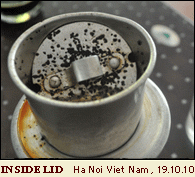
Second, take a Vietnamese coffee filter. Spoon in about 30ml of the coffee, and push down the inside lid to pack the grounds. (The inner lid has tiny holes, like a tea strainer.)

Next, pour a little condensed milk into a coffee cup or a whisky glass. It should cover the bottom of the cup/glass, but not much more.

Put the filter on top of the cup or glass, and pour in a tiny amount of water – just enough to soak the coffee grounds.

After a few seconds, add as much boiling water to the filter as you think you'll need in the final brew, and put the top on.

For the next 10 minutes or so, find something else to do while the water slowly filters through the coffee and into the cup/glass below. (I find that writing ridiculous blog entries on scraps of paper is a good way to fill in this time – though you have to be careful that your words aren't obscured by coffee stains, 'cause most tables at Vietnamese cafes aren't fabulously clean.)


When gravity has done its divine work and all your water has drained into the cup or glass, remove the filter. You'll see a thick, viscous** black liquid – about as thick as Turkish coffee, but without the sediment. Stir it a little, scraping your teaspoon firmly across the bottom to mix in the condensed milk.

And here's the point where you do the unexpected thing which will surprise your house guest/customer/mortal enemy if he or she hasn't experienced a VN coffee hit before.

Take a tall glass filled with three large ice cubes (it's always three for some reason), and tip it upside down to strain off the excess water, using a long-handled teaspoon to stop the ice from falling out of the glass. Then pick up your coffee cup or whisky glass, empty its contents into the tall glass, and put it aside. You won't be needing it anymore.

Btw, one thing I love about this process is that, by the time you've reached the drinking stage, your little cafe table has become cluttered with apparatus. You've got your coffee cup, your filter, your glass of weak tea or water (which always comes with coffee), your teaspoons and your tall glass, plus one or two other optional things. It's almost reminiscent of a traditional absinthe-drinking session***.

Anyway, now you're ready to sample the exotic eastern brew. Use your long-handled teaspoon to stir the coffee, condensed milk and ice together, then pick up the tall glass and take a sip.

Say to yourself:
"Ohmigod ... that's incredibly strong and incredibly good!".

Repeat at regular intervals until the glass is empty.

If you're in a cafe, at this point you'll float effortlessly to the counter, open your wallet, and take out approximately 15,000 Vietnamese Dong (about 75 cents). Make sure to hold your arm at a downward angle when you do this – you'll be pretty close to the ceiling by now, and it's impolite to make the counter staff climb up a step-ladder just so that they can reach your money.

Finally, go about your day with renewed energy, as the caffeine gradually infiltrates your blood stream and alters your body chemistry more than you thought possible from a single cup of coffee. And be sure to return the next day for your follow-up hit ... 'cause life is just too damn short to be worried about the health risks of such a wonderful substance ;-)

I swear it's the most fabulous caffeine-hit I've ever had. Almost worth a visit to this less-than-fabulous city ...

Bye!


* "to flip your lid" = to go crazy (for those readers who speak English as a second language, and haven't seen this expression before :-)

**I had to use that adjective in The Manor at some point ... if only for the amusement of Mr. Spannagle, whom I know is as fond of the word "viscous" as I am.

*** I'm no expert on this, but I remember there are a lot of stages, each involving some form of equipment ... like there's one stage where you pour the absinthe into an unusual metal strainer with a sugar cube inside it, letting the alcohol drain through the sugar. It's a slow, ritualistic process which, for me, suggests that you're somehow re-creating the mood of an earlier period in history, when absinthe was enjoyed by poets and artists in European coffee houses. So I'm a fan of that kind of 'ritual preparation'.


Friday, 24 September 2010

socialist republic of scooterville


The display on my mobile shows 6:15am, and the city is buzzing. At least half of the shops have already opened, people are congregating on the cluttered pavements for breakfast, and food vendors are laying out tiny plastic chairs – no more than about 30cm high – for their customers. Not far away, foul-smelling three-wheeled garbage carts lurk in grey herds, waiting sullenly for their chance to devour whatever falls from the breakfast table.

At one edge of the throng are small groups of men, also lurking. Depending on when and where you are, they either stand expectantly waiting to spring into action, or lean back casually on their motorbikes, nursing cigarettes in their hands and calling "Hello! Xe om?" or "Moto?"* to passers-by. If you show interest,
they helpfully produce a spare helmet, which is usually just about strong enough to protect your head from a stiff breeze.

Picking your way through the chaos, you pass enormous chickens standing terrified in their bell-shaped cages, hoping not to be on today's menu, while fish, shrimps and yabbies swim in filthy plastic buckets. Dogs and cats stand tied up outside shops (or sometimes caged inside), and occasionally a rat can be seen dashing bravely through the field of engagement, from one piece of cover to the next.

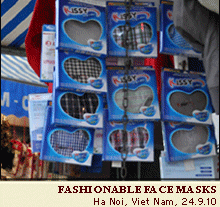
The traffic, meanwhile, has yet to hit its horrible peak, but already it's thickening like blood in an unhealthy artery. Even at this early hour, a foreigner could be forgiven for doubting that so many motor-scooters actually exist on Earth, and suspecting that there are just 10,000 or so going around the same block on some kind of endless loop. The fumes are intense, and you're starting to understand why so many people opt for those ridiculous face masks – which, btw, are available here in an extensive range of colours, patterns, novelty shapes and Hello Kitty prints.

For all of this mad activity, though, the city has yet to officially begin its day.

As six-thirty rolls around, something new pierces the airwaves**. Beatific music is blasted from lo-fi loudspeakers around the city, carried on cushions of polluted air to the ears of every citizen. And then a voice begins talking: urgent, shrill, and incredibly annoying. If you live near one of these loudspeakers, this morning announcement will finish what the lack of oxygen started, giving you a headache that could last you till the evening. It continues for about 15 minutes, then dies away and allows the army of scooters to once again take pole position in the race to corrode your eardrums.

And so ... welcome to another day in Ha Noi, glorious capital of the glorious Socialist Republic of Viet Nam.

*cough, wheeze, splutter*

But why (you might just conceivably be thinking) am I telling you about early morning street life in Ha Noi? Well, the reason's pretty simple: Yuliya and I now live here.

We arrived in Viet Nam on September 10th and signed nine-month contracts with our school, which of course means that they end next June. Thing is, though, after two weeks of life in the city we're already having serious doubts. We seem to spend a lot of our time trying to convince ourselves that we don't, y'know, utterly loathe and despise the place ... and so far we're not making much headway.

To be fair, our Ha Noi experience hasn't been completely without adventure, and the city isn't entirely lacking in atmospheric spots. For the first few nights, we stayed in a hotel hidden in a maze of alleyways, which was fun to explore. The first day also saw Yuliya getting acquainted with chopsticks, as we ate in local restaurants, ordering from menus we didn't understand and hoping we'd get something edible that was neither frog, dog nor pigeon. That was kind of an adventure in itself.

(Incidentally, as with every new thing she tries, my mad genius of a wife picked up the chopstick technique almost immediately. Jealous!)

I'd also have to say that the colours of the city are pretty amazing. You don't really notice how vivid they are until you review some of your own photos and think "Wow, look at those reds, yellows and greens!" After that, you start appreciating the intense tonal contrasts.

In general, though, our first few days in Scooterville saw us inundated with relentless, deafening noise, drenched in sweat (the temp was about +30, but the humidity was just incredible), repulsed by the never-ending bad smells – especially those which emanate from the city's stomach-churningly putrid waterways – and wondering what the Hell we were doing here.

On our first weekend we decided to get out of the city, which gave us a break from the noise, but in every other way it just confirmed the ickiness. We went to Tam Coc: a place about two hours from Ha Noi, where you cycle through villages and countryside to a town beside a river, then row down the river, which goes underneath several mountains. The scenery there was rather beautiful (and quiet!), but again, the villages were ugly, with construction materials lying everywhere and reservoirs of stagnant water that stank so badly it made me want to bring up breakfast. And the weather was appalling. I lost a few litres of liquid just on the bike ride (which was only about 6km ... i.e. no distance at all, compared to my recent 'cycling days' in Finland).

Still, at least we got to see foot-rowing, a skill that I was previously unaware of. Oh ... and inside a Buddhist shrine in a place called Ho Lua, we found out what Vietnamese people consider to be a suitable offering to the Gods. Not sure that, if I were a divine presence, I'd be so thrilled to receive half-a-dozen cans of coca cola. Then again ... maybe along with the vodka, it would help pass some time in the Otherworld ;-)

Back to Ha Noi for the second week, and it was more of the same: noise, smells, problems with food. We'd initially enjoyed the Asiatic flavours in some of Ha Noi's cafes and restaurants, but as we stayed longer, we noticed restaurant staff doing some really dodgy things, like sticking their hands into the middle of a dish to 'fluff it up', and handling food with filthy fingernails. Perhaps the worst thing we discovered, though, was the tendency of restaurants here to 're-use' food. This means that, for example, if you don't finish your soup, they'll take the leftover portion into their kitchen and pour it back into the pot. Result: the next customer gets part of your soup.

I'm fairly sure this happened to me once in a beer hall restaurant near our hotel. The waitress recommended chicken soup to me, then a few moments later went to clear a big table where several people had been eating what she'd recommended. A few minutes after that, my bowl of chicken soup appeared, looking unaturally thick and ... I don't know, somehow just 'wrong'. I ate it anyway, 'cause I figured it was just 'Vietnamese-style'. Then afterwards Yuliya and I put two and two together, and came up with "Euuuwww!!!".

Later we asked a couple of people about this, and they said "Yeah, you have to be careful about re-used food here". Great.

So that compromised one of the few things we were enjoying about the city up to that point. Which left ... er, our boss (who's awesome), the friendliness of Vietnamese people (who are incredibly smiley and keen to say "hello" – though their friendliness does seem quite insincere at times), and ... well, the coffee. The coffee here is beyond all expectations. I'm gonna tell you about it in a separate entry, 'cause it deserves a page of its own on The Manor.

Oh, and about those public announcements I mentioned earlier: I asked around to find out more information, 'cause they struck me as probably being a 'socialist relic', and I admit to becoming a bit fascinated (while simultaneously annoyed) by them. Far as I've worked out, the loudspeaker systems mostly date from a time when lots of Hanoians didn't have their own TV or radio at home – so I guess they were a kind of 'public service' (with an ulterior motive, of course). On the other hand, I've also heard that more have been installed during 2010, to prepare for Ha Noi's 1,000-year anniversary celebrations.

Yay   >:-[

Accounts vary as to what kind of information comes from the speakers. Back in the day they were definitely a party tool, spouting communist rhetoric and so on. I also read somewhere (don't know if it's true) that they were used for 'shaming' purposes; i.e. lists of people who hadn't paid bills were read out over the air, so that the whole city could hear about Citizen Trang's unpatriotic failure to pay for his electricity.

In recent years the flavour of the announcements has beсome more 'news of the day', with a light dusting of propaganda (stories about good things the government have done for its population recently and so on). In the lead-up to the 1,000th anniversary, morning announcements have also included some stories from Viet Nam's history, to stir up some national pride among the volk. That's also the idea of the music I mentioned before – it's mostly comprised of patriotic hymns.

On a more ordinary day, you can even hear the price of fish, rice and eggs blasted at 100s of decibels across the city. Though of course, if you happen to be one of those unlucky people with a speaker placed right outside your flat, you might not be quite as keen to know that rice is cheaper this month than last month as you are, say, to protect yourself from permanent hearing damage, or to have the option of sleeping in occasionally!

So anyway, that was our first two weeks in the city which (thanks to my boss) I've come to think of and refer to as "Scooterville".


Of course, we know that Viet Nam is under no obligation not to be crappy, and you could even argue that it has a kind of 'special dispensation'. I mean, it was only 40 years ago that the whole country was virtually annihilated, when the US put Operation Destroy an Entire Nation For No Good Reason And Fail Disastrously into effect. They dropped more bombs here than were dropped in the whole of WWII (by everyone, not just by the Americans), and the chemical constituents of some of those explosives were absolutely ruinous from an agricultural point of view. So the fact that the country still exists at all is a frikkin' miracle. In that sense, it isn't Viet Nam's fault that it's kind of an unpleasant place to live, and we're trying to keep that in mind.


It also has to be said that not every foreigner who comes here feels the way we do about it. We've met a couple of people who absolutely love Ha Noi and wouldn't be anywhere else, and others who say it was "difficult at first" but they "got used to it", and now "quite like it".

As to whether we'll stay ... well, of course we're gonna give it some more time. Two weeks is not enough to judge how you feel about a city. That said, I have a sneaking feeling that we won't be seeing out our contracts.

More about this soon, no doubt.  

Bye!  
 

* Xe-om / Moto = motorbike taxi

(** I wanted to say "fills the airwaves" ... but they were already full.)


Monday, 6 September 2010

l'viving for the moment


Ok, so let me start by re-assuring everyone that I don't plan to send you all to sleep with a long, sentimental blow-by-blow of the wedding. I've already posted some pics on Facebook, so if you're interested you can head over there. (I'll post the address in a sec.)

For now, let me give you just the bare outlines. The Zhena* is called Yuliya, and I met her at work on my 2nd day in L'viv. She's an English teacher like me, and completely mad ("Also like you", I guess some of you are thinking). I was immediately interested, so I asked her to be my Russian teacher. (Sneaky man! Though in my defence, I really was looking for a teacher at the time.)

Over the following months we kind of just became inseparable – like, y'know, a teenaged girl and her mobile, or a crocodile and a German tourist. (Northern Australian joke there.)

By the time we'd hit March or April, Yuliya was already calling me muzh*, less and less jokingly. And so it went, until finally I rode up to her flat one day on a white stallion (completely true) and asked her if she'd like to marry either of us. I guess my luck was in that day, 'cause she didn't choose the horse – even though, truth be told, he was rather handsome )))

And what else? Oh yeah: the Happy Ending. I became the real "muzh" in L'viv, on August 31st and September 1st, after I'd got back from my summer job in Finland and Yuliya had returned from her CELTA course in Kiev. It was like we'd rendezvoused in the city especially to get married, which was kinda cool.


Now the plan is to explore the world together ... starting in a few days' time.

I could continue rambling about Yuliya for hours, but I d'know ... somehow it just seems a little out of place, telling you my whole 'wife story' in these pages. The Manor is supposed to be my "travel and teaching blog" (I'm quoting myself here – how's self-referential is that?). That's why I went for the Facebook option. In any case, I'm sure you'll be hearing a lot more about Yuliya (a.k.a. The Belle) in future entries. It's my personal guarantee :-)

Meanwhile, the gallery is here, with accompanying details:
http://www.facebook.com/album.php?aid=252767&id=753604782

Let me move on to try and explain my silence on the subject of L'viv**, where I lived between Oct 2009 and July 2010, where Yuliya was born, and where I find myself again now, in the aftermath of a bi-lingual wedding that involved a mountain of organisation and guests literally crossing the globe to be at the Big Event. 

*ahem* 

So ... at different times during the past year I've started writing L'viv entries, but they never seemed to get off the ground. I just had an awful time working out what I actually wanted to say about the place.

Its status and reputation as a city is quite unusual: among those who are well-travelled within the former USSR, it's disproportionately famous for its beauty, whereas for everyone else (apart from Polish people, who flock there in summer), it seems almost unknown. In 2009, when I was tossing up between L'viv and Minsk, I consulted a number of 'seasoned former USSR traveller'-type people, and they all gave me pretty much the same advice: L'viv is an absolute must. Phrases like "one of the most beautiful of all former Soviet cities"*** were splashed around freely in these advice sessions, so I naturally thought "Ok, cool. Sounds like a promising destination".

Months after that I finally arrived, but the circumstances were not what you'd call 'normal' or 'ideal'. For one thing, I was almost two months late because of visa troubles which had stranded and almost bankrupted me ... so I arrived as a poor, belated straggler.

Also, coming to L'viv was supposed to involve a 'reunion' with my good friend Scott, who I'd lived with in Kazakhstan (and who was 'Best Man B' at the wedding – Ukrainian tradition being to have two of them). But a week or so before I finally made it to Ukraine, Scott came down with pneumonia and was confined to a hospital bed when I got there. I couldn't even locate him in the city, so as to visit him in his 'hour of need' (though I later found out that he was being visited each day by a different local teacher from our school, making him the envy of his fellow patients as they wondered about the foreigner with the endless stream of beautiful young women coming to his bedside. Scott, you rascal!)

So that was ... well, it just cast kind of a weird light on everything.

Then there was the epic luggage drama, wherein I tried for three months to convince Ukrainian customs that they should give me my suitcase (which had been 'sent on' from Kazakhstan by my friend Zhazira), until finally they shipped the bag back to its origin without telling me. The result: about 2/3 of my worldly possessions have now been to Amsterdam (a transit point on the suitcase's return journey), whereas I haven't. Plus, I had to start almost from scratch in terms of wardrobe ... oh, and Zhazira has a very effective door stop.

Also, despite some outstandingly fabulous admin staff (feel compelled to mention the name 'Jana' here, just to give my L'viv colleagues the opportunity to nod in heartfelt agreement), my school in L'viv was basically crap. 

So I guess you're getting the picture here. These and other things inevitably factored in to my early feelings about the city ... even though I knew that the stuff I've just mentioned was either a) entirely coincidental, b) specific to me or c) both. On top of this, there was the voice in the back of my head telling me that I should be blown away by L'viv, 'cause others had been before me. That also tended to put a slightly odd spin on my early days there.

One thing which was never in doubt, though, was the 'Beauty Factor'. In its low-key way, L'viv is a real stunner. It was formerly in Polish territory, and also a part of the Austro-Hungarian empire, so to say that the centre is pretty and ornate would be an understatement. I mean, everything is rendered on a small scale in comparison to other civic beauties like St Petersburg (almost the 'N' scale to Peter's 'HO', if you're a model rail enthusiast), but in a way that actually adds to the appeal. In good former Soviet tradition, it's also a very green city with lots of parkland, wide verges and large courtyards which lend an air of spaciousness and calm to the whole picture. 

For me, though, the best thing about all this architectural treasure is its rather poor state of repair. If you love the painstakingly-restored prettiness of western European cities like Vienna, then forget L'viv. But if you're more turned on by phrases like "faded grandeur" and "atmospheric decay" (which I used in countless emails and
Facebook messages while trying to describe my new environs), then put L'viv on your itinerary for sure.

There's something quite dignified about a city as cute as this one remaining 'natural', rather than tarting itself up and opening its legs for the throng of tourists arriving on Ruin Air, looking for a suitably debauched location in which to conduct their buck's night. I hope L'viv doesn't change its mind about this when it co-hosts the European Football Cup in 2012. That would be a shame.

The city's run-down charm actually became the inspiration for a tradition which I really enjoyed, and which I miss now: the "Photo Day". These were days when I'd meet up with my friend Janet (a photographer), and we'd wander around decomposing squares, along crumbling alleyways and through messy, laundry-strewn courtyards with tangled electrical wires everywhere, taking pic after pic in between coffee/lunch/hot wine breaks.

L'viv is the kind of place where you can do that – and where you'll always find some new and interesting detail to point your camera at. Koroche: from a purely aesthetic point of view, it's a frikkin' gem.

The city also comes with its fair share of odd characters and random weirdness (though in this respect it lags way behind Kazakhstan ... which is possibly one reason why I prefer The Big K). On the "odd characters" front, my landlord and next-door neighbour Igor was hard to beat. If I could take only one memory with me from L'viv (apart from those involving The Belle), it would be this: opening my front door one morning to find Igor standing outside my flat with a power drill in his hand, one finger curled around the trigger, pointing the drill at the ceiling like a starter's pistol and wearing only a tiny pair of US flag-patterned underpants. 

This was about ten days after I'd moved into my flat, and a few days earlier I'd asked Igor about getting cable internet in the flat. He'd brought the drill because he wanted to put holes in his walls, so that he could lay the cables. I wasn't so keen on this idea; it was a beautiful old flat, and I didn't want him to destroy the plaster in the walls if it wasn't absolutely necessary. I suggested that we get little pins and just tack the cable to the skirting boards, but in response to this, Igor told me something I'll never forget:

"Entoni", he said. "Without holes, there is no progress."

I didn't know quite how to reply to this, and decided it would be best just to shut up and nod politely. But the incident inspired me to add a new item to my list of 'rules for good living' (a list which begins with "Never eat anything bigger than your own head"). The new rule is as follows:

"Never argue with a nearly-naked man holding a power drill".

I think it's excellent advice, and I intend to publish it in booklet form just before I die.

Btw, later when I thought about Igor's statement, I realised that what he'd said had more or less encapsulated one difference between 'developing' and 'developed' nations. In places like Ukraine, the 'Stans etc., there's noticeably more building, renovating, road work and reapirs than there is in the wealthier countries of, say, Western Europe. Construction noise and construction materials are an almost constant presence. Which makes sense I guess, since obviously part of 'developing' is mixing concrete, banging stuff with hammers, and yes, making holes. In fact, without the last thing, nothing would ever be bolted together, and there would simply be no development.

So there you had it: our future depends on negative space. The Way to A Better Tomorrow is through the holes we make in our lives. They are The Way Forward ... and my landlord is a philosopher for our times ;-) 

Actually Igor turned out to be a fabulous landlord, providing regular surreal entertainment as well as genuine care and concern for his tenant. He frequently invited me in for coffee, soup and cognac (or whatever else he had), and every inquiry I made about practical stuff in the flat led to a long conversation about Life, The Universe and Everything – and especially about my marriage prospects. Like so many people I've met in the former USSR, Igor worried that I was alone and wanted to try and help if he could. His suggestions were usually more funny than helpful, but it was sweet that he was trying.

Plus he had a cute cat called Elka, who was always worth visiting )))

Igor also saved me from the clutches of ex-militia man who lived downstairs, when water from my bathroom leaked through the floor into his, and the cranky old bastard wanted to hang me over the balcony. So in a sense he was sort of my guardian angel, just like my previous landlady Natasha. Admittedly Igor wasn't 
a typical member of his profession – most guardian angels, for example, don't
lift up their shirt in your hallway to show you their multiple stab-wounds, or invite your female friends into their kitchen to show off their weightlfiting equipment. (And indeed, most don't offer you cognac as "compensation" every time you have a problem with your flat or you have to pay a bill.) Then again, perhaps more guardian angels should do these things. You might feel a lot more well-protected if you knew that the Holy Man in your corner was packing some muscle and had survived the occasional knife fight.

There's one more L'viv-related thing I want to mention before I put this topic to rest. It's also pretty high up on the weirdness scale.

One morning during my first month of work, as I was preparing for lessons, one of the admin staff came and warned me not to go out on the street for the rest of the afternoon. When I asked why, I was told that the army was going to spray the city from the air.

Again, "Why?" seemed like the natural question.

The answer was that swine flu had hit the western part of Ukraine – and hit it hard. We had an 'epidemic' on our hands, and also a complete quarantine. Later that day, we discovered what 'quarantine' meant: schools had been ordered to close, the Slovakian and Polish borders sealed, and every road into and out of L'viv patrolled so that no-one could enter or leave. We were stranded here, in what was soon to become almost a ghost town.

During the first week of the quarantine (which happened to coincide with Halloween), people were in a panic. The streets became eerie, with just a few people rushing home, looking scared, faces covered with masks. Government announcements suggested that citizens should stay away from "places where people gather", so most markets and shops closed (except for chemists, who turned a very good profit). Restaurants and bars closed too, and public transport was almost empty.

But you know, creepiness aside, there was something that just didn't add up about the whole situation. The locals were petrified, but to Scott, Janet and I, it seemed somehow 'wrong'. Hard to explain ... it was just a feeling. In any case, the feeling encouraged us to head into town on Saturday night, looking for some Halloween celebrations. (Apparently they're usually big in L'viv, with elaborate costumes etc.) When we did, though, things got even creepier: the old centre was almost deserted, and there was a slight 28 Days Later**** edge to things. We saw maybe 1/2 a dozen people in costume the whole night ... my personal favourite being a guy in a kind of grim reaper-ish cloak with a gas mask. (Practical and thematic!)

We headed to a restaurant/ bar called Kriyïvka – a
24-hour place, normally packed and rowdy, but on this occasion depressingly subdued. There we caught some of Prime Minister Timoschenko's emergency TV broadcast. She was visiting rural communities, handing out medical supplies and
touching forearms  sympathetically, all the 
while addressing the camera. Swine flu had gripped the western part of the country, she said, but the government had swung into action and would save western Ukraine from what would otherwise have been its apocalyptic fate.

And there, it seemed, was the rub. 

The quarantine lasted three weeks altogether, but in the second week people slowly began emerging from their houses. There was a shift from panic to mere caution, as more and more folks came to an audacious conclusion: namely, that the government had actually invented the flu epidemic to get itself re-elected. And anyone who watched Timoschenko's speech would have to concede that it was at least possible.

I don't think we'll ever know the truth of this, but in that second week some very suggestive facts and figures began to appear. For example, while a few Ukrainian websites were showing a 'death toll' (regularly updating the number of people who had died from flu), doctors released records showing that the figures had actually been higher the previous year. Comparing the two, you could see that when the winter of 2008 came along with its usual crop of illnesses, it had killed more people than 2009's so-called 'epidemic'. And every politician in the country had suddenly become a humanitarian hero, trying to show they were the bravest and most compassionate opponent of the killer disease.

Throughout that period, I found myself pondering the significance of it all. I compared it to things that have happened in Australia, like the 'Children Overboard Affair'. There, the government of the day invented a completely fake scenario, designed to make Australians vote for them because of concerns about border security. And shamefully enough, it worked*****. What's worse: when their deception was discovered, the government were allowed to continue ruling the country ... and people even voted for them again in the following election.

Why? Because in English-speaking countries, if you want people to support you to an unreasonable extent, you 'play the security card'. People there are completely freaked out about their security – perhaps because the English-speaking world includes the 'warrior states' of the last 60 years, who have spent their time since WWII flying/sailing around the world to kill people more or less non-stop. Other countries are understandably sick of that, and people in the English-speaking world kinda know it (even though they would deny it if you asked them).

So during the epidemic-that-wasn't, it seemed to me that the Ukrainian leadership were doing something very similar. In the Slavic world – thickly populated with hypochondriacs who reach for the folk remedies at the first sign of a sniff – you don't play the security card to get re-elected. Instead, you play the 'health crisis card', and you achieve more or less the same result. 

Interesting, I mused, how different peoples have their easily-exploited logical weak spots.

Wow ... did I get spectacularly off the point or what? Sorry. 

Anyway, that was my ten months in L'viv – or at least heavily abridged highlights of same.

Along with the good things I've mentioned, there were also some negatives; the racism pissed me off for one thing, as did the more extreme forms of nationalism (especially the "death to all Russians" kind). Maybe more of a drain than that, though, was the depressive outlook of many western Ukrainians. They feel ignored and unwanted by the EU – which ends a couple of hours west of their city – betrayed by their pro-Russian countryfolk in the east, and shat upon by their corrupt government, and hence they see no future at all for Ukraine. There may be some measure of truth in all of these things, but it's massively exagerrated in their heads.

I mean, obviously not every western Ukrainian person feels like this. (The Belle, for example, has never been one to complain about the slide into socioeconomic decay. For her there are far more important things in life – which was one reason why I found her company so refreshing, I s'pose.) But enough of them do to make "Isn't Ukraine a steaming pile of crap nowadays?" an all-too-regular conversational topic.

I sometimes wanted to yell "Helloooo!!! Welcome to the world, people! You can find poverty, corruption, bribery etc. anywhere from Thailand to Tanzania. Stop thinking that Ukraine is the suckiest country on Earth ... or at least stop telling me about it! You're making me want to leave."

Of course, if you said anything like this, the usual response would be "Yes, but I think it's worse in Ukraine." At which point you'd just have to give up and let people wallow.

So yeah ... overall, I'd have to say that I felt ambivalent towards L'viv. Then again, maybe it wasn't that the city failed to inspire me, so much as the fact that I was focussed on other things. I remember saying in one email to a friend that "I haven't so much moved to L'viv as moved to Yuliya", and in the last year that has certainly been a fairly strong theme. 

We'll see how the story develops from here.

In fact, we'll see very soon, 'cause in two days' time The Belle and I are leaving L'viv and journeying to another continent, to take up residence in our new home town. It'll take us two full days to get there, neither of us have ever been before, and it promises to be a totally new cultural experience.

Give me a week (or six) to settle in, and I'll let you know how it's all going.

Bye! 
Anthony. 


* "Zhena" = wife; "muzh" = husband.

** "L'viv" is the actual Ukrainian name. It's known as "Lvov" in Russian, "Lwow" in Polish and German, and "Say that again? Nope, never heard of it" in most varieites of English.

*** A pretty huge call, when you consider that the USSR covered about 1/4 of the world's landmass.

**** Cool British movie about a virus that kills off almost all of humanity, and about how the few survivors try to re-group and deal with the new, savage breed of human that has taken over. At the beginning of the film there are stunning shots of central London, in which you can't see a single person. Still don't know how they got those shots.

***** I'm applying the word "shameful" to all citizens of Australia here, not just to the government (who we already knew were evil little hall monitors with tongues that reached all the way to Washington). Anyone who calls themselves "Australian" should be thoroughly embarrassed to live in a country where crap politicians rely on lies and racist paranoia to get elected, where they succeed, and where, when they're found out, everyone just shrugs their shoulders and goes "Politics, huh? Whatcha gonna do?", rather than removing the bastards from office. Far as I'm concerned, if you live in Australia, you've pretty much forfeited the right to criticise any other political system in any way ever, 'cause your own system is clearly a frikkin' joke. So there :-P


Friday, 3 September 2010

two weeks in 'the hole'


So, er ... just in case anyone is wondering, Finland continued to do its marvellously spacious and tranquil thing all the way through to the end of my time there. In fact, it did so even more determinedly in the final two weeks, stepping up from Sparsely Populated Mode to Well-Nigh-Deserted Mode ... which is possibly my favourite mode of all.

My final obligation to my employer involved spending two weeks in "The Hole" (a literal translation of Valkeala, which was the closest town to the college where I worked). So down The Hole I went, and this is where the mode change happened.

RUSH HOUR                                                                         Nuutilla, FInland, 21.8.10 
I know I've said this before, but honestly, ESL teaching is an odd profession. I mean, some of the places where you can land a job teaching English are seriously crappy*, whereas others are ... well, strangely reminiscent of paradise. At both extremes of the spectrum, you end up spending quite a bit of time in locations where the average comfortable Westerner simply wouldn't ever find themselves. To me, this is still hugely appealing.

A case in point: imagine you wake up every morning at around 6:30am, and the first thing you do is throw open your curtains to reveal a panoramic view of a calm, picturesque lake, its shores lined with pine forests and dotted with red timber cottages. You finish planning your lessons (started the night before), then stumble up to the dining room where a buffet breakfast awaits your perusal, before adding some final tweaks to your lesson plans and plunging into five hours of teaching.

Come mid-afternoon, classes finish and your students are transferred into the care of their camp instructors, leaving you free to spend the rest of your day as you like. And so you jump on the bike and go cycling through farmland and forest. Or you take on a longer expedition to a town or village. Or you go for a row on the lake, play badminton with your colleagues, read in the afternoon sun, or row/walk to a beautiful 100-year-old wooden hydro-electric station (only in Finland could you have a "beautiful power station"), to enjoy ice cream with friends while watching a family of ducks choosing their route up river. Or, y'know, you just go to your room, mess around on the internet for a while, and sleep till dinner time.

Of course you have to plan everything you want to do in the classroom, and some days this can be very time-consuming. But more often than not, a large portion of your time is completely your own.

After a few days of this, one morning you hear a sound that gets your attention. It's the sound of a car engine, and it's getting louder. You think "Hmmm, strange. Who that could be?".

Then the following realisation hits you:  "Holy crap! I'm so far removed from civilisation here that an approaching car is a frikkin' event ... and yet, I'm actually holding down a job in this place!"

And at that point, you know you've been making some good choices in your life.

This, in the proverbial shell of a metaphorical nut, was my time in Valkeala. Even though I was missing The Belle intensely the whole time, and there were some issues with the camp instructors, and the students weren't nearly as cool there as they were in Anjalankoski, being in The Hole still contributed to making 2010 one of the best summers I've had.

At the end of it all, I rode back to the town of Inkeroinen, and returned my bicycle to the bike hire shop. This in itself was quite an intense experience – a 55km 'farewell ride' through some stunning countryside*. Not wanting to compromise my rugged manliness or anything, but I've really no idea when (or even if) I'll be back in Finland, and as I approached Inkeroinen's not-especially-charming town centre, there were some emotional moments. I have a lot of good memories that centre around this little corner of the world now.

So yeah ... on my fourth year there, I think I finally learned how to appreciate Finland properly. Amazing that it took me so long – for the last couple of years I've been the Meg Ryan character to Finland's Annoying Guy who Randomly Meets Meg and Inconveniences/Irritates Her. You know the plot outline even if you haven't suffered through the films: she sees all his faults and complains bitterly about him, then later realises that she's madly in love with the very same guy, a minimum of half an hour after every single audience member – even those with IQs bordering on the subnormal – have effortlessly reached the same conclusion**.

Silly Me(g)! 

Oops, sorry for the tangent. Let's skip to the finish of the Finnishness.

The following day, several expensive train rides and a fairly bad hostel experience later, I flew out of a completely different part of southern Finland. Ascending over the Turku archipelago, on my way to Gdansk in northern Poland, I had one last rush of "Oh my gods, this country is amazing".

The archipelago extends far out into the Baltic Sea and is made up of more than 2,000 islands. on some of them I could see little communities, joined to their neigbouring islands by bridges, but on quite a few of the smaller ones there was just a single visible house, alone among the waves and the wilderness. Still others remained completely uninhabited ... at least for now.

I just don't think I could have been more impressed with this. I really don't. It was as if Finland was sending me a farewell message – something along the lines of:

"Don't dismiss your dreams, Anthony. Nothing is too far-fetched, 'cause after all, you live in a world where people can still have their own frikkin' islands! Got that?"

Yep. Message received.

Perhaps the weirdest thing about all this is that, despite everything I've described in the last two entries, plus a well-functioning socialist society, an educational system that's the envy of the rest of Europe, brilliant health care, decent life expectancy, financial comfort, low crime and more quiet lakeside beauty spots than you can poke a fishing rod at***, Finns are one of the most clinically depressed races of people on Earth. They have one of the highest incidences of both suicide and chronic alcoholism you'll find anywhere. So why?

Seems to me there's a whole treatise waiting to be written in answer to that question. It'd be about how people who routinely live in ideal circumstances struggle to find 'highs', because the good moments in their lives aren't that much better than what seems normal, while on the other side of this coin, those who live in crappy circumstances are often happier because any time something good happens to them (even small, everyday stuff), it stands out from the crappiness ... blah blah.

Or maybe none of that is true, and northern peoples are just more inclined to be melancholic.

As intrigued as I am by this question, though, I think I'll leave the treatise to other people (and there are plenty of them) who have spent a lot more time than I have trying to penetrate the mysteries of Finnish culture. Good luck, guys!

Anyway, to get back to the original point of this entry, which sort of got buried in the ramble: Turku-Gdansk was part of a longer journey leading back to Lviv, the Ukrainian city where I lived and worked until recently. I'm in the 'burbs of the city now, looking out of a 2nd story window into a street called Rubchaka, which has witnessed some fairly significant events in The Word Nerd's recent life.

At this point, the super-observant reader might be questioning my decision-making capacities. The question would go something like this: "So, Mr Nerd, you're telling me that you've just left behind a country which you've said is pretty darn fabulous, and returned to a city which you didn't write a single word about during the whole ten months you lived there ... and where you no longer have a job. So, er, what the Hell are you doing back in Lviv?"

It's a fair question, and I'm glad you asked it ;-)

I'll tell you next time ... but meanwhile, I've posted the above pic to help you guess (if you don't know already).

Bye!


(*Just wanted to acknowledge the extensive and obvious Photoshop work on this photo. My excuse is poor light ... the skies went all moody and dark while I was setting up for the shot, and I didn't feel like fiddling with my camera for ages to try and brighten up the shot.)

(**And yet they stay and watch the whole tedious thing unfold with mind-numbing inevitability ... leading to such questions as "Why?", "Why oh why?" and "For Douglas' sake, WHY do they do that?")


(***Estimates of the number of lakes in Finland range from 30,000 to 200,000. That's just a ridiculous number of lakes, don't you think? I mean, how do they manage to fit any actual land into the country?)