Tuesday, 9 November 2010

wat's up?

(angkor part one)

So, about Angkor ... I know that a few people reading this have already been there, so to you, apologies for filling this entry with stuff you already know and things you've already seen.

To everyone else, I just wanna say this: if you've got any interest in ancient sites at all, you really, really should go there. In the last entry I quoted Henri Mouhot as saying that the temples are "grander than anything left to us by Greece or Rome", and he wasn't wrong. Angkor is, in a word, mind-blowing.

The typical tour starts with sunrise at Angkor Wat, which is the best preserved of the area's temples and palaces, as well as being ... get this ... the biggest religious structure of any kind, anywhere in the world! So, y'know, it makes a fairly obvious centrepiece.

(Wat means "temple", btw.)

In practical terms, catching the sunrise means stumbling out of bed at 4:30am, eyes half-closed, dragging yourself into the shower, dragging yourself out again, making a mental list of all the things you need for the day, forgetting the list completely before you've even finished it, packing whatever useful stuff you can see, and rushing downstairs to meet your tuk-tuk driver, still barely awake and definitely not functioning in the brain area.

The driver smiles and whisks you off through the darkened streets of Siem Reap (the closest town to the temples – previously a place with a definite 'Wild East' vibe, which is still faintly discernible despite the plethora of tourist hotels, travel agents and restaurants). Half an hour later, as the dark of night slowly softens to pre-dawn grey, you emerge from jungle into a wide clearing, where a large body of dark water appears on your right.

My first thought upon seeing this was "Ooh, what a pretty lake". Then we rounded a corner, and the lake followed us in a 90-degree turn. I thought "Huh?" (which is about my level of mental sophistication at 5:30am), realising later that I was in fact looking at an extraordinarily wide moat, encircling a walled city. I was subsequently told that, back in the day, the king ordered this moat to be filled with crocodiles (whereas, if I had my own city, I'd have quite a tough time deciding what to fill the moat with. It'd probably end up being either mango juice or bubble bath. Guess I'd be a fairly crap god-king.) 

To get across the moat you walk over a huge sandstone bridge, then through a grand gateway (constructed with elephant access in mind), where the bridge becomes a kind of raised stone highway. It stretches from the city's entrance all the way to the far end, where the temple stands.


Along the road there are stairways down to ground level, each guarded by seven-headed serpents. While in themselves they're not the most visually impressive features of Angkor Wat, the stairways are extremely cool for this reason: they show where each street began in the original city plan.

See, Angkor was actually not just a city but an empire of cities, each with a temple at its centre. Around the temple, people lived, worked, ate, shopped and, when they were sick of all that, died. The signs of their habitation are completely gone now, 'cause it was believed that only constructions dedicated to the gods should be made of stone. So these were wooden cities. But unlike the other sites in the area, Angkor Wat gives you enough of a sketch to imagine a whole metropolis functioning within its walls.

When you consider that there are 100s of these temples already uncovered, with an estimated 1,200 still hidden in the jungle, this makes Angkor a full-blown civilsation in itself. Somewhere in a guide book I read that, in the 11th century, over a million people lived there. At around the same time, the population of London was about 50,000. So y'know, we're talking huge here. 


Anyway, as you walk towards the popular viewing spots, Khmer people run up and start trying to sell you coffee from nearby stalls. Seemed like a pretty fabulous idea to me, so I bought my tall glass of coffee and shared the sunrise with a squillion other tourists, before escaping as quickly as possible from the hordes to do some exploring inside the temple. This is when the fun really began.

Inside the walls of the wat, trying to take in both the scale and the level of fine detail together is quite overwhelming. There are grand halls with Hindu and Buddhist carvings adorning every surface ('cause Cambodian religion is a mixture of these two faiths with some pre-existing pagan/animist beliefs thrown in). There are forests of stone columns holding up ornately carved ceilings. There are long cloisters and
hallways, some
  of them lined with statues and carvings that depict episodes from mythology. In fact, there's pretty much everything
you'd want from a temple of great antiquity, in pretty darn generous quantities. Not only that, but
somehow the whole thing is rendered in a symphony of rich monochromes and variegated colours that change throughout the day. (We know this because we went back to Angkor Wat the following day to get some more pics in bright afternoon sunshine.)

As with the other temples and palaces of Angkor, you can climb all over the many structures in Angkor Wat to your heart's content. The elegant outbuildings are accessible only by partly-worn staircases that are almost vertical, but you can get up onto those too. You can even – if you have the inclination – place a beautiful Ukrainian woman on top of one of them, and encourage her to reach into the morning sky, just for the sake of a good photo. But of course, only irresponsible husbands do that sort of thing. I personally wouldn't recommend it ...


From Angkor Wat, you head by tuk-tuk to Angkor Thom, also the centre of a great city now swallowed by the jungle. This temple is quite confusing in its layout, conceived as a "mountain of faces" and subsequently
re-modelled by successive kings into a mish-mash of styles and ground plans. But you sense you're getting further into the wilderness here – at Angkor Wat, you feel that nature has been effectively held at arm's length, but Angkor Thom and surrounding structures (including the enigmatically named 'Terrace of the Leper King') are set in a huge park with jungle licking at the edges, clearly wanting to reclaim the whole area.

None of this, however, will prepare you for what you see when you leave central Angkor and head to the eastern part of the former empire. Out here lies a temple called Ta Prohm, which would have to be one of the world's weirdest structures, just in the way that nature and architecture have joined together in a relationship which is both symbiotic and mutually destructive at the same time.

Before I go further, I should probably give you just a little more background info (not enough to send you to sleep, I hope). The khmer people always knew that Angkor's temples were there somewhere in the jungle, but other than Angkor Wat (which was inhabited and cared for by Buddhist monks), the khmer didn't set out to find and restore them. The restoration efforts only started in the late 19th and early 20thC, and were/are mainly conducted by an organisation called the École Française d'Extrême Orient.
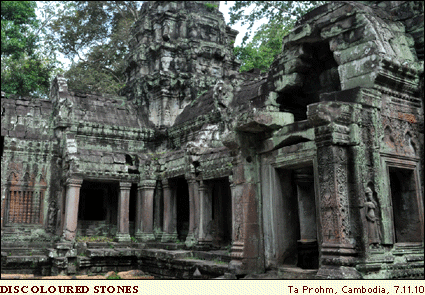
When the École first arrived in Cambodia, many of the temples were in an advanced state of disrepair; the stones were discoloured by fungus and bat droppings, while silk cotton trees and other arboreal giants had taken root between building blocks, ripping apart walls and sending rooves crashing to the jungle floor as they grew to enormous dimensions. It was clearly going to be a huge job fixing even one of these temples, let alone all of them.

Over a century later, the École's restoration efforts grind on. But at some early point in the process, they decided that cleaning up everything would deny visitors the pleasure of seeing these vast stone edifices in the state they were in when found. So the decision was made: let's leave a few of the temples as they were when we found them, doing just enough work to stop them falling apart any further.

One result of this inspired decision is the wonderful Ta Prohm, a maze of open galleries, mysterious dark passageways partly blocked by fallen masonry, library rooms hidden in corners of the complex, and parallel doors and windows that produce a 'hall of mirrors' effect. There are so many atmospheric little corners in this place, you could spend a weekend exploring them, admiring the faded carvings, the incredible colours, and the romance of stone crumbling to dust around you. I can't imagine there are too many sacred sites in the world that can match this one for beauty and atmosphere (although there is another temple at Angkor which does exactly that – tell you 'bout it later).

Yet for all I've just said about the architecture of Ta Prohm, the real star here is Mother Nature herself. It's her contribution to Ta Prohm which makes it the most frequently sketched of all Angkor's temples, and the one which has "prompted more writers to descriptive excess"* than any other part of the ancient empire.

When archaeologists from the École first came to the site, Ta Prohm's walls were under attack from an unlikely enemy: giant silk cotton trees and strangler figs (or possibly golden apple tress; sources disagree about the identity of this species).

The fruits of these trees are eaten by birds, whose droppings contain the seeds for the next generation. If a bird leaves a dropping on a stone wall, and a seed finds its way through a crack in the sandstone (between two blocks, for example), the tiny seed will germinate in the darkness and, in time, become a huge "wooden octopus"** strangling and suffocating its prey.

Maybe the most fascinating aspect of this (for me at least) is that in some cases the trees are actually the only things preventing a complete collapse of the temple walls, whereas in others, they're crushing and tearing the stonework year by year, and causing amounts of damage that you wouldn't dare put a dollar sign on. So it's a love-hate relationship between stone and wood, between nature and architecture.

The École are doing their best to keep the balance, letting the trees remain  
in place wherever possible while re-inforcing the structures which they're parasitising. But one gets the feeling that no group of mere humans can determine the fate of this site. Whether the jungle or the gods will emerge as victors is something only time can decide.

By the time you've seen these and two or three other sites at Angkor, it's mid- to late afternoon and you're feeling more than a little mind-blown, exhausted and temporarily 'templed out'. So then, there you are in northern Cambodia, wondering what the Hell there is to do here (I mean, apart paying to stand in a glass tank for 15 minutes, so that small fish can eat the skin off your feet – something that's offered on almost every street corner here).

Then you notice the signs saying "Happy Pizza", and you think

"Hmmm ... should I risk it? Is it a crime in this country? Will it make me miss my 5am start for the excursion tomorrow? And how strong will it be? Strong enough to make me think I'm a flying bunny on an interstellar mission to spread joy throughout the world via the medium of the Happy Dance? This is Indo-China, after all".

In the end, you decide to brave the Happy Pizza ... I mean, the signs are so blatant, it must be legal, right? And the guy taking orders is so middle-aged and respectable looking, he can't possibly be part of the 'criminal element', peddling substances which make people think they're alien rabbits. There's just no way.

Ok, enough justification. You know you're trying it for one reason only: namely 'cause you want to.

An hour later, head to the conveience store to grab some snacks for tomorrow's temple-viewing, continually asking yourself "Has the pizza started working yet?" After a little bit of giggling and a few odd but inconclusive moments, decide that in fact, the happiest thing on your pizza was probably the blue cheese.

And that – apart from a visit to the night market to do a bit of haggling and be chased by people who want your dead skin to feed their fish – is your day. Time to head back to the hotel and rest; you've been awake for a ridiculously long time!

Goodnight )))


* An often-cited quote from the book "Ancient Angkor" by Michael Freeman and Claude Jacques.

** A phrase used by one of Yuliya's friends when she saw a pic we'd taken of a huge silk cotton tree growing on top of a temple wall.


Monday, 8 November 2010

legacy guy


Around about 155 years ago, a French naturalist called Henri Mouhot went to the British Royal Geographic Society and asked them for some money. He and his wife wanted to go on a botanical expedition to Indo-China, and he wanted them to provide all the necessary funds for him to meander through obscure parts of the Far East, scribbling in his sketch pad and collecting samples of unknown flowers.

Correction: he and his wife wanted to go on four botanical expeditions, and he wanted the Geographical Society to pay for all of them.

Now, I d'know about you, but to me this sounds like a request which was almost tailor-made to be a) laughed at and b) flatly rejected. I mean, I'm sure if you've ever applied for an arts or science grant, or worked in project management and fought hard to get project budgets approved, you'll appreciate that getting the people with the money to be enthused about your Big Idea is always a challenge. And of course, getting them to actually open their purse and let you put your hands in is harder still. In this case, though, we're talking about an even bigger ask: a French explorer wants money from a British organisation, to bankroll his exploits in a region (Indo-China) that was of little interest to anyone at the time – and for a completely uncertain, probably very minimal result that would be of interest to a select few scientists and enthusiasts.

Hmmm ... not the easiest thing to sell.

The fact that Mouhot did manage to get the money for these expeditions forces me to consider an idea which I generally resist with all my argumentative powers: namely, that perhaps some things really are meant to happen. See, at that point, nobody (including Mouhot himself) could've predicted how much a few quirky little expeditions would enlarge our knowledge of the world, and the strange wonders lying therein. His big discovery had nothing to do with flowers, and everything to do with ...

wait, I'll tell you in a sec.

On his third Indo-Chinese round-trip, Mouhot traversed the jungles of northern northern Cambodia. There he came across something which hadn't been the focus of his journey at all, but which so moved and inspired him that he decided to deviate from his orginal plan and investigate. Out of the endless tangles of dense vegetation, as he hacked his way through with machetes, there emerged a series of impossibly vast, stunningly ornate and sublimely beautiful temple complexes – "grander than anything left to us by Greece or Rome"*, as he later put it. They were so overrun by nature that they seemed almost at one with the fertile jungle flora, but nonetheless they were still at least partially intact.   

Astonished and moved by what he'd discovered, Mouhot started sketching these weird, wonderful, other-worldly sacred sites. He also started writing ... evocatively, passionately, copiously. As it turned out, our nerdy botanist hero had quite a talent for literary description, and when he brought his accounts of these buried temples back to France, they caused quite a sensation.

It was only a couple of years later that Mouhot's writings were compiled into an illustrated book – an instant bestseller which fired the imaginations of the French people and made Angkor the subject of intense interest and speculation. Mouhot never claimed to have "re-discovered" the temples in his writing (because he knew that at least two other Europeans had been there before him), but before long, his name had become synonymous with 'the ancient city of Angkor'. 


And here comes the inevitable tragic twist to the story – the bit which convinces me that, if indeed there is such a thing as fate, she's a cruel bitch who deserves to be tied to the back of a tuk-tuk* and dragged through streets freshly re-surfaced with boiling tar. See, Mouhot never got to see the stunning effects of his work. Fired up as he was about expedition #4, he stayed only a short time in France before venturing even further into the unknown. By the time his book had been published, and become a sensation, he was lying in a grave in Laos, having died there of malarial fever in 1861.

See? Cruel. Bitch. Boiling tar.

As to why I'm telling you all this: well, I guess I kind of admire, and even slightly identify with, this Nerdy Little Plant Nerd (who, btw, worked as a language tutor in Russia before he disappeared into the Eastern haze). As I read more about him, I've also come to see him as something like the Indo-Chinese equivalent of those "Men of The Stans", who I've written about previously in The Manor, and who I admire very much. And lastly, I feel kind of a debt to Mouhot, since it was his work more than anything before it which eventually resulted in the re-habilitation of Angkor's temples.

Thousands of other people who come to Angkor and sit sketching the temples ("following in Mouhot's footsteps", as one website puts it) also feel seem to feel this debt. He's become almost as much of a legend as the temples themselves. And deservedly so, it seems to me – firstly for having such a wonderfully silly dream (the whole 'Flower-sketching in Indo-China' thing), secondly for convincing others to let him follow said dream, thirdly for being ready to Man Up and face the jungle, and fourthly for bringing such an incredible thing to the eyes of the world.

So ... thank you, Legacy Guy. We owe you one )))

I'm gonna write more about Angkor ... probably much more, in fact. It's without doubt one of the most astounding places I've ever been to, so I figure it's worth a couple of entries – plus I have loads of pics to show you.

Bye!   


* (A quote from Mouhot's writings.)

* A motorbike or bicycle taxi, very numerous in Thailand and Cambodia. They're kind of like a horse and cart, but with a roof on the cart and a bicycle or motorbike where the horse should be. Great way to travel in the hot Indo-Chinese weather, 'cause you get shelter from the sun and wind on your face )))


Wednesday, 27 October 2010

sa-pa, cat cat and the terraces of the hmong


Quick readership survey: hands up if you don't love it when the world suddenly turns around and surprises you by revealing some detail about itself that you'd never previously suspected, heard about or even dreamed of.

Ok, now hands up if you do love that.

Yep, it's as I thought … we're more or less unanimous )))

Of course, it does depend on the kind of detail we’re talking about. I mean, if someone came up to me in a bar tomorrow night and asked “Did you know that the State of Kansas hosts a 5km running race every April, which is one of the most popular in the whole of the USA?”, I wouldn’t be going “Wow, that's amaaaaaazing!!! The world is such an interesting place, isn’t it?”. At least, not unless there was a twist ... as for example, you went on to tell me that competitors are required to throw buckets of pure alcohol over each other before the race, then set themselves on fire at the starting line so that the audience – watching overhead in hot air balloons – could get high on the fumes that rose skyward, as sprinting fireballs sent intoxicating clouds of ethanol into the air. In that case, I'd be reaching for my laptop and getting hold of every single available Youtube video before you could say "sick imagination" ;-) 

Generally speaking, though, I'd consider myself a reasonably big fan of discovering-stuff-you-didn't-know-about-the-world (especially if it's of the weirder variety). It's usually small things, of course; you put the puzzle together piece-by-incredibly-tiny-piece, knowing you’ll never have the full picture but enjoying the process, as here and there little areas resolve themselves into something you can almost make out. However, on the odd occasion you do find something fairly big, and that's ... well, pretty damn cool.

A case in point: this year at uni I've been studying East and South East Asia as a 'language area', looking at the languages spoken in that part of the world and learning about some weird/interesting characteristics that many of them share. You can divide most of these languages into 'families', like the Sinitic (i.e. Chinese) languages, the Tai-Kadai family (including Thai and some other formidably difficult monsters) and so on.

Quite a lot of SE Asian languages are rather obscure, exotic and not yet fully documented, and lots of them have features that seem completely bizarre from a Eurocentric point of view. I s'pose the most famous of these is 'lexical tone' – i.e. where saying a word with different intonation completely changes its meaning.

As luck would have it, last month I moved to a country where the national language has this weird lexical tone thing, and I've enjoyed encountering a few multi-function words in Vietnamese. My favourite is "ga". This little midget of a word turns out to be quite versatile, with a range of meanings from "chicken" to "railway station", depending entirely on the intonation. And because the tonal system is so difficult for foreigners to master, if you try ordering "com rang ga" (rice fry chicken) in a Ha Noi restaurant, you can quite easily end up asking for fried rice with a railway station. Or else you can go the other way, and ask a taxi driver to take you to Ha Noi's Central Chicken.

*pause for giggling*

Really not sure why I find this so funny. I just do.

Sign of immaturity, I guess.

For me, though, the most exotic languages I've come across this year are a family called 'Hmong-Mien'. Like other SE Asian languages, they tend to contain loads of exotic stuff like lexical tone, classifiers* and (for Western folk) virtually unpronouncable consonants with weird descriptions like "retroflex" and "uvular stop". But the main reason why I found them so interesting to learn about was simply this: there are something like 100 languages in the Hmong-Mien family, and I'd never even frikkin’ heard of them before.

I mean, in one sense this isn’t in the least bit surprising: Hmong-Mien languages are mainly spoken by so-called 'hill tribes' in remote parts of Vietnam, Laos etc., so not exactly the kind of thing you’d regularly come across in everyday life. But still, when you consider that 90% of all the languages in Europe fit into just three families (Germanic, Latin and Slavic)**, a whole family of languages is a pretty huge thing to hide from a Word Nerd for so many years.

Imagine my delight, then, when I found myself actually talking to people of the Black Hmong tribe last weekend, as we trekked side-by-side with them through the hills around Sa Pa in northern Viet Nam. It was quite an adventure: I visited their villages (pigs and buffalo were notable features), injured my head on their low rooves, learned a couple of Black Hmong starter phrases (like ka mun qi for “Hello” and o chou for “thank you”), admired their amazing kimono-meets-cowboy traditional clothing, bought a Hmong jacket which I’ll probably never wear, and had my taste buds thoroughly tingled by their delicious apple wine and their sticky rice with lime, salt and peanut paste, barbequed on hot coals inside bamboo bark. Yum!

The down side: the Hmong people haven’t yet mastered the art of the Soft Sell, and I was quite annoyed at times by their pushiness. (Imagine the phrase “Buy some’hing fom miiiiiiiiiii????” being screamed into a megaphone by an angry parrot.) But never mind … you take the good with the bad.


Sa Pa itself, meanwhile, is a far-northern mountain community, just a handful of kilometres from the Chinese border. It’s full of tourists, but the hills and mountains around the town are home to some absolutely jaw-dropping, expletive-producing scenery. It’s certainly the prettiest part of Viet Nam I’ve seen, by a factor of at least two to the power of 25, possibly more.

We caught the overnight train there from Ha Noi, and as the sun rose, we found ourselves in a minibus, ascending along winding roads with the silhouettes of rice terraces creating dramatic shapes around us. In some cases, nearly an entire mountainside seemed to have been carved into terraces, one above the other, hugging the contours of the landscape and forming imaginary Mayan pyramids in the mist.

Later in the day, when the air had cleared, we got a much clearer view of the terraces – a little less mysterious, for sure, but no less
beautiful. Then our chance came to see them up close: we trekked for “five kilometres” (I put that in quote marks because it’s what the travel agent told us, but there’s no way we did less than eight!) down a mountainside to the Hmong villages of Lao Chai and Ta Van at the bottom. It was a stunning walk.


Along the way I had one of those 'movie set moments' that one occasionally gets while travelling. In this case, the thing that inspired it was a couple of Hmong houses hidden amongst impossibly lush vegetation on a river bank, and the movie in question was Apocalypse Now***. I almost expected Robert Duvall to turn up any moment and deliver his "napalm in the morning" line. Guessing I'm not the first traveller who's had that thought ... or indeed the follow-up thought, which was basically "How the Hell did we ever convince ourselves that it was ok to bomb the f!#$%k out of a country that was a) so incredibly poor and b) so incredibly idyllic?

But, y'know, travelling in places that used to be considered 'enemy territory' will do that for ya. Which is one reason why I recommend it ))) 

Anyway ... the journey down the mountain was rather challenging – I got a touch of altitude sickness part-way down and had to stop frequently to prevent my insides from imploding – but the rewards at the bottom more than justified the pain. Long, low wooden houses sat in rice fields half-submerged in muddy water, gardens and yards were strewn with animals and farming equipment, and sheaves of corn hung drying out under wide verandahs.

All this was set against a backdrop of terraces ascending towards cloud-covered peaks, with a river snaking through the whole scene, occasionally breaking into stretches of rapids. This place was definitely like none I'd ever seen before ... so, y'know, that was a good thing )))

The next day we hiked in the opposite direction to another Hmong village, and this time I liked the place even before we got there, on the strength of its name alone.

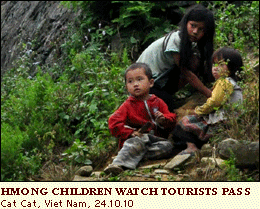
Unfortunately, although the village of Cat Cat was very cute, and the surrounding scenery once again fantastic, it seemed to Yuliya and I that the whole place had 
been turned into a kind of living museum exhibition. The people of Cat Cat were living what I'm sure more or less amounts to a traditional Hmong lifestyle, but all of it appeared to be done a little self-consciously, in the presence of an unending trickle of tourists wandering through their village and going "Ooooh" at the general Hmonginess of it all.

Actually, the general status of the Hmong around Sa Pa raised interesting questions about the meeting of 'traditional' and 'modern' (which is to say wealthy and industralised) cultures. As I mentioned, Sa Pa is a tourist town full of hotels, restaurants, souvenir shops and the usual palaver. Hmong women hike up to the town every single day in full traditional costume, babies on their backs and daughters alongside. They stride up the slopes, long strands of hemp fibre wound around their wrists, weaving the strands together as they go*** and looking for foreigners to sell stuff to. You get the feeling that a significant % of the female population spends their whole day like this, wandering the hills and speaking English to foreigners.

The daughters of these women, meanwhile, grow up surrounded by travellers from all over the world – hearing their stories and their foreign perspectives on life, picking up the slang expressions they use, and getting used to living in 'international company' from a very young age.

Seems to me there are at least two ways to look at all this (and probably some more I haven't thought of). First you could ask whether, and to what extent, such extensive contact with the external world risks corroding the culture of these previously isolated hill folk. Or you could view it from the opposite end and ask: does the need  
to 'Hmong it up' for the tourists, with all the trad clothing and weaving and rice-harvesting and so forth, keep them stuck in a kind of developmental tar pit, in which they can't move their lifestlye forward because it would take away the 'primitivity' which is now their major source of income?

I s'pose the answer depends on how shrewd, tough and determined the Hmong people really are. In my brief encounters with them, they seemed to have all these qualities in spades ... but I guess we'll see what happens.

Btw, just like with the flaming alcoholic runners, there's an added twist here too. Notice that everything I said just now was about Hmong women and their daughters, not men or boys or all of the above. That's because the male folk have no part at all in this interaction with foreigners. Outside the villages, I saw maybe two in two days. They stay at home, presumably tending the rice terraces, feeding the buffalo and what-have-you. So, I mean, where does that leave Hmong culture? Don't you find that kinda weird ... that one gender spends all its time with foreigners, and the other has no outside contact at all? I just can't quite imagine the effect (if any) this would have on family life ... but in any case, I'm intrigued.

One last random and intriguing thing about the Hmong, to which I've alluded a couple of times but haven't really explained: they make almost all of their clothes from hemp, which they get from the marijuana plants that grow in and around their villages.

Our guide in Cat Cat invited me to pick a leaf from one of these plants and check that it was 'the real thing' (though I'm not sure how I was supposed to do that, not being terribly wise in the Ways of The Ganja). I asked "Do people here use marijuana for purposes other than making clothes?", and the guide said "No, because they know that if they get caught, the government will take the plants away, and then they won't be able to make their clothes".

So there you go ... if my guide is to be believed, it implies both an Indo-Chinese govt showing tolerance towards the cultivation of 'drugs', and a people who live surrounded by marijuana leaves and yet never chop them up, roll them up and smoke them.

Once again, I mention this for no particular reason apart from that it's yet another example of the "Hey, weird ol' wide ol' world we live in" thing that I was talking about before.

Ok, time to end this rather long ramble and get some sleep. Next up: Angkor Wat.

("Angkor what?")
("Yes, wat.")
("What?")
("Mm-hmm, that's right.")
("Huh?")
("Wat.")
("Yeah, that's what I'm asking. What?")
("It's, y'know, part of the name.")
("What name?")
("I've already ... oh, forget it. This is turning into the George W Bush / President Hu joke.")

Bye!


* Btw, in case anyone's remotely interested, classifiers are extra words that precede nouns in some languages, providing information about what kind of thing the noun is. To get an idea, imagine if you had to precede the word "umbrella" with the phrase "long, pointy, stick-like thing" in English ... but also imagine that we had a single word which meant "long, pointy stick-like thing". If the word was, say, "smurg", you'd say "Dammit, I left my smurg umbrella on the bus again!", to indicate that the thing you left on the bus was pointy and stick-like. These terms don't fit into any of the 'word classes' (noun, adverb etc.) that we discuss in relation to European languages, so they're fun in the sense of being totally alien. Least I think so )))

** Of the others, three (Finnish, Estonian and Hungarian) belong to the fascinating Finno-Ugric family, and there are also a few mysterious ‘isolates’ like Euskara, spoken in the Basque provinces. If you have a taste for weird exotic theories and academic mysteries, check this one out. It has baffled linguists for decades, and the more ‘respectable’, and some wild theories have been proposed. My favourite: that Euskara is a cousin of the Ainu language, spoken by the minority indigeous population on Hokkaido, the northernmost island of Japan. Seems unlikely, but if a connection between the two were ever definitively established, it could challenge some of our ideas about humankind’s early global migrations, and thus about the genetic links between European and Asian people. I love fringe theories like this… which, y’know, probably just proves that I should get out more ;-)

*** Film about the US/Vietnam war, but completely different to all the others I've seen (and the only one worth watching i.m.h.o.). An extremely atmospheric, surreal, drug-laced and disturbing film that nearly sent its creators insane. (I'm not kidding.)

**** (to make the thick hemp thread from which most Hmong clothing is woven)


Friday, 22 October 2010

ca phé


Here's a question that's bound to spark some disagreement: who, in your opinion, makes 'the best coffee in the world'?

Had I been asked that question, say, three months ago, I probably would've said "The Italians" – but only because this somehow seems like the logical answer, until you start giving it some thought. I mean, I've definitely been served some great coffee by Italians ... but then, if I think about it, I've been served some great coffee by New Zealanders, too. And Brazilians. And Egyptians. And Americans, Swiss, Australians, Slovaks ... and even, if you can believe it, by Ukrainians. (Never by Russians, though ;-) So I really wouldn't have had a well-considered answer to the question posed.

I do now, though. Can I tell you?

Great :-)

The best coffee in the world is made by ...


*ahem*

... are you ready for this? 

You're sure?

Ok.

You're sure you're sure?

Alrighty then. Scroll down.


the best coffee in the world is made by ...


ummmmmm ...


ridiculous though it may seem ...


The Vietnamese.

Now, if at this point you're thinking "Right ... well, clearly Anthony has finally flipped his lid"*, I'll understand completely. But give me a few minutes to explain before you consign me to the Casa de Batas Blancas. I mean, I know coffee is a subject close to many people's hearts, and almost anything I say about it is gonna be highly subjective and hotly disputed ... but fortunately, I'm not averse to the occasional bout of hot disputation with the subjectively high :-) So let me tell you how to make coffee VN-style ...

First, the obvious thing: you need the coffee. It's coarsely ground, it looks a bit like tea leaves when they're wet, and it's evil. (I mean evil in a good way – strong coffee being, of course, the only known substance apart from vodka which can resolve the age-old struggle between Good and Evil by making them one and the same thing).

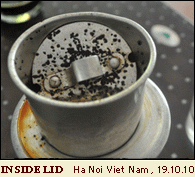
Second, take a Vietnamese coffee filter. Spoon in about 30ml of the coffee, and push down the inside lid to pack the grounds. (The inner lid has tiny holes, like a tea strainer.)

Next, pour a little condensed milk into a coffee cup or a whisky glass. It should cover the bottom of the cup/glass, but not much more.

Put the filter on top of the cup or glass, and pour in a tiny amount of water – just enough to soak the coffee grounds.

After a few seconds, add as much boiling water to the filter as you think you'll need in the final brew, and put the top on.

For the next 10 minutes or so, find something else to do while the water slowly filters through the coffee and into the cup/glass below. (I find that writing ridiculous blog entries on scraps of paper is a good way to fill in this time – though you have to be careful that your words aren't obscured by coffee stains, 'cause most tables at Vietnamese cafes aren't fabulously clean.)


When gravity has done its divine work and all your water has drained into the cup or glass, remove the filter. You'll see a thick, viscous** black liquid – about as thick as Turkish coffee, but without the sediment. Stir it a little, scraping your teaspoon firmly across the bottom to mix in the condensed milk.

And here's the point where you do the unexpected thing which will surprise your house guest/customer/mortal enemy if he or she hasn't experienced a VN coffee hit before.

Take a tall glass filled with three large ice cubes (it's always three for some reason), and tip it upside down to strain off the excess water, using a long-handled teaspoon to stop the ice from falling out of the glass. Then pick up your coffee cup or whisky glass, empty its contents into the tall glass, and put it aside. You won't be needing it anymore.

Btw, one thing I love about this process is that, by the time you've reached the drinking stage, your little cafe table has become cluttered with apparatus. You've got your coffee cup, your filter, your glass of weak tea or water (which always comes with coffee), your teaspoons and your tall glass, plus one or two other optional things. It's almost reminiscent of a traditional absinthe-drinking session***.

Anyway, now you're ready to sample the exotic eastern brew. Use your long-handled teaspoon to stir the coffee, condensed milk and ice together, then pick up the tall glass and take a sip.

Say to yourself:
"Ohmigod ... that's incredibly strong and incredibly good!".

Repeat at regular intervals until the glass is empty.

If you're in a cafe, at this point you'll float effortlessly to the counter, open your wallet, and take out approximately 15,000 Vietnamese Dong (about 75 cents). Make sure to hold your arm at a downward angle when you do this – you'll be pretty close to the ceiling by now, and it's impolite to make the counter staff climb up a step-ladder just so that they can reach your money.

Finally, go about your day with renewed energy, as the caffeine gradually infiltrates your blood stream and alters your body chemistry more than you thought possible from a single cup of coffee. And be sure to return the next day for your follow-up hit ... 'cause life is just too damn short to be worried about the health risks of such a wonderful substance ;-)

I swear it's the most fabulous caffeine-hit I've ever had. Almost worth a visit to this less-than-fabulous city ...

Bye!


* "to flip your lid" = to go crazy (for those readers who speak English as a second language, and haven't seen this expression before :-)

**I had to use that adjective in The Manor at some point ... if only for the amusement of Mr. Spannagle, whom I know is as fond of the word "viscous" as I am.

*** I'm no expert on this, but I remember there are a lot of stages, each involving some form of equipment ... like there's one stage where you pour the absinthe into an unusual metal strainer with a sugar cube inside it, letting the alcohol drain through the sugar. It's a slow, ritualistic process which, for me, suggests that you're somehow re-creating the mood of an earlier period in history, when absinthe was enjoyed by poets and artists in European coffee houses. So I'm a fan of that kind of 'ritual preparation'.


Friday, 24 September 2010

socialist republic of scooterville


The display on my mobile shows 6:15am, and the city is buzzing. At least half of the shops have already opened, people are congregating on the cluttered pavements for breakfast, and food vendors are laying out tiny plastic chairs – no more than about 30cm high – for their customers. Not far away, foul-smelling three-wheeled garbage carts lurk in grey herds, waiting sullenly for their chance to devour whatever falls from the breakfast table.

At one edge of the throng are small groups of men, also lurking. Depending on when and where you are, they either stand expectantly waiting to spring into action, or lean back casually on their motorbikes, nursing cigarettes in their hands and calling "Hello! Xe om?" or "Moto?"* to passers-by. If you show interest,
they helpfully produce a spare helmet, which is usually just about strong enough to protect your head from a stiff breeze.

Picking your way through the chaos, you pass enormous chickens standing terrified in their bell-shaped cages, hoping not to be on today's menu, while fish, shrimps and yabbies swim in filthy plastic buckets. Dogs and cats stand tied up outside shops (or sometimes caged inside), and occasionally a rat can be seen dashing bravely through the field of engagement, from one piece of cover to the next.

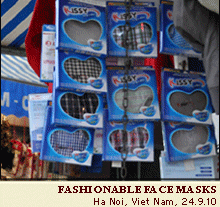
The traffic, meanwhile, has yet to hit its horrible peak, but already it's thickening like blood in an unhealthy artery. Even at this early hour, a foreigner could be forgiven for doubting that so many motor-scooters actually exist on Earth, and suspecting that there are just 10,000 or so going around the same block on some kind of endless loop. The fumes are intense, and you're starting to understand why so many people opt for those ridiculous face masks – which, btw, are available here in an extensive range of colours, patterns, novelty shapes and Hello Kitty prints.

For all of this mad activity, though, the city has yet to officially begin its day.

As six-thirty rolls around, something new pierces the airwaves**. Beatific music is blasted from lo-fi loudspeakers around the city, carried on cushions of polluted air to the ears of every citizen. And then a voice begins talking: urgent, shrill, and incredibly annoying. If you live near one of these loudspeakers, this morning announcement will finish what the lack of oxygen started, giving you a headache that could last you till the evening. It continues for about 15 minutes, then dies away and allows the army of scooters to once again take pole position in the race to corrode your eardrums.

And so ... welcome to another day in Ha Noi, glorious capital of the glorious Socialist Republic of Viet Nam.

*cough, wheeze, splutter*

But why (you might just conceivably be thinking) am I telling you about early morning street life in Ha Noi? Well, the reason's pretty simple: Yuliya and I now live here.

We arrived in Viet Nam on September 10th and signed nine-month contracts with our school, which of course means that they end next June. Thing is, though, after two weeks of life in the city we're already having serious doubts. We seem to spend a lot of our time trying to convince ourselves that we don't, y'know, utterly loathe and despise the place ... and so far we're not making much headway.

To be fair, our Ha Noi experience hasn't been completely without adventure, and the city isn't entirely lacking in atmospheric spots. For the first few nights, we stayed in a hotel hidden in a maze of alleyways, which was fun to explore. The first day also saw Yuliya getting acquainted with chopsticks, as we ate in local restaurants, ordering from menus we didn't understand and hoping we'd get something edible that was neither frog, dog nor pigeon. That was kind of an adventure in itself.

(Incidentally, as with every new thing she tries, my mad genius of a wife picked up the chopstick technique almost immediately. Jealous!)

I'd also have to say that the colours of the city are pretty amazing. You don't really notice how vivid they are until you review some of your own photos and think "Wow, look at those reds, yellows and greens!" After that, you start appreciating the intense tonal contrasts.

In general, though, our first few days in Scooterville saw us inundated with relentless, deafening noise, drenched in sweat (the temp was about +30, but the humidity was just incredible), repulsed by the never-ending bad smells – especially those which emanate from the city's stomach-churningly putrid waterways – and wondering what the Hell we were doing here.

On our first weekend we decided to get out of the city, which gave us a break from the noise, but in every other way it just confirmed the ickiness. We went to Tam Coc: a place about two hours from Ha Noi, where you cycle through villages and countryside to a town beside a river, then row down the river, which goes underneath several mountains. The scenery there was rather beautiful (and quiet!), but again, the villages were ugly, with construction materials lying everywhere and reservoirs of stagnant water that stank so badly it made me want to bring up breakfast. And the weather was appalling. I lost a few litres of liquid just on the bike ride (which was only about 6km ... i.e. no distance at all, compared to my recent 'cycling days' in Finland).

Still, at least we got to see foot-rowing, a skill that I was previously unaware of. Oh ... and inside a Buddhist shrine in a place called Ho Lua, we found out what Vietnamese people consider to be a suitable offering to the Gods. Not sure that, if I were a divine presence, I'd be so thrilled to receive half-a-dozen cans of coca cola. Then again ... maybe along with the vodka, it would help pass some time in the Otherworld ;-)

Back to Ha Noi for the second week, and it was more of the same: noise, smells, problems with food. We'd initially enjoyed the Asiatic flavours in some of Ha Noi's cafes and restaurants, but as we stayed longer, we noticed restaurant staff doing some really dodgy things, like sticking their hands into the middle of a dish to 'fluff it up', and handling food with filthy fingernails. Perhaps the worst thing we discovered, though, was the tendency of restaurants here to 're-use' food. This means that, for example, if you don't finish your soup, they'll take the leftover portion into their kitchen and pour it back into the pot. Result: the next customer gets part of your soup.

I'm fairly sure this happened to me once in a beer hall restaurant near our hotel. The waitress recommended chicken soup to me, then a few moments later went to clear a big table where several people had been eating what she'd recommended. A few minutes after that, my bowl of chicken soup appeared, looking unaturally thick and ... I don't know, somehow just 'wrong'. I ate it anyway, 'cause I figured it was just 'Vietnamese-style'. Then afterwards Yuliya and I put two and two together, and came up with "Euuuwww!!!".

Later we asked a couple of people about this, and they said "Yeah, you have to be careful about re-used food here". Great.

So that compromised one of the few things we were enjoying about the city up to that point. Which left ... er, our boss (who's awesome), the friendliness of Vietnamese people (who are incredibly smiley and keen to say "hello" – though their friendliness does seem quite insincere at times), and ... well, the coffee. The coffee here is beyond all expectations. I'm gonna tell you about it in a separate entry, 'cause it deserves a page of its own on The Manor.

Oh, and about those public announcements I mentioned earlier: I asked around to find out more information, 'cause they struck me as probably being a 'socialist relic', and I admit to becoming a bit fascinated (while simultaneously annoyed) by them. Far as I've worked out, the loudspeaker systems mostly date from a time when lots of Hanoians didn't have their own TV or radio at home – so I guess they were a kind of 'public service' (with an ulterior motive, of course). On the other hand, I've also heard that more have been installed during 2010, to prepare for Ha Noi's 1,000-year anniversary celebrations.

Yay   >:-[

Accounts vary as to what kind of information comes from the speakers. Back in the day they were definitely a party tool, spouting communist rhetoric and so on. I also read somewhere (don't know if it's true) that they were used for 'shaming' purposes; i.e. lists of people who hadn't paid bills were read out over the air, so that the whole city could hear about Citizen Trang's unpatriotic failure to pay for his electricity.

In recent years the flavour of the announcements has beсome more 'news of the day', with a light dusting of propaganda (stories about good things the government have done for its population recently and so on). In the lead-up to the 1,000th anniversary, morning announcements have also included some stories from Viet Nam's history, to stir up some national pride among the volk. That's also the idea of the music I mentioned before – it's mostly comprised of patriotic hymns.

On a more ordinary day, you can even hear the price of fish, rice and eggs blasted at 100s of decibels across the city. Though of course, if you happen to be one of those unlucky people with a speaker placed right outside your flat, you might not be quite as keen to know that rice is cheaper this month than last month as you are, say, to protect yourself from permanent hearing damage, or to have the option of sleeping in occasionally!

So anyway, that was our first two weeks in the city which (thanks to my boss) I've come to think of and refer to as "Scooterville".


Of course, we know that Viet Nam is under no obligation not to be crappy, and you could even argue that it has a kind of 'special dispensation'. I mean, it was only 40 years ago that the whole country was virtually annihilated, when the US put Operation Destroy an Entire Nation For No Good Reason And Fail Disastrously into effect. They dropped more bombs here than were dropped in the whole of WWII (by everyone, not just by the Americans), and the chemical constituents of some of those explosives were absolutely ruinous from an agricultural point of view. So the fact that the country still exists at all is a frikkin' miracle. In that sense, it isn't Viet Nam's fault that it's kind of an unpleasant place to live, and we're trying to keep that in mind.


It also has to be said that not every foreigner who comes here feels the way we do about it. We've met a couple of people who absolutely love Ha Noi and wouldn't be anywhere else, and others who say it was "difficult at first" but they "got used to it", and now "quite like it".

As to whether we'll stay ... well, of course we're gonna give it some more time. Two weeks is not enough to judge how you feel about a city. That said, I have a sneaking feeling that we won't be seeing out our contracts.

More about this soon, no doubt.  

Bye!  
 

* Xe-om / Moto = motorbike taxi

(** I wanted to say "fills the airwaves" ... but they were already full.)