Showing posts with label 2011 Kazakhstan. Show all posts

Sunday, 30 October 2011

first and final moments #2

V drugom aeroporte, Astana KZ, circa 1pm (GMT +6)

You know what I want? I want to go through that security gate. Like, really, really want to. Security won’t let me, ‘cause my flight doesn’t board for another four hours. But on this side of the gate the shops only accept Kazakh tenge, and I’ve already exchanged all of mine for dollars, and I really want lunch!

You know what else I want? I want a razetka (an electrical socket ... but razetka sounds much better). Really, really want one.

I’m just a bundle of wants right now.

Anyone the tiniest bit familiar with Buddhism, Shamanism or any other want-abhorring philosophy would be ashamed of me, and I’d be duly lectured. And I probably deserve to be. Still …

Let me through, you bastards!!!

Part 2 of my ‘day of airports’ takes place in Astana, KZ’s gleaming capital-on-the-steppe, where I’m doomed to wait for five hours for my connecting flight to Frankfurt.

A brief wander outside confirms something that I already know about this city: it’s one of the coldest corners of civilisation! Last time I was here was back in February, when I came to do some seminar presentations for teachers using Oxford University Press course books in their high schools. On the first morning, we awoke early to discover that a blizzard was in progress outside our hotel – and when I say “blizzard”, I’m not exaggerating for effect.
It was -20C, and great flurries of snow were zipping about in all directions, some heading downwards toward the Earth (as you’d normally expect snow to do) while others soared wildly upward and away from it.

I asked if the seminar was going ahead, naïvely thinking that a blizzard might call a halt to plans. But this is Astana, and hence nothing out-of-the-ordinary. These are the kind of atmospheric conditions in which the daily business of life is carried out here as per usual. The seminar went ahead, and it was great … but on at least two occasions, I was amused and bemused to overhear people chatting during coffee breaks about the mercifully ‘Nye kholodnaya pagoda’ (“not-cold weather”) they’d been having so far that winter.

Hmmm. I guess everything really is relative.

That visit was also my first opportunity to see the recently completed, Norman Foster-designed Khan Shatyr. This is basically a shopping centre located about a kilometre beyond the far end of Astana’s main boulevard – so no big deal, you might reasonably think – but I’m betting that most people reading this have never seen a shopping centre of quite this kind.
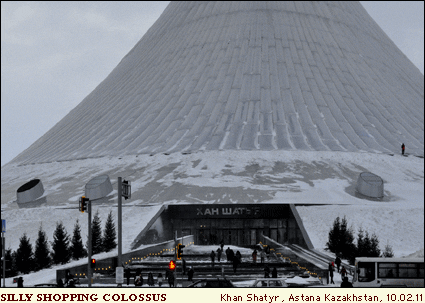
Modelled after a ‘royal yurt’ typical of those used by the Khans, shatyr’s exterior combines the sterile futurism of post-2001 spaceship design with the somewhat comical form of a partly-erected circus tent, its central supporting pole leaning heavily to one side. It squats on the steppe like a stubborn mirage, determined to make you believe that it's real despite your brain’s insistence that nothing so preposterous could actually be loitering out here in a place like this.

Inside you’ve got three floors of predictably overpriced boutiques, some game arcades and similar amusements … and then you’ve got the upper floors, where thankfully things get a little less run-of-the-mill. The highlight is a beach about 50m long, hermetically sealed and temperature controlled, with real beachfront sand trucked in from Turkey (if I remember correctly) and palm trees from somewhere that has lots of spare palm trees. If you qualify for V.I.P. status, you can buy a membership card which entitles you to do the following:

- hurry indoors out of the frigid cold, in your super jacket
  and your big woolly hat that ties at the chin
- take a lift up four floors
- strip off to your underwear 
- relax among the trees or simply luxuriate on the sand,
  in partial view of shoppers
- take a dip whenever you like
- repeat steps 4-5

The premiere weirdness here: Khan Shatyr’s inward-sloping walls are all glass, so as you sip your tropical cocktail and adjust your speedos, you can survey the ice- and snow-covered expanses of the Central Asian steppe.

Of course, not being vippy* enough, I didn’t go to the indoor beach. I did, however, let two minimum-wagers strap me into a chair, send me up to the roof of Khan Shatyr, then drop me like a stone through five storeys. I’m sure many of you have seen a ride at fairgrounds (if you can even call it a ride) which is basically a tall metal pole with hydraulics inside and chairs attached. The chairs are lifted slowly up to the top of the pole, and then the hydraulics are released and anyone foolish enough to be in one of the chairs comes free-falling back to Earth. It’s pointless and terrifying, and I had to do it.

In fact, I was voluntarily sent into freefall seven times inside a Temple of Retail shaped to resemble a giant tent, in the absolute centre of nowhere … which frankly, looking back, makes me wonder whether I’m really playing with a full set of marbles. Feel free to join me in doubting this if you’d like to )))

With that little adventure over, it was back to the absurdly opulent hotel (previously some kind of theatre, now a virtually deserted fiesta of lavish carpentry, statuary and plasterwork) to enjoy sweet tea and lemon while the weather continued violently arguing with itself outside.

So yeah, that’s Astana: an architectural fun park, largely unknown to the world, where the most whimsical demons of Lord Foster’s imagination are allowed to physically manifest. (Foster has collaborated with President Nursultan Nazarbayev on several architectural behemoths, all of which seemingly bear witness to Pressie N’s wish to be remembered as a kind of ‘New Sun King’ of the East.) It manages to be both fascinating and abhorrent, admirably bold and mildly obscene** at the same time. But still, it’s definitely nowhere as difficult to leave as Almaty is.

See, in addition to being home to quite a few of my favourite humans, Almaty has the undeniably impressive Zailiskiy Alatau mountain range towering over it like a chain of huge mountains over a medium-sized city.*** They’re unbelievably tall, wild-looking, fearsome rock massifs that are terrifying to walk on at night, and require a serious commitment to climb at any time of day, in any weather, at any time of year. Or, if you prefer your descriptive prose short and sharp, they’re freakin’ big, freakin’ tough and freakin’ goddam cool.

My personal favourite thing about the Zailiskiy Alatau is their noticeable mood swings. A little over three years ago, I moved into a top-floor flat on Zharokova street, from which I had a frankly stunning panoramic mountain view, and this is when I got acquainted with the many moods of the Zailiskiy. They could be bright, cheery and cogent one morning, sketchy and vague the next, and then turn positively dark and Mordory the morning after that.

What all of this means, in relation to the present entry, is twofold: first, the Zailiskiy Alatau have always contributed to my feeling that Almaty is “a great city to come back to”. (I stuck that in quote marks because I’ve said it so often.) Every time I return there, whether from another country or another part of KZ, the mountains give me a fresh thrill on my way into town. And secondly, they make leaving Almaty a somewhat fretful experience. As you look over your shoulder at the receding peaks, you think “What the heck am I doing, travelling away from those ridiculously cool things, instead of towards them?” And then “If only I'd spent more of my weekends up there in the Zailiskiy”. And so on.

On this particular morning – my last in Almaty – the mountains were in stunning form. There was a low cover of cloud blanketing the city, so they were invisible at street level, but in the air you could see them soaring majestically  skyward, their sunny sides a brilliant white and their shaded sides a deep, mystic blue. From where I was looking, they actually seemed to be sitting on top of the cloud bank, slowly floating across the sky in a way that somehow reminded me of a Terry Gilliam animation. And I thought what I usually think: "Well, bye guys. Prob'ly see you before too long."

And then we were over the horizon, and I was heading in the general direction of a funny, lop-sided circus tent with a thermally heated beach inside.

Funny old thing, life.


* A word I made up specially for this occasion – it’s an adjective, and it means “possessing the qualities of a V.I.P.”.

** (Because these building projects have cost SO many billions of dollars, which could have been used to improve conditions in other parts of the country.)

*** This is a new literary device I’ve invented called “zero simile”. It’s easy to master: just describe something performing an action, and say that it performs the action “like xxxxx”, where “xxxx” is the thing itself. (Example; “The Desert Sun, which had been punishing us so mercilessly since early morning, finally disappeared in the West like a fierce red celestial orb dipping below the horizon of a vast sandy plain”.) I think this is definitely gonna catch on … don’t you?

first and final moments #1

V Aeroporte, Almaty Kazakhstan, circa 9am (GMT +6)

So, this is it. One chapter ends, another begins. One door slams shut, another yawns open. One discoloured, exhausted-looking lemon slice gets a lift back to the bar at the bottom of an empty martini glass, another arrives floating gaily atop the next round of delicious vermouthy fun*.

Or, y’know, something like that.

In case you’re wondering what has motivated this sudden outburst of “best of times, worst of times, times when really opposite things were happening”** metaphors, they've been occasioned by my arrival at Almaty International Airport this morning. And as always, it’s an incalculable pleasure to be here.

*a-khe a-khem!*

(That's the official transliteration for "sarcastic clearing of the throat", recognised by international treaty.)

Ahhh, the airport … where so many great journeys begin, so many plans reach fruition, and so many life decisions transform from abstract thought into concrete action – and all this against an aesthetic backdrop that makes the average hospital waiting room appear thoughtfully decorated and charmingly rustic by comparison. A huge, over-lit building filled with parting loved ones ready to cry, taxi drivers ready to mercilessly rip you off, and dreadful, pre-wrapped food ready to unfairly diminish your roll of recently-exchanged currency, and leave you with a vague feeling of disappointment. What a place.

Sorry. Enough of the endless, aimless blah – it’s getting-to-the-point time. I’m here today because I’m leaving Kazakhstan to go and live elsewhere … and for the third time, no less! This time, though, it seems pretty final. And as with the previous two departures, if I could sum up the feeling of the event in one word, the word would be “conflicted”.

On the one hand, my wife left KZ some time ago, and is waiting for me with ‘Timurchik’ (our yet-to-be-born son, coming soon to an operating theatre near you) in a warm cosy flat in Ukraine. So obviously that’s a sizeable incentive to get on my figurative bike and leave this great ‘stan in the metaphorical dust. Also, between now and the point in time when I see them both, I’ll be taking the ‘long road home’ – visiting some unvisited bits of Eastern Europe, calling on a couple of old friends, and generally indulging my appetite for being on the road, which has been eating away at me all year. So while this morning brings the final moments of one adventure, it also ushers in the first moments of another. Which is both fun for me, and a nice link to my hastily-thought-up title for this series of entries ;-)

Moving now to the contents of the other hand: on that hand, there’s Almaty. It's the only city in this hemisphere where I have more than one or two good friends, and it has effectively become my ‘home’. For all their faults (mostly driving-related), I love the local people here, and they’ve graciously returned the sentiment over the last few years. And I also love quite a few of the foreigners who end up on Kazakhstan’s south-eastern border. For some reason, Almaty attracts a rather interesting crowd, and I regularly meet ‘new’ people who I like / get along with / have stuff in common with.

(I mean, I guess you have to be somewhat interesting and/or unusual to think “I know what I’ll do: I’ll leave my safe, comfortable life in Britain, Europe, the US, Canada or wherever, and go to Kazakhstan. Yeah, that seems like a logical step.”)

So this week has been a ‘typical last week’: a million things to do in an impossibly short time-frame, from visiting consulates to get visas for the next place to posting things you can’t carry with you, through to farewells and work handovers and a hundred taxi rides to fulfil a hundred errands.

This, btw, is exactly when I'm most susceptible to the odd charms of Almaty: when I move around the city, enjoying the fabulously mismatched clutter of its architecture, and being chauffeured by outgoing, friendly, quirky and occasionally insane folks who drive as though they were just one in a vast herd of wildebeest, thrusting boldly forward and trusting their horns to prevent them from being crushed in the general melee.

I realise it’s perverse, but I just can’t help being tickled when I climb into the passenger seat of a rusty old Mercedes, and an elderly moustachioed gentleman bellows at me “Tebye ne kholodno?” (“Aren’t you cold?”), then pulls a traditional Kazakh hat out of his glovebox and rams it onto my head before I have time to answer.

He adds to the general amusement by laughing raucously at how ridiculous I look in his little round hat, throwing his head back as he does so – and all without taking his foot off the accelerator! I mean, whatever else happens on that day, you’ll never be able to mark it down in the diary as “Dyen kak dyen” (“a day like a day” – meaning one like any other, without anything special to distinguish it).

... right?

The unusual character of the last week can be largely attributed to what I'll call the ‘ryhthm of leaving'. I've experienced it before, and it goes sth like this: you run to the street carrying odd collections of things, you ride in taxis, you leave stuff and collect stuff and sign stuff, you run madly back, teach a lesson, run somewhere else, sign another thing, run back … then stop to drink champagne and listen to moving farewell toasts from people you’ve grown quite close to … then run again, jump in another taxi … and so the cycle repeats.

The thing is, this leaving rhythm is quite exciting in its own way, but it can also be rather sad and depressing. Obviously there's the "saying goodbye to good, valued people" issue, but there's also this: I know from experience that the level of acceptance I have among people in KZ isn't available just anywhere. You need to find a culture that’s a reasonable fit for you, so that you give out the “Hey, I dig this place” vibe and so that, as a result, people fully accept and embrace you. It’s an uncertain process, and it takes time, and it doesn’t happen that often. Hence the sad.

Meanwhile, the city has unexpectedly pulled out its first fresh and glistening snow-coat for the year, seeing me off in style but also cruelly implying that I’m missing another opportunity to plunge into a hardcore Kazakh winter, which I would love to do.

Evil little city!

Anyhow, the second boarding call has just sounded (the first always being my signal to run to the smoking room and breathe in a final dose of precious, sanity-enhancing nicotine before entrusting my life to a complete stranger who wears a silly hat to work every day). So I’ll continue these ramblings in a few hours, when I land in Astana.

Right now, it’s time to say another farewell – this time to some mountains …

Bye )))


* Unfeasible though it may sound, I only recently discovered martinis. Had my first one maybe three or four months ago … and gosh, was it great or what?


** A quote from an entry in the Edward Bulwer-Lytton Awards for "writing the introduction to the worst of all possible novels". It’s a contest that happens every year somewhere in San Jose, California. Cool idea, no?

Tuesday, 9 August 2011

land of ghosts, sea of dreams


Rounding a bend on the highway about 15km out of Aktau, we pass a white Volga* saloon standing on the roadside. It’s abandoned, it’s facing the wrong way, and its front section is horrifically squashed up into its cabin, like the nose of a pug dog. This is clearly a warning to those who might be tempted to risk a similar fate by driving recklessly on Kazakhstan’s bumpy, pock-marked highways (which is just about every person in the country who owns and operates a car or any other vehicle).

But why here? I mean, why this particular bend, as opposed to any other?

The answer lies written on a gravestone that stands about 20 metres from the edge of the road, directly behind the Volga. Our driver tells us that the grave belongs to a man who died here some time ago in a car accident, and whose ghost has since been making deadly mischief in this spot. He regularly stalks the highway, “throwing people from the road” (direct translation), and his sinister presence has made this corner the premiere ‘accident hot spot’ in these parts. Numerous cars, trucks and the occasional minibus have met their end here, often with fatal results for the occupants.

A real piece of luck, then, that our driver knows the ‘special words' (something like prayers or magical incantations) that will keep the ghost happy, persuading him to spare our lives. Under his breath, the driver has already uttered these words, so we’re safe … for now at least.

A couple of hours later we’re standing at the crest of a low hill, looking down a valley at what appears to be a set from a Sergio Leone film … or possibly (for those of you who are afficionados of Clint Eastwood westerns) the town in High Plains Drifter. This is Fort Shevchenko, a dusty outpost at the far western reaches of Central Asia, where the vast yellow expanse of desert which covers half of this region meets the brilliant blue of the Caspian Sea.

And right there, at the risk of boring you to tears, I have to stop and insert a long and winding tangent. I just can’t let the words “Caspian Sea” go by without comment.

See, when I was in the 11th grade at school (they called it ‘5th form’ in Australia), my Modern History teacher Brother Sean introduced me and about 30 classmates to the concept of revolution – specifically, to the Bolshevik Revolution of 1917 and the events leading up to and following it. I honestly don’t remember ever having been so fascinated by anything I'd encountered in a classroom, and the fascination has never really left me. Luckily though, that's a whole other story, and not the subject of this particular tangent )))

At some point while talking about Bolsheviks and Mensheviks and serfs and Tsars, I clearly remember Brother Sean producing a map of western Russia and adjacent territories, on which appeared a huge croissant-shaped body of water – a sea in the middle of a continent. This was, of course, the Caspian. I hadn’t previously suspected that such a thing could exist, growing up as I did in a country entirely surrounded by ocean. It was the precise opposite of what I considered 'normal': a sea surrounded by land. 

"How bizarre!", thought my 16-year-old brain.

To make it seem even more exotic, the shores of this freakish sea were dotted with utterly alien-sounding place names that I’d naturally never heard of. Cities with names like Astrakhan, Aqtau, Makhachqala and the like simply don’t figure much on the mind of your average 16-year-old. So the whole impression was one of something completely ulterior to my world, and somewhat fantastical. I even remember the Caspian cropping up in a dream I had (though what the dream was about, I have no idea now).

Bearing all of that in mind, you can imagine that not long ago, when I realised there was a chance I might actually go to the Caspian Sea, I was just a little bit amazed. It was, as one of my favourite colleagues here put it, a "sea of dreams" from my adolescence.

My first direct sighting of the Caspian was in Aktau, a settlement established in the 1960s. In a uniquely Soviet amalgam, Aktau was developed both as a uranium mining town and an elite resort destination. Nowadays it’s neither of those things; rather it presents as a mish-mash of depressing housing blocks and soulless new development, ringed by an industrial wasteland that is the cadaver of the mining industry.

In the city centre, boulevards that lead down to the seashore look broken and dishevelled; even the MiG fighter monument at the head of one street looks as if it might suddenly wilt and fall off its perch like a dying parrot. And this ugly infrastructure continues right to the water's edge ... so, y'know, it wasn't exactly how I'd imagined the first meeting between me and the big wet croissant from high school history classes. But hey ... reality does that sometimes.

The one small saving grace of Aktau** is the system of street names here. They, um, have none. I mean literally no names at all. To give your address to a taxi company in Aktau, you say "5-24-36" (that's microdistrict/street/building number), and they go "ok", as though that were a perfectly normal thing to say to a taxi company. It adds a kind of appealing spookiness to this otherwise unpleasant place.

In truth, though, the crappiness of Aktau hardly mattered. We were in the Caspian basin for unrelated reasons: one, because I wanted to pursue my ridiculous mission to visit Fort Shevchenko (for which I had no justification at all … I’d just somehow got it into my head that I had to go there); and two, to see the remote desert region of Mangyshlak (Mangistau in Russian), an area of stark natural beauty which has recently shown up on the radars of archaeologists as a place to go digging for the ruins of undiscovered ancient civilisations.

And so there we were, on the first of these missions, standing next to a gigantic colonnade stuck incongruously in the middle of nowhere, with the name "Fort Shevchenko" written on it in Cyrillic letters. A few stray horses ambled by as we looked down at this town which no-one else I know had ever been anywhere near. I was excited – this was really going to be something!

Btw, I know some of you have heard the name Shevchenko before, and yes, the guy you’re thinking of is the same guy after whom this town is named.

For everyone else: Taras Shevchenko is considered the national poet of Ukraine. He was also an accomplished painter of Ukrainian landscapes, a composer of Ukrainian folk songs and, according to some sources, a progenitor of the modern Ukrainian language. So we're talking about a real 'favourite son of a nation' here. His face even features on the Ukrainian 100 hryvnia note.

At some point, though, Shevchenko annoyed Tsar Nicholas I with his dreams of a pan-Slavic uprising and the emancipation of serfs, so he was exiled. He ended up at a tiny military fort called Orsk (it wasn’t even a town then), situated on the western edge of what would later become known as Kazakhstan, seemingly because it was the remotest place that his exilers could think of. And although he always missed Ukraine, this harsh, dusty outpost by the sea slowly became his second home.

One crucial link in this chain of events was Shevchenko’s meeting with a senior army officer who greatly admired his work. It was an amazingly fortunate coincidence. The Tsar had specified that, as a condition of his exile, Shevchenko was forbidden to write, paint or do anything else remotely artistic, but the military man decided to help him, giving him a semi-underground room where he could continue his work away from prying eyes. This became Shevchenko’s studio, and the output he produced here was prolific.

Today, the town formerly known as Orsk now bears Shevchenko's name, and you can visit his studio – a small, low-ceilinged room at the bottom of a stone stairway, reminiscent of a a burial chamber more than anything else. Next door to that is a museum, where Shevchenko’s artwork is displayed.

It’s so, so weird to see this Ukrainian artist’s work, lovingly catalogued and curated not in his green European homeland, but here in the middle of a desert on a different continent. The curators have not only kept the building in tip-top condition; they've built a green shady grove around it, which (this being an arid region, to say the least) requires constant maintenance and irrigation. So you walk in through a gate, and all at once the dust and heat and glare give way to cool respite. The temperature drops noticeably as you enter, and there are workers scurrying around, tending to the upkeep of the place. It's quite a singular experience.

The thing is, though, I’m not even sure why I wanted to come here. I’ve never read Shevchenko’s poems, and knew nothing about his illustrative skills (which were rather good, I have to say). I just don’t know.

Maybe it’s because I’ve spent time in both Ukraine and KZ, and I enjoyed learning about this relatively little-known link between them. Or maybe I liked the fact that our talented but rather dark and gloomy Ukrainian hero (many of whose countryfolk tend to share these qualities) was saved by the no-nonsense, ‘can-do’ Kazakh soldier (many of whose countryfolk share his qualities).

Or maybe I’m just perverse, and therefore making a taxi driver take us to a ‘fort’ in the middle of the desert seemed like a cool idea. Yeah … it was probably that ;-)

Anyway, a little way north of town was a hotel which, from its description, seemed like the only place around which might be able to provide us with some semi-edible food. So we piled into the car and went there, passing a pink lake (!) on the way.

I asked the driver “Why is it pink?”, but he had no idea. A follow-up question – “Is that its natural colour?” – failed to draw anything more than a shrug and a three-word response: “I think so”.

There's actually a pink lake somewhere in Western Australia***, and companies like 'Crikey Tours' (such a dreadful name!) offer to take people there on buses. But out here in the furthest reaches of Central Asia, a similar natural phenomenon (if indeed it is natural) draws zero reaction from the locals and zero attention from anyone else. Odd.

A surprisingly good lunch was followed by another little excursion out of town in the car. We’d been told that there was a beach not far from the restaurant, and after the slight disappointment of the less-than-stunning Aktau beachfront, we figured that finding another view onto the sea might be a good idea. 

In fact, this little detour turned out to be a high point of our journey: a beautiful and almost deserted coastline, stretching as far as the eye could see in either direction. In the distance was a yurta, pitched on the shore. Closer to us, two local kids frolicked in the gently rolling waves, calling out and waving a friendly "Privet!" ("Hi!") to us. Other than that, we had the sea completely to ourselves.

Yuliya decided to go in for a dip, and as I sat on the shore taking in the whole "sitting-on-the-edge-of-the-Caspian" vibe, two Czech backpackers came wandering randomly out of the haze. We briefly swapped travel stories and tips, and then they went a little further along the beach, stripped off and jumped into the sea. As soon as they were out of earshot, the calm resumed and the only audible sounds were those of nature: waves lapping the shore, wind blowing the sand, and the occasional bird. 

At this point, it crossed my mind that I really had seen the Caspian now, and I had a moment of extreme, undifferentiated happiness. Those are always good )))

Next we tried to get our taxi driver to take us to a place called Beket-Ata, an underground mosque situated in a remote desert cave and inhabited by some kind of Sufi master. Some Kazakhs are known to make  pilgrimages to this place, and after Fort Shevchenko it was one of the main things on our itinerary.

Ourselves, our driver and his friend (supposedly a good source of knowledge about the region) all thought we'd be able to reach Beket-Ata by taking a desert road for a few miles and joining up with the main highway a little further southeast. We were all completely wrong.

Instead, after bouncing wildly along a track so dusty that one car half a kilometre ahead could make the way forward almost invisible, we suddenly rounded a corner and found ourselves staring at a virtual impasse. The previously flat road suddenly fell into a huge valley, degenerating into little more than a track as it did so. At the bottom lay a kind of plain, which stretched to the edge of the sea. (And all this time, we'd thought that we were heading away from the water!) In the middle of the plain stood a collection of buildings that the driver told us were mausoleums – though to be honest, they looked more like mud-brick cottages to us.

Of course we were dying to find out whether the inhabitants of this remote settlement were corporeal or spectral in nature, but the driver said his car probably wouldn't make it down to the remote village/cemetery/whatever-it-was and back. (I personally think he may have been spooked by the idea.)

With that, our journey effectively came to an end. We agreed to head back to Aktau, and make a separate round trip to Beket-Ata the following day. And so we took to the road once again, throwing up so much dust in the process that it got inside the car and tickled our throats.

That evening we quarelled with the driver over money, and after calling the friend of a friend of a friend who'd set up our meeting, the driver took the cash we offered him and drove away in a temper.

This pretty much killed off our chances of seeing anything else in western Kazakhstan without time to plan, because finding another driver seemed almost impossible, and joining organised excursions in this part of the world generally costs much more than an English teacher can afford. So the next morning, we went to the airport and left Aktau prematurely.

It was a strange and unsatisfying end to a holiday that promised to deliver a lot more. But at the same time, we certainly weren't going away empty-handed. It had definitely been a trip worth making.

By the time I got back to Almaty (a three-and-a-half-hour domestic flight – almost as long as Sydney to Perth!), I was already planning a return to western Kazakshtan. I wanted more than anything to see the mysterious underground mosque of Beket-Ata, the wind-sculpted mountains of Mangyshlak, and the weird 'Valley of Balls', which is reputed to be one of the strangest and most dramatic landscapes anywhere in Central Asia.

However, since I'm writing the closing bits of this entry with the benefit of hindsight, I can tell you that it wasn't to be.

Oh well ... maybe next year.


* Fabulous old Soviet cars ... kind of the Russian equivalent of Chevrolets.

** Apart from the fact that two excellent former colleagues, Mirian and Vasiliy, who I met in Almaty some years ago, have spent the last year living there. Our visit to Aktau therefore meant a chance to catch up with them both, which certainly made for a more pleasant stay )))

(*** Its pinkness is explained by a high presence of a salt-tolerant form of algae called Dunallela Sailina. Whether similar things apply to the pink lake near Fort Shevchenko, I've no idea.)

Saturday, 1 January 2011

conspiring elements


At approximately 11:45pm last night, something rather fabulous occurred about 1000 metres above my flat. It wasn't anything especially remarkable – in fact it's almost commonplace at this time of the year. But I’d spent days wishing for it to happen, and the Weather Gods had been rudely ignoring my requests up to that point.

Around eight-ish on NYE, I went to the supermarket to stock up on supplies, and suburban Almaty was looking about as unappealing as it ever does. The last snows, almost a whole week old, had all but disappeared. Only an ugly, brown, icy slick remained on the streets, making a stroll through the hood slightly treacherous and unpleasant.

Also, the winter cold had abated, replaced by ‘neither-tut-nor-tam’* temperatures which hovered non-committally a few degrees either side of zero. This wasn’t winter – it was just a non-descript coffee break between seasons. I was feeling somewhat deflated, cheated out of the rather hardcore chilly season that had seemed imminent a couple of weeks earlier.

Then, in the final hour of 2010, everything changed. There was a dramatic temperature drop to around -12C, bringing back the frigid intensity of the Kazakh winter. And about 15 minutes before the Big Moment, snow began falling silently from the fog-lit skies.

It was that fine, glassy, almost colourless kind of snow, which glistens and sparkles in the orange fog lights like tiny falling diamonds. (I’m sure the Eskimos have a specific word for it.) This is one of my favourite kinds, ‘cause it tends to charge the atmosphere with a strange kind of energy, powerful enough to produce a smile from even the most jaded of folks**. And it was perfectly timed for the beginning of 2011.

I’d planned to host a small gathering for New Year, but had cancelled the party because I’d been experiencing some stomach problems during the day and was feeling distinctly unsociable. Yuliya, meanwhile, was visiting her family in Ukraine. So I was alone on NYE.

At a couple of minutes to midnight I wandered outside to see the fireworks (which are legal here, btw). It was at this moment, when I closed the heavy metal door of our building and stepped out onto the street, that my mood suddenly lifted. I was immediately assailed by the cold, and the glittering, semi-translucent snowflakes began to decorate my jacket in a layer of silver-white. Then the sky erupted in a palette of intense colours.

I headed out onto Mynbaeva street, where the atmosphere was nothing short of magical. A white carpet had covered the road, and there were no cars moving, so the light snow-cover was perfectly fresh and unspoiled. I stood in the middle of the thoroughfare, watching people setting their pyrotechnical purchases alight and then standing back to watch fireballs shooting into the heavens.

A couple of months ago, in Viet Nam, I’d briefly taught an IELTS preparation class. IELTS is a popular English exam – an introduction to academic English for those wishing to study at universities in Australia or The UK. The reading passages in this exam often concern technical subjects, and in one lesson we examined a text about how fireworks are manufactured. It spoke of such technicalities as ‘second-stage detonators’, but also of the patterns one could make in the sky with a bit of specialist knowledge. Terms like “hearts”, “palm trees” and “stars” were bandied about, these being among the favourite patterns that pyrotechnicians try to incorporate into their creations. And now, months later, here I was alone on the street in Kazakhstan, freezing my arse off, being snowed on, and watching these patterns explode into life around me.

It was, in a word, perfect.

At about 12:10am, some other locals arrived on Mynbaeva and began adding to the clamour with the fireworks they’d purchased from the Green Bazaar (a huge market in the centre of town which is the source of most fireworks sold in Almaty). Two Russian women set a Roman candle on the road, shrieked girlishly and ran away, seconds before it started sending green missiles into the sky, each one detonating in a multi-coloured shower of sparks that lit up the grey tower blocks in an exuberant flash.

As the snowfall became progressively heavier, silhouetted figures appeared further down the road, shooting blue and yellow fireflies into the air – some of which fell to earth almost immediately next to a line of parked cars. I vaguely wondered what constituted a safe distance from an exploding fuel tank, but I enjoyed the show anyway. In fact, I remember laughing out loud in the street ... which under normal circumstances might have been a good indication that I was losing my mind. On this occasion, though, the mental diagnosis would have to wait ... it was just a marvellous, silly moment, and laughter was the only natural response.

After standing around for about 20 minutes, being snowed on and watching the tower buildings take on a festive selection of hues, mundane reality began to press on the walls of my little Glee Bubble. My glass of G&T had become empty, my matches had run out, and the tips of my fingers were beginning to warn me that frostbite is a reality in this part of the world. So I headed back to the warmth of my flat, 2011 well and truly rung in.

Since then, temperatures have continued falling, reaching an invigorating -24C tonight ... a 'real' Kazakh winter. Honestly, going outside in weather like this makes you feel that you're really alive – at least for a while, until the "Oh my god, the flesh on my face is necrotising!" sensation begins to kick in ;-)

The snow is gone now, though. In fact, it stopped less than an hour after my little midnight walk. Seems like it was a special consignment, delivered to Almaty to coincide with the New Year. So, er ... thank you, Weather Gods!

Hoping those same gods will be generous in the weeks to come, 'cause it would be nice to have a cold, snowy January. We'll see.

In the meantime … Happy New Year, everyone!!!

Anthony.


(* tut is an informal way of saying “here” in Russian, and tam means “there”. I invented the phrase neither tut nor tam in L’viv, and Yuliya thought it was kinda funny. She repeated it to a few colleagues, and it has survived as a little in-joke.)

(** This kind of snow has such a powerful effect on me that I can effortlessly remember specific times when it fell during previous winters. An example is January 2006, when I’d spent a night hanging out with my friend Astrid in Moscow cafés, then walked home at about 6am through the glistening snow. I have an incredibly vivid memory of walking along my street while the snow fell, and grinning like an idiot. I think I even sang.)