Wednesday, 23 March 2011

The Inconsistent Traveller

(Karakalpakistan Part 1)

About four months ago, I ranted at length on this site about my rather vehement dislike (some might say ‘pathological hatred’) of beaches. And although I got a few interesting replies/rebuttals – which I enjoyed and appreciated – nothing much has changed in the relationship between me and beaches. Which is to say that I still loathe them every bit as much as I always have.

however …

I do have to go back on one aspect of my rant, and it has to do with sand. I remember writing that it’s basically dirt made of silicon (which is true), and that it’s extremely annoying when it transfers itself from the beach to your shoes, your underpants etc. (also true), and that I can’t quite work out why people pay such ridiculous sums of money to go and lie on it, surrounded by thousands of others doing the same (super-true with sparkles).

Then today, as I was walking up a deserted hillside towards an abandoned 3,000-plus-year-old fortress in the Kyzylkum desert of Karakalpakistan (as one so often does), I had the following thought:

“You know, I really love the sand here.”

Let me preface my explanatory ramble with some detail about what I was doing in Karakalpakistan and, incidentally, where the hell Karakalpakistan actually is.

Yuliya and I are on holiday in Uzbekistan at the moment, staying in fabulous Khiva – the beautifully preserved Silk Road oasis town hidden in the desert beyond the Amu-Darya river basin, whose mud-brick city walls and sumptuous majolica-tiled madrassas transported me far from reality on my first visit here in 2009*.
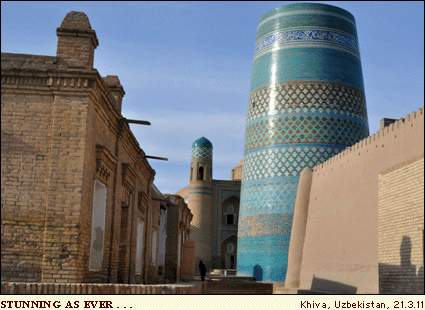

Khiva is the capital of Khorezm, one of two main regions in far western Uzbekistan. The other region – separated by the one of Central Asia's two largest rivers, the Amu-Darya – is Karakalpakistan. The name comes from its inhabitants the Karakalpaks, who are (more or less) a sub-group of the Uzbek people.

In travel guides and on Central Asia-related websites, the word "Karakalpakistan" tends to crop up most often in proximity to phrases like “ecological disaster”, “blighted landscape” and “respiratory disease”. It lies adjacent to what is now the Southern Aral Sea, which was created not long ago when the level of the original Aral Sea dropped something like 70 metres and the whole thing split into two separate halves. The northern Aral, in Kazakhstan, is being slowly restored to its former level via a series of dam projects, while the southern part, in Uzbekistan, is expected to disappear completely some time in the not-too-distant. Its legacy will be … well, nasty.

Geographically, large parts of Karakalpakistan are basically uninhabited desert, and walking around in these expanses, you see evidence of the Aral disaster everywhere. A fine powder of sea salt covers the ground almost entirely in some areas, blown here from the dehydrated seabed. Periodically, desert windstorms whip this white invader into stinging airborne clouds that can find their way into your lungs and do some pretty horrible damage there (hence all the reports of respiratory problems).

Elsewhere the sodium beast has attacked lakes like the formerly pretty Ayaz Kol, which has now fragmented into a series of pools with bone-white, boggy shorelines. Walking around the edges of these is a really weird experience; there is no wildlife of any
kind, the area is completely silent, the white powder has mixed with greenish mud to create something not entirely unlike quicksand, and bushes growing in the shallows are so thickly covered with waterlogged salt that they’ve taken on the appearance of dead coral.

Seen on the horizon from a few kilometres away, the entire lake appears to be either a hazy mirage, or a deserted beach (there’s that word again) with white-crested waves breaking on its shores. But of course, there are no waves in Ayaz Kol. The water barely moves at all, and neither does anything else.

Like I said … weird.

Actually, though, I didn’t start this rant with the intention of recounting the tragedy of the Aral Sea disaster; that's been done elsewhere. It's just my inability to resist a good tangent, getting in the way as usual. Let's get back to the sand.

Another, less foreboding word that you'll often see printed in close proximity to "Karakalpakistan" is "fortress". That's because the desert which I mentioned before – called Kyzylkum, meaning "red sands" – is home to an impressively large collection of ancient forts ... and when I say "large" and "ancient", I really mean "LARGE" and "aaaaancient".


First to deal with the LARGEness factor: one commonly visited area of the Kyzylkum is called Eliq-Qala, which means "fifty fortresses", and you can see them dotted around the map in clusters. But in actual fact, the name is a misnomer – archaeologists believe that there may be as many as two thousand of them yet to be discovered. Which basically makes this area one huge archaeologists' paradise.

About "ancientness" ... well, Yuliya and I hired a driver to tour four or five of these fortresses, and we started with Toprak-Qala and Qyzyl-Qala. The first of these was a mere babe, having been the main HQ for the Kings of Khorezm in the 3rd and 4th Centuries AD, while its neighbour was a tad more mature at roughly 1,800 years old. Later, though, we came to Ayaz-Qala, a complex of three fortresses which some sources say has been in use for – get this – about five thousand years**.

Exactly who built and used these incredible structures varies from fort to fort. A number of them belonged to the ancient Zoroastrians (or "fire worshippers", as they're called in these parts), including one where bodies used to be hung out in the open air to be picked by vultures (a Zoroastrian tradition for millennia). The aforementioned Khorezmian kings were also rather keen on fortress-building and -dwelling, and they contributed quite a few to the collection, while other forts were inhabited by early Christians. And there are probably some which had different owners and uses ... it isn't entirely clear in every case.


Our guide's commentary as we walked around the first two fortresses was rather minimal, and he didn't even bother to join us at the others, so we got no information at all. I found this a little disappointing at the time, but I later realised that his sparse explanations arose from a simple fact: namely, that this area is only now opening up to the enquiries of archaeologists, and many secrets of the little-known cultures who lived here are ... well, little-known. Therefore, there wasn't much that our guide could really say! We were looking at the pieces of a vast historical mystery.

Cool, huh?

Anyway, it was while walking up the hill towards the outer walls of Ayaz-Qala that I had the thought about sand. It was about a 20-minute walk through terrain that had looked fairly unremarkable when seen through a car window, but when I got up and close and personal with the desert here, I found myself in awe of it. Aside from the broad, horizon-to-horizon skies and the twisted, spiny vegetation, there was the sand itself. A rich pinkish-yellow colour for the most part, it rippled slighty on the ground, and at the crest of each ripple seemed to be a little sprinkling of gold dust. It was truly beautiful sand.
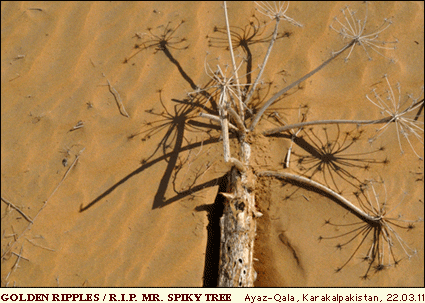

(Also, it was soft and comfy to walk on.)

So yeah ... hence my need to go back on what I said about sand. It really wasn't fair, and I realise that now.

When we crested the hill and entered the main compound of Ayaz-Qala (which was being guarded by an eagle, soaring overhead), we had the entire fortress to ourselves.

Like so many of Uzbekistan's amazing sights, I found myself amazed not only at the place, but also at the lack of tourist throngs. "Why the Hell isn't this more famous?", I asked myself – for about the eight-millionth time since first visiting this country two years ago. But y'know, although a bit more tourism would undoubtedly benefit the Uzbek people, from a selfish p.o.v. it's a wonderful privilege to come here and check out the great secrets hidden in Uzbekistan's deserts and oases ... which may be one reason why I'm already thinking about the possibility of coming back for a third bite of the cherry )))

Our last fortress for the day was the impressive Qirq Qyz-Qala, which translates as "Fortress of The Forty Girls". These groups of girls are one of several recurring motifs in Uzbek legend – so much so that there's another Fortress of Forty Girls in Termez, near the southern Tajik border. Both that one in Termez and this one in Karakalpakistan are claimed as the home of a 16-year-old warrioress called Gu'layim. The story goes that she built the fortress herself, then trained forty virgins to become a formidable combat squad who would (and did) defend it against all comers.

Of course, the wisdom of choosing young virgins as your defending force – as opposed to, say, experienced and well-armed professional soldiers – could be questioned, but on the other hand, "Fortress of The Forty Big Dumb Guys with Spears" doesn't strike quite the same poetic note. So each to her own, I guess.


As it turns out, this legend has even migrated internationally over the years, and popular etymology attributes the country name "Kyrgyzstan" (which neighbours Uzbekistan to the east) to the same story – only in that version, a dog somehow gets involved with the forty girls. There used to be a brand of dog food in Australia called "Lucky Dog" ... wonder if that's where they got the inspiration for the brand name ;-) 

Btw, now that I'm on the 'popular Uzbek legends' theme, let me throw in an even more irrelevant tangent.

Here it is: the other big recurring plotline in this corne of the world revolves around an architect commissioned by a powerful ruler to build a spectacular structure – a mosque, say, or a minaret. The ruler orders the project to begin, then goes off to battle, and while he's absent his master architect falls in love with his beautiful wife. After committing a mild romantic indiscretion, such as asking the ruler's wife for a kiss, the architect starts fearing for his life, and so sets about making a pair of wings for himself and jumping off the top of his own building, flying away to Persia to avoid the wrath of the returning Khan or Emir. It seems like every Uzbek city has one of these naughty flying builder guys somewhere in its 'history'. Must've been the thing to do back then.

Anyway, about the fortress: its size is just immense, but it's in a far more advanced state of ruin than Ayaz Qala, to the point where every structure except sections of the outer wall have melted back into the desert. So now you basically walk on a wide raised plateau, with dissolving fortifications adding slightly surrealistic contours to the horizon. It's, er ... pretty damn cool )))

Believe it or not, though, what I've told you so far is only about half of our little Karakalpak adventure. For the sake of giving you (and my fingers) a break, I'll tell you the rest a bit later. Until then ... Khaer!!

(That's "bye" in central Uzbek.)

  
* Btw, if you want to read my original rant about the wonderful city of Khiva, it's here:
   http://rantingmanor2.blogspot.com/2009/07/khan-you-believe-it.html

(** Of course, like a lot of stuff around here, the figures change depending on who you talk to.)

Saturday, 1 January 2011

conspiring elements


At approximately 11:45pm last night, something rather fabulous occurred about 1000 metres above my flat. It wasn't anything especially remarkable – in fact it's almost commonplace at this time of the year. But I’d spent days wishing for it to happen, and the Weather Gods had been rudely ignoring my requests up to that point.

Around eight-ish on NYE, I went to the supermarket to stock up on supplies, and suburban Almaty was looking about as unappealing as it ever does. The last snows, almost a whole week old, had all but disappeared. Only an ugly, brown, icy slick remained on the streets, making a stroll through the hood slightly treacherous and unpleasant.

Also, the winter cold had abated, replaced by ‘neither-tut-nor-tam’* temperatures which hovered non-committally a few degrees either side of zero. This wasn’t winter – it was just a non-descript coffee break between seasons. I was feeling somewhat deflated, cheated out of the rather hardcore chilly season that had seemed imminent a couple of weeks earlier.

Then, in the final hour of 2010, everything changed. There was a dramatic temperature drop to around -12C, bringing back the frigid intensity of the Kazakh winter. And about 15 minutes before the Big Moment, snow began falling silently from the fog-lit skies.

It was that fine, glassy, almost colourless kind of snow, which glistens and sparkles in the orange fog lights like tiny falling diamonds. (I’m sure the Eskimos have a specific word for it.) This is one of my favourite kinds, ‘cause it tends to charge the atmosphere with a strange kind of energy, powerful enough to produce a smile from even the most jaded of folks**. And it was perfectly timed for the beginning of 2011.

I’d planned to host a small gathering for New Year, but had cancelled the party because I’d been experiencing some stomach problems during the day and was feeling distinctly unsociable. Yuliya, meanwhile, was visiting her family in Ukraine. So I was alone on NYE.

At a couple of minutes to midnight I wandered outside to see the fireworks (which are legal here, btw). It was at this moment, when I closed the heavy metal door of our building and stepped out onto the street, that my mood suddenly lifted. I was immediately assailed by the cold, and the glittering, semi-translucent snowflakes began to decorate my jacket in a layer of silver-white. Then the sky erupted in a palette of intense colours.

I headed out onto Mynbaeva street, where the atmosphere was nothing short of magical. A white carpet had covered the road, and there were no cars moving, so the light snow-cover was perfectly fresh and unspoiled. I stood in the middle of the thoroughfare, watching people setting their pyrotechnical purchases alight and then standing back to watch fireballs shooting into the heavens.

A couple of months ago, in Viet Nam, I’d briefly taught an IELTS preparation class. IELTS is a popular English exam – an introduction to academic English for those wishing to study at universities in Australia or The UK. The reading passages in this exam often concern technical subjects, and in one lesson we examined a text about how fireworks are manufactured. It spoke of such technicalities as ‘second-stage detonators’, but also of the patterns one could make in the sky with a bit of specialist knowledge. Terms like “hearts”, “palm trees” and “stars” were bandied about, these being among the favourite patterns that pyrotechnicians try to incorporate into their creations. And now, months later, here I was alone on the street in Kazakhstan, freezing my arse off, being snowed on, and watching these patterns explode into life around me.

It was, in a word, perfect.

At about 12:10am, some other locals arrived on Mynbaeva and began adding to the clamour with the fireworks they’d purchased from the Green Bazaar (a huge market in the centre of town which is the source of most fireworks sold in Almaty). Two Russian women set a Roman candle on the road, shrieked girlishly and ran away, seconds before it started sending green missiles into the sky, each one detonating in a multi-coloured shower of sparks that lit up the grey tower blocks in an exuberant flash.

As the snowfall became progressively heavier, silhouetted figures appeared further down the road, shooting blue and yellow fireflies into the air – some of which fell to earth almost immediately next to a line of parked cars. I vaguely wondered what constituted a safe distance from an exploding fuel tank, but I enjoyed the show anyway. In fact, I remember laughing out loud in the street ... which under normal circumstances might have been a good indication that I was losing my mind. On this occasion, though, the mental diagnosis would have to wait ... it was just a marvellous, silly moment, and laughter was the only natural response.

After standing around for about 20 minutes, being snowed on and watching the tower buildings take on a festive selection of hues, mundane reality began to press on the walls of my little Glee Bubble. My glass of G&T had become empty, my matches had run out, and the tips of my fingers were beginning to warn me that frostbite is a reality in this part of the world. So I headed back to the warmth of my flat, 2011 well and truly rung in.

Since then, temperatures have continued falling, reaching an invigorating -24C tonight ... a 'real' Kazakh winter. Honestly, going outside in weather like this makes you feel that you're really alive – at least for a while, until the "Oh my god, the flesh on my face is necrotising!" sensation begins to kick in ;-)

The snow is gone now, though. In fact, it stopped less than an hour after my little midnight walk. Seems like it was a special consignment, delivered to Almaty to coincide with the New Year. So, er ... thank you, Weather Gods!

Hoping those same gods will be generous in the weeks to come, 'cause it would be nice to have a cold, snowy January. We'll see.

In the meantime … Happy New Year, everyone!!!

Anthony.


(* tut is an informal way of saying “here” in Russian, and tam means “there”. I invented the phrase neither tut nor tam in L’viv, and Yuliya thought it was kinda funny. She repeated it to a few colleagues, and it has survived as a little in-joke.)

(** This kind of snow has such a powerful effect on me that I can effortlessly remember specific times when it fell during previous winters. An example is January 2006, when I’d spent a night hanging out with my friend Astrid in Moscow cafés, then walked home at about 6am through the glistening snow. I have an incredibly vivid memory of walking along my street while the snow fell, and grinning like an idiot. I think I even sang.)


Friday, 19 November 2010

year three ...


“So … welcome back, Mr. Nerd, to the land of the perverse and the perplexing. Are you sure you’re ready for another year of this?”

That, in case you’re wondering, was the voice of the universe. Specifically, it’s what the universe seemed to be saying to me as Yuliya and I ran madly towards gate G1 at Bangkok’s Suvarnabhumi airport, to board flight KC932 to Kazakhstan.

Running beside us was an airport employee, looking extremely worried. “Hurry Up! No time!” he kept urging us, in the manner of someone who fears the wrath of a superior and has reason to think that said wrath may be close at hand.

Yuliya and I did our best to keep up with the guy, though we were a little confused as to why the situation had suddenly become so urgent. Our plane wasn’t due to take off for another 35 minutes, so when we’d heard our names read out over an airport PA system in close proximity to the words “final” and “immediately”, it had come as something of a surprise. But when a uniformed official repeatedly says “You have to get to the gate right away!”, and you’ve paid $700 each for the flight, you tend to adopt a ‘run now, ask questions later’ approach.

This flight was part of an international move, so we had a ridiculous number of carry-on items with us. After going through security and passport control, we’d grabbed two of those miniature trolleys you can get in some airport departure lounges to help you carry around your extended family of little bags. We were pushing those frantically in front of us now.

As we got closer to the gate, a random thought surfaced from my subconscious and began back-stroking around my head:

“You know”, I thought, “this is exactly like the shopping trolley races I remember from high school.”

I’m sure it’ll cause you no great surprise when I report that, upon further analysis, this comparison turned out to be less-than-perfectly accurate. I mean, for a start, none of the participants in those trolley races had been grown adults. And there was usually a second person inside the trolley – as opposed to a laptop, a digital SLR (that’s a camera, not a rifle), a bulky winter coat and a backpack full of books, snacks, medication and laundry. Also, as far as I can remember the teenaged trolley races usually ended when one trolley fell over and everyone’s attention was transferred to dealing with the occupant’s injuries – not when, for example, we reached a departure gate and a person wearing epilettes took our tickets and motioned us onto a waiting aircraft.

Thinking about it more, I realised as well that the trolleys were bigger back then, had dodgier wheels and sharp soldered edges, and were often found abandoned in suburban streets… so basically they were the trolley equivalent of rough-edged moggies with a habit of straying, whereas today’s sleek Suvarnabhumi model was the pampered Siamese* who never leaves the comfort of her owner’s slick city pad.

Still … apart from that, the similarities were eerie.

Anyway, we finally made it to the plane, and were welcomed on board with an icy “zdrastvuiyte” (hello). The brusque Russian greeting contrasted dramatically with the cheerful Thai “Sawasdee ka(p)” we’d been hearing all week, in roughly the same way that bathing in freshly chilled mango juice contrasts to bathing in your own blood. We were the last people to board, and everyone else was already in their seats. A few glares were noticeable as we walked down the centre aisle.

But why, I wondered, had we been rushed onto the plane so far ahead of time, and with such urgency? Well, we soon found out, and here’s the reason:

It was so that we could watch the safety demonstration.

Mm-hmm, that’s right. I'm not making it up, or leaving bits out for comic effect. See, while most airlines ask their cabin crews to demonstrate the safety features while the aircraft is taxiing toward the appropriate runway**, our airline had decided to provide us with this information while the plane was standing completely still at the gate. Only then, after the hostesses had simulated pulling an oxygen mask down from the ceiling and attaching it to a child’s face, would the pilot turn the ignition key and start the engines.

Result: twice as much ‘dead time’ between boarding and take-off.

Very post-Soviet, I thought.

Small compensation came from the fact that it was quite an entertaining demonstration … or at least, it was if you were watching the air hostess nearest to us. Her range of expressions was great: there were a couple of moments when you could see her looking down the aisle at another crew member, grinning about a dirty joke they’d no doubt shared earlier. At other points in the performance, she made no attempt to hide her boredom, looking almost contemptuously at the life jacket with its ridiculous lamp, and blowing the whistle with all the joy and enthusiasm of a person signing insurance documents before undergoing bowel surgery.

Then we were ready to go, and the aircraft began taxiing away from the terminal. We’d flown three times in the previous fortnight with Air Asia – not what you’d call a ‘top shelf’ airline, but fairly decent – and once again, the contrast was immediately evident. Our plane shuddered to life, pulled grudgingly out of its parking space, and treated every tiny bump and crack in the asphalt as a personal insult, bouncing along like something that would have difficulty getting up a steep-ish driveway without falling apart, let alone into the air. When our turn finally came to take off, I was pretty close to being terrified (and I’m usually pretty good with flying).

A few minutes later we were climbing towards the clouds, and I started to relax. Years ago, I read somewhere that most airline accidents happen in the first or the last minute of flight, and I often use this randomly-gathered statistic to calm myself down if I feel nervous about the aeroplane that’s carrying me. It came in very handy on this occasion!

Putting all the post-Soviet weirdness to one side, though, the crucial fact was this: we were on our way to Kazakhstan. And somehow, the weirdness/scariness of the flight seemed like a fitting re-introduction.

I definitely didn’t expect to be back in the 'Stans so soon … I mean, it wasn’t the plan at all. Plan A for the 2010-11 academic year was to stay in Ha Noi and get our teeth into Far Eastern culture, taking up cycling, morning yoga and perhaps a martial art along the way. On the other hand, though, when I realised that a return to KZ was imminent, I can’t say that I felt overly surprised. Ever since I’d left Almaty 18 months ago, it had always seemed to me that I had a future date to keep with the ‘Stans.

And so now that date begins.

No idea how it will go, of course, but I’ll let you know as things unfold.

Here’s to Year Three!


(* We were in Thailand, after all – home to the Siamese breed. And let me say, the cats there are gorgeous, and they all have that fantastic deep and strident Siamese “miaow”.)

** (for ESL people) we use “taxiing” to describe an aircraft travelling very slowly across the ground at an airport, and a “runway” is the long straight road on which aeroplanes take off and land.


Thursday, 11 November 2010

curmudgeons in the sand


I remembered something today that I'd kinda forgotten: namely, that there's almost nothing on this planet that brings out my Inner Curmudgeon more than spending time on a beach*.

The memory was awakened for me in, of all places, southern Cambodia. Yuliya and I are staying in a coastal town called Sihanoukville, which is desperately trying to tart itself up and become a Hot Backpacker Destination. Quite frankly, it isn't a place I’d recommend to anyone (unless I had at least one good reason to dislike the recommendee). But it’s right on the sea's edge, and from the town there are boat trips to some of the islands lying offshore.

We’re on one of these delightful excursions today, about to have lunch on a lump of sand and tangled vegetation known as Koh Ru (“Bamboo Island”). Yuliya has disappeared into the undergrowth, possibly never to been seen or heard of again, and I’m ‘relaxing’ on the beach.

For some people this may sound like a rather pleasant way to spend a day, so let me explain the presence of rabbit ears around the word "relaxing".

Basically, I find beaches just about the least relaxing places on Earth. I mean, if I thought really hard I could probably list some other environments that would put up a fair fight in the ‘least relaxing’ stakes … like, say, jungle trails strewn with deadly poisonous millipedes (miles from the nearest hospital, which is bound to be crappy anyway), and fishing boats so completely infested with wood lice that you can’t sit down or put your belongings on the deck for a moment without them snooping around your backpack, looking for a way in. Fortunately, though, our little day trip to the islands includes both of those environments as well … so whatever happens, we’ve hit the discomfort jackpot.

Amazing what you can get here for US$15.

So anyway, now that I've put the "I hate beaches" thing out there, let's consider for a moment: what IS this thing called "the beach"?

As far as I can see, a beach can be defined thusly: it’s the place where land runs out and water begins. Or, if you want to be a tiny bit more accurate, the observable point at which the land becomes lower than the water, thereby disappearing from view.

For me, this begs one obvious, two-word question. As questions go it’s rather direct and not overly imaginative, but nonetheless I think it demands an answer. In fact, if I were World President, I'd be tempted to display said question on every single beach in 4-metre high flashing neon letters, surrounded by dancing girls who periodically spell out the two words by lifting their skirts provocatively to reveal large yellow letters printed on their knickers (except for one girl who would have just plain red knickers, corresponding to the space between the words). Surrounding this scene would be hippos dressed in marching band costumes, each with a huge bucket in front of them, the size of a small wading pool. From the buckets they would regularly draw water, then spit it dramatically into the air, further drawing readers' attention as the neon sizzles at the impact of their spray. Then a curtain would fall away, revealing a 100-strong chorus line of arm-linked, leg-kicking dancers, all singing the same refrain.

(There might be some skywriting in there too ... but I’m not sure. Would that be overkill, do you think?)

Let’s get to the point. The question I want to ask about this land-ending-and-water-beginning place, worshipped by so many for so long, is as follows:

SO WHAT?!?!?

And btw, you can feel free to add an expletive in the middle if you want.

I mean, really, folks. Is it that exciting when one element stops and another takes over? ‘Cause if it is, you ought to be experiencing complete, undiluted bliss every waking moment of your life. I mean, we live continuously in what you might call ‘boundary conditions’: our planet is solid rock most of the way through (with some hot gooey stuff in the middle, if scientists are to be believed), but the part of it we happen to inhabit is the precise point where the rock runs out and the atmosphere begins … i.e., every single breath we take during our existence is taken at the boundary point between two elements.

So if elemental boundaries are so fabulous, why are we not jumping up and down, waving flags and giant soft toys, and inventing catchy little sing-along chants to celebrate the end of rock and the beginning of the air?

“Because they're not”, would be my answer.

For some reason, though, when I've complained about the crappiness of beaches in the past, I've found that this opinion has raised its share of objections. So if you'll bear with me, I want to examine a few of these objections now.

First, it could be pointed out that being near a body of water is very pleasant. I can’t say that I completely disagree with this, but guess what else bodies of water are, apart from pleasant? Yep … they’re extremely common. Just go for a walk beside a river or a stream, a canal or a lake. They're honestly not that difficult to locate.

Or here’s another thought: if you really want to be near the water, and nothing but sea or ocean will do, then fine: buy a boat.

Some may also say that I'm de-personalising the experience of being at the beach to suit my own narrative purposes (if indeed I actually have any). I'll admit that the descriptions I've given so far are a tad clinical, and do little to capture the 'beachfront atmosphere' so keenly sought out, or at least dreamed of, by people of all nationalities. So ok, let's zoom in a little closer: what is it, in fact, that comprises this special atmosphere?

First of all, there are the unique sensations that await beachgoers, like the feeling of warm sand between your toes. I know that a lot of people claim to like this, but really: would you go outside tomorrow, strip down to your underwear and lie in the dirt beside your nearest main road? Or how’s this: you’re in a bar and you meet a woman who tells you that she has silicon breast implants, then goes on to reveal that one of her implants is defective. There’s a hole in it, and the silicon is slowly leaking out. A little shocked by this new and surprising information, you haven’t had time to formulate a suitably sympathetic response when the woman suddenly offers to squeeze the silicon onto your face and body if you pay her. My question: would you accept her proposition? Cause at the end of the day, that’s what sand is: it’s dirt made of silicon. And yet people pay thousands of dollars to go and lie in the stuff.

To me that's just insane, and I’ll never, ever get it.

But maybe there's something else I'm missing. Let me see ...

Is it the knowledge that the sand grinding between your toes now will be in your shoes, your socks, your underpants and, finally, your bed later? Maybe. Is it the smell of salt and rotting seaweed, or the bitter taste of these in your mouth when you come out of the water? Hmmm ... well, I s'pose that could be it. Weird, though.

Is it the collection of people you can find on beaches, who roughly divide into two categories: 1) those who really should never go anywhere dressed in bathers, and 2) those with far more athletic bodies than your own, who make you feel depressed and self-conscious, whereas just a few hours earlier you were basically ok about yourself? No, that can't possibly be the deciding factor.

Must be the overpriced crappy food being sold in the immediate environs, combined with the gradual roasting process that your skin undergoes on the beach, slowly altering your white/red blood cel balance to get you a little closer to having cancer.

Yeah, that sounds right.

Btw, before we go any further, a little disclaimer: I fully realise that I’m being a cranky old grandpa here. Feel free to regard this entry as just that: the rantings of a grandpa at the height of his cumudgeonry.

Still, I really think that the beach is vastly overrated. No, more than that: it isn’t just overrated. It’s highly unpleasant.

And see, here’s where I’m really gonna lose you, because now I need to tell you what I think when I see other people enjoying the beach. Most of you are gonna hate what I have to say … but please don’t take it too personally.

Some background first: as you know, I grew up in Australia, where the beach is more or less a given. The centre of the country is pretty close to being uninhabitable, so ninety-something per cent of the population live on the coast, and there beaches are just a fact of everyday life. And even when I lived there, I hated the beach. In the last few years, though, all the beaches I’ve visited have been mainly populated by people who don’t come from countries like this.

And so here’s the honest truth. Basically, when I’ve seen people walking, sitting, and especially lying on beaches recently, they’ve often seemed to me a little desperate. It’s as if these people come from sad, grey, depressed corners of the world, where the drabness of their daily reality weighs them down so heavily that they feel compelled above all else to spend their money trying to escape into the sunshine, pursuing some vaguely-construed myth about having their own piece of ‘tropical paradise’. They’ll continue chasing this dream regardless of cost, subjecting themselves to the most uncomfortable and humiliating circumstances just to feel the satisfaction of lying on any white (or yellow, orange or stony grey) shoreline with a barely perceptible tidal swell.

I try not to think in such condescending terms, but when I go to those ‘boundary areas’ where tourists recline on hard wooden chairs being served massively overpriced, diluted cocktails by obsequious waiters who eye their bikini-clad adolescent daughters avariciously, I just can’t help it. Beaches seem to me so self-evidently horrid that I can’t quite manage to put myself in the headspace of a person who thinks “Yay!” when s/he encounters one … especially in places like Cambodia, where the beachfront enviroment is pretty average, and the attendant conditions (e.g. drainage pipes leading directly from restaurant toilets to places where people are swimming) are rather scary.

And so now you’ve heard my piece, it’s your turn to reach out across the electronic oceans and slap me in the virtual face. What you’ve read here is my honest opinion, without a word of exaggeration – I really, really hate the beach! But I know that my view leans towards the extreme, and you know that I’m the kind of person who won’t mind if you come back at me hard and say “Listen, Anthony, you’re full of shit, and here’s why …”

So go on then: try to sell me on the beach. Bet you won’t succeed ;-)


*(except MS Windows of course.)


Wednesday, 10 November 2010

preah khan


Hello!

This entry is a slight deviation from the usual Ranting Manor format – something like a 'photo album', but with a bit more commentary than, say, Facebook allows.

The previous rant was about my first day at Angkor, the ancient empire state of the Khmers, which lies in the jungles of northern Cambodia. I said more or less everything I wanted to say about Angkor, but I couldn't leave the subject alone without showing you some photos from our second day.

The main reason for this is that Day Two kicked off at a temple called Preah Khan. When we left our hotel in the morning, I had serious doubts about whether I could cope with another full day of temples. But by the time we'd reached the entrance of this remarkable place, standing in a junge clearing in a state of elegant ruin, my mind was well on its way to being blown all over again.

Every bit as grand, colourful and chaotic as its older sister Ta Prohm (which I enthused about in the previous entry), Preah Khan had one advantage: namely, that when we got there at 8am, we had the place almost to ourselves. We saw just a few tourists wandering through, a group of construction workers out the front working on the main entrance, and a Thai family trying to have breakfast in one of the many ruined halls that led off the main passageway. (They were chased away by a policeman – guess you're not supposed to eat in the sacred spaces of Angkor.)
  

So, what you've got here is basically a short selection of pics from one of the most beautiful places I've ever visited. (I wanted to include many more, but I have to catch a plane this afternoon!)

Hope you enjoy )))

First cab off the rank: the almost inevitable 'cute kid sitting on enormous grisly statue' shot.

Like many of the temples at Angkor, the entrance to Preah Khan is flanked by dvarapala (temple guardians). They're suitably fierce-looking creatures, with warriors' scowls and so on, but when a ridiculously cute Cambodian girl sits on one and starts singing to herself, some of the fearsomeness is definitely lost.

I did take this photo partly for its 'cute value', but I also liked the fact that the dvarapala here has lost part of his arm. It struck me as being somehow symbolic of one of the major problems plaguing Cambodia today: namely, that the whole northern half of the country is packed full of land mines.

Even after decades of clearing, land mines remain a major issue here. There are still a staggering number of live mines in the country (estimates range from 6 million to 42 million), and they claim large numbers victims every year – about 800 in 2009, for example.

Travelling around Cambodia, you see these people all the time: amputees, legless people on wheeled carts, blind people and so on. So it  really is a daily fact of life here.

(Btw, an extremely cool initiative has taught people blinded by landmine explosions to perform therapeutic massage, and the resulting industry has really taken off. Now you can find 'blind massage' centres in any Cambodian city or tourist town. Brilliant idea, no?)

Ok, social conscience sated. Back to looking at pretty stuff )))

Preah Khan's ground plan is extraordinarily complex, with four main enclosures each containing multiple galleries, courtyards and so on, linked by a complicated maze of corridors.

Here, for example, you can see a small courtyard lying adjacent to the central passageway. As with most of the temple, nearly every surface is partly or fully covered with carved motifs or figures, and nature has supplied some extra colour to complete the artwork started by the Khmer.

In a lot of the outlying rooms the ceiling and parts of the walls have collapsed, so as you stroll along the central passageway, you see glimpses of sunlight and great piles of rubble, inviting you into halls and corridors at either side. This one's a ruined cloister leading onto an open verandah area. Cute, isn't it?


The carvings mostly depict figures and episodes from various myths. Back in the day, spiritual beliefs in Cambodia were rather syncretistic, with aspects of Hinduism and Buddhism mixed in with earlier pagan/animist beliefs. So as you walk around the temples, you often see austere Buddhist statues right next to, say, episodes from the life and times of Vishnu (who always looks like he's on the verge of delivering some incredibly cheesy pick-up line, don't you think?).

These ladies are devatas (female deities of Indian descent), often designed to look like they're dancing, or else just smiling enigmatically.


Looking from one parallel roofless hallway to another, Yuliya noticed something weird: there's a second floor, but no stairs. We looked it up in our guide, and apparently there was never a staircase to the upper floor of the temple, as far as anyone knows.


Mmmmm ... spooky )))

But possibly the most spectacular scenery here is supplied by nature herself. When restoration began in Angkor, Ta Prohm and Preah Khan were chosen as sites that should remain as close as possible to their 'natural state'. So everywhere you go, you see what appear to be giant botanical cephalopods** from outer space, locked in mortal combat with the masonry.

Actually these attacks begin inside the walls of the temple, as tiny seeds germinate, grow into enormous silk cotton trees, and burst through the stones. But whether you choose to go with the scientific truth, or the flights of fancy which these scenes inspire, the spectacle is awesome. 

And here's my personal favourite. This enormous silk cotton tree has the rear gopura (entrance door) of the temple in its unshakeable grip, creating a dramatic and surreal final view of Preah Khan that's rather difficult to extract yourself from.


Of course, if you happen to be a mad Ukrainian woman trained in the Eastern arts, you can find 101 uses for this remarkable tangle of stone and wood.


Or, if you're just a typical gawping tourist like me, you can simply stroll around and marvel at the queer beauty of it all. Preah Khan rises quite suddenly out of the undergrowth, immerses you in its hallways and courtyards for a few hundred metres, then rapidly disappears from view as you walk away from it. As the semi-digested remains of the rear wall (pictured below) vanish under a carpet of green, it's fun to let your imagination tell you that you've hallucinated the whole thing under the influence of jungle fever.

Or at least, I thought so )))  

Ok ... that's it for the moment. Have lots more pics of Preah Khan sitting on my hard drive, but no time to sift through them now. This will have to do. Hope you enjoyed the visuals.

Bye!


* The caption of this photo, btw, comes from one of my all-time favourite pieces of music by the Norwegian band Ulver. For some reason, when I first looked at this photo the song (both its music and its title) came to mind.
** The generic word for that family of animals which contains octopi, squid, shrimp and so on. It's another word I simply had to use on The Manor at some point.


Tuesday, 9 November 2010

wat's up?

(angkor part one)

So, about Angkor ... I know that a few people reading this have already been there, so to you, apologies for filling this entry with stuff you already know and things you've already seen.

To everyone else, I just wanna say this: if you've got any interest in ancient sites at all, you really, really should go there. In the last entry I quoted Henri Mouhot as saying that the temples are "grander than anything left to us by Greece or Rome", and he wasn't wrong. Angkor is, in a word, mind-blowing.

The typical tour starts with sunrise at Angkor Wat, which is the best preserved of the area's temples and palaces, as well as being ... get this ... the biggest religious structure of any kind, anywhere in the world! So, y'know, it makes a fairly obvious centrepiece.

(Wat means "temple", btw.)

In practical terms, catching the sunrise means stumbling out of bed at 4:30am, eyes half-closed, dragging yourself into the shower, dragging yourself out again, making a mental list of all the things you need for the day, forgetting the list completely before you've even finished it, packing whatever useful stuff you can see, and rushing downstairs to meet your tuk-tuk driver, still barely awake and definitely not functioning in the brain area.

The driver smiles and whisks you off through the darkened streets of Siem Reap (the closest town to the temples – previously a place with a definite 'Wild East' vibe, which is still faintly discernible despite the plethora of tourist hotels, travel agents and restaurants). Half an hour later, as the dark of night slowly softens to pre-dawn grey, you emerge from jungle into a wide clearing, where a large body of dark water appears on your right.

My first thought upon seeing this was "Ooh, what a pretty lake". Then we rounded a corner, and the lake followed us in a 90-degree turn. I thought "Huh?" (which is about my level of mental sophistication at 5:30am), realising later that I was in fact looking at an extraordinarily wide moat, encircling a walled city. I was subsequently told that, back in the day, the king ordered this moat to be filled with crocodiles (whereas, if I had my own city, I'd have quite a tough time deciding what to fill the moat with. It'd probably end up being either mango juice or bubble bath. Guess I'd be a fairly crap god-king.) 

To get across the moat you walk over a huge sandstone bridge, then through a grand gateway (constructed with elephant access in mind), where the bridge becomes a kind of raised stone highway. It stretches from the city's entrance all the way to the far end, where the temple stands.


Along the road there are stairways down to ground level, each guarded by seven-headed serpents. While in themselves they're not the most visually impressive features of Angkor Wat, the stairways are extremely cool for this reason: they show where each street began in the original city plan.

See, Angkor was actually not just a city but an empire of cities, each with a temple at its centre. Around the temple, people lived, worked, ate, shopped and, when they were sick of all that, died. The signs of their habitation are completely gone now, 'cause it was believed that only constructions dedicated to the gods should be made of stone. So these were wooden cities. But unlike the other sites in the area, Angkor Wat gives you enough of a sketch to imagine a whole metropolis functioning within its walls.

When you consider that there are 100s of these temples already uncovered, with an estimated 1,200 still hidden in the jungle, this makes Angkor a full-blown civilsation in itself. Somewhere in a guide book I read that, in the 11th century, over a million people lived there. At around the same time, the population of London was about 50,000. So y'know, we're talking huge here. 


Anyway, as you walk towards the popular viewing spots, Khmer people run up and start trying to sell you coffee from nearby stalls. Seemed like a pretty fabulous idea to me, so I bought my tall glass of coffee and shared the sunrise with a squillion other tourists, before escaping as quickly as possible from the hordes to do some exploring inside the temple. This is when the fun really began.

Inside the walls of the wat, trying to take in both the scale and the level of fine detail together is quite overwhelming. There are grand halls with Hindu and Buddhist carvings adorning every surface ('cause Cambodian religion is a mixture of these two faiths with some pre-existing pagan/animist beliefs thrown in). There are forests of stone columns holding up ornately carved ceilings. There are long cloisters and
hallways, some
  of them lined with statues and carvings that depict episodes from mythology. In fact, there's pretty much everything
you'd want from a temple of great antiquity, in pretty darn generous quantities. Not only that, but
somehow the whole thing is rendered in a symphony of rich monochromes and variegated colours that change throughout the day. (We know this because we went back to Angkor Wat the following day to get some more pics in bright afternoon sunshine.)

As with the other temples and palaces of Angkor, you can climb all over the many structures in Angkor Wat to your heart's content. The elegant outbuildings are accessible only by partly-worn staircases that are almost vertical, but you can get up onto those too. You can even – if you have the inclination – place a beautiful Ukrainian woman on top of one of them, and encourage her to reach into the morning sky, just for the sake of a good photo. But of course, only irresponsible husbands do that sort of thing. I personally wouldn't recommend it ...


From Angkor Wat, you head by tuk-tuk to Angkor Thom, also the centre of a great city now swallowed by the jungle. This temple is quite confusing in its layout, conceived as a "mountain of faces" and subsequently
re-modelled by successive kings into a mish-mash of styles and ground plans. But you sense you're getting further into the wilderness here – at Angkor Wat, you feel that nature has been effectively held at arm's length, but Angkor Thom and surrounding structures (including the enigmatically named 'Terrace of the Leper King') are set in a huge park with jungle licking at the edges, clearly wanting to reclaim the whole area.

None of this, however, will prepare you for what you see when you leave central Angkor and head to the eastern part of the former empire. Out here lies a temple called Ta Prohm, which would have to be one of the world's weirdest structures, just in the way that nature and architecture have joined together in a relationship which is both symbiotic and mutually destructive at the same time.

Before I go further, I should probably give you just a little more background info (not enough to send you to sleep, I hope). The khmer people always knew that Angkor's temples were there somewhere in the jungle, but other than Angkor Wat (which was inhabited and cared for by Buddhist monks), the khmer didn't set out to find and restore them. The restoration efforts only started in the late 19th and early 20thC, and were/are mainly conducted by an organisation called the École Française d'Extrême Orient.

When the École first arrived in Cambodia, many of the temples were in an advanced state of disrepair; the stones were discoloured by fungus and bat droppings, while silk cotton trees and other arboreal giants had taken root between building blocks, ripping apart walls and sending rooves crashing to the jungle floor as they grew to enormous dimensions. It was clearly going to be a huge job fixing even one of these temples, let alone all of them.

Over a century later, the École's restoration efforts grind on. But at some early point in the process, they decided that cleaning up everything would deny visitors the pleasure of seeing these vast stone edifices in the state they were in when found. So the decision was made: let's leave a few of the temples as they were when we found them, doing just enough work to stop them falling apart any further.

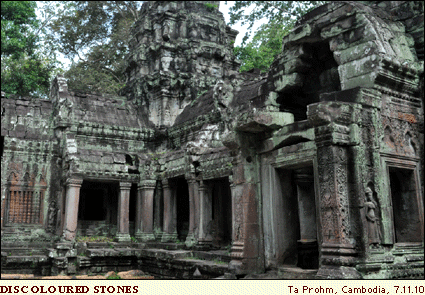
One result of this inspired decision is the wonderful Ta Prohm, a maze of open galleries, mysterious dark passageways partly blocked by fallen masonry, library rooms hidden in corners of the complex, and parallel doors and windows that produce a 'hall of mirrors' effect. There are so many atmospheric little corners in this place, you could spend a weekend exploring them, admiring the faded carvings, the incredible colours, and the romance of stone crumbling to dust around you. I can't imagine there are too many sacred sites in the world that can match this one for beauty and atmosphere (although there is another temple at Angkor which does exactly that – tell you 'bout it later).

Yet for all I've just said about the architecture of Ta Prohm, the real star here is Mother Nature herself. It's her contribution to Ta Prohm which makes it the most frequently sketched of all Angkor's temples, and the one which has "prompted more writers to descriptive excess"* than any other part of the ancient empire.

When archaeologists from the École first came to the site, Ta Prohm's walls were under attack from an unlikely enemy: giant silk cotton trees and strangler figs (or possibly golden apple tress; sources disagree about the identity of this species).

The fruits of these trees are eaten by birds, whose droppings contain the seeds for the next generation. If a bird leaves a dropping on a stone wall, and a seed finds its way through a crack in the sandstone (between two blocks, for example), the tiny seed will germinate in the darkness and, in time, become a huge "wooden octopus"** strangling and suffocating its prey.

Maybe the most fascinating aspect of this (for me at least) is that in some cases the trees are actually the only things preventing a complete collapse of the temple walls, whereas in others, they're crushing and tearing the stonework year by year, and causing amounts of damage that you wouldn't dare put a dollar sign on. So it's a love-hate relationship between stone and wood, between nature and architecture.

The École are doing their best to keep the balance, letting the trees remain  
in place wherever possible while re-inforcing the structures which they're parasitising. But one gets the feeling that no group of mere humans can determine the fate of this site. Whether the jungle or the gods will emerge as victors is something only time can decide.

By the time you've seen these and two or three other sites at Angkor, it's mid- to late afternoon and you're feeling more than a little mind-blown, exhausted and temporarily 'templed out'. So then, there you are in northern Cambodia, wondering what the Hell there is to do here (I mean, apart paying to stand in a glass tank for 15 minutes, so that small fish can eat the skin off your feet – something that's offered on almost every street corner here).

Then you notice the signs saying "Happy Pizza", and you think

"Hmmm ... should I risk it? Is it a crime in this country? Will it make me miss my 5am start for the excursion tomorrow? And how strong will it be? Strong enough to make me think I'm a flying bunny on an interstellar mission to spread joy throughout the world via the medium of the Happy Dance? This is Indo-China, after all".

In the end, you decide to brave the Happy Pizza ... I mean, the signs are so blatant, it must be legal, right? And the guy taking orders is so middle-aged and respectable looking, he can't possibly be part of the 'criminal element', peddling substances which make people think they're alien rabbits. There's just no way.

Ok, enough justification. You know you're trying it for one reason only: namely 'cause you want to.

An hour later, head to the conveience store to grab some snacks for tomorrow's temple-viewing, continually asking yourself "Has the pizza started working yet?" After a little bit of giggling and a few odd but inconclusive moments, decide that in fact, the happiest thing on your pizza was probably the blue cheese.

And that – apart from a visit to the night market to do a bit of haggling and be chased by people who want your dead skin to feed their fish – is your day. Time to head back to the hotel and rest; you've been awake for a ridiculously long time!

Goodnight )))


* An often-cited quote from the book "Ancient Angkor" by Michael Freeman and Claude Jacques.

** A phrase used by one of Yuliya's friends when she saw a pic we'd taken of a huge silk cotton tree growing on top of a temple wall.


Monday, 8 November 2010

legacy guy


Around about 155 years ago, a French naturalist called Henri Mouhot went to the British Royal Geographic Society and asked them for some money. He and his wife wanted to go on a botanical expedition to Indo-China, and he wanted them to provide all the necessary funds for him to meander through obscure parts of the Far East, scribbling in his sketch pad and collecting samples of unknown flowers.

Correction: he and his wife wanted to go on four botanical expeditions, and he wanted the Geographical Society to pay for all of them.

Now, I d'know about you, but to me this sounds like a request which was almost tailor-made to be a) laughed at and b) flatly rejected. I mean, I'm sure if you've ever applied for an arts or science grant, or worked in project management and fought hard to get project budgets approved, you'll appreciate that getting the people with the money to be enthused about your Big Idea is always a challenge. And of course, getting them to actually open their purse and let you put your hands in is harder still. In this case, though, we're talking about an even bigger ask: a French explorer wants money from a British organisation, to bankroll his exploits in a region (Indo-China) that was of little interest to anyone at the time – and for a completely uncertain, probably very minimal result that would be of interest to a select few scientists and enthusiasts.

Hmmm ... not the easiest thing to sell.

The fact that Mouhot did manage to get the money for these expeditions forces me to consider an idea which I generally resist with all my argumentative powers: namely, that perhaps some things really are meant to happen. See, at that point, nobody (including Mouhot himself) could've predicted how much a few quirky little expeditions would enlarge our knowledge of the world, and the strange wonders lying therein. His big discovery had nothing to do with flowers, and everything to do with ...

wait, I'll tell you in a sec.

On his third Indo-Chinese round-trip, Mouhot traversed the jungles of northern northern Cambodia. There he came across something which hadn't been the focus of his journey at all, but which so moved and inspired him that he decided to deviate from his orginal plan and investigate. Out of the endless tangles of dense vegetation, as he hacked his way through with machetes, there emerged a series of impossibly vast, stunningly ornate and sublimely beautiful temple complexes – "grander than anything left to us by Greece or Rome"*, as he later put it. They were so overrun by nature that they seemed almost at one with the fertile jungle flora, but nonetheless they were still at least partially intact.   

Astonished and moved by what he'd discovered, Mouhot started sketching these weird, wonderful, other-worldly sacred sites. He also started writing ... evocatively, passionately, copiously. As it turned out, our nerdy botanist hero had quite a talent for literary description, and when he brought his accounts of these buried temples back to France, they caused quite a sensation.

It was only a couple of years later that Mouhot's writings were compiled into an illustrated book – an instant bestseller which fired the imaginations of the French people and made Angkor the subject of intense interest and speculation. Mouhot never claimed to have "re-discovered" the temples in his writing (because he knew that at least two other Europeans had been there before him), but before long, his name had become synonymous with 'the ancient city of Angkor'. 


And here comes the inevitable tragic twist to the story – the bit which convinces me that, if indeed there is such a thing as fate, she's a cruel bitch who deserves to be tied to the back of a tuk-tuk* and dragged through streets freshly re-surfaced with boiling tar. See, Mouhot never got to see the stunning effects of his work. Fired up as he was about expedition #4, he stayed only a short time in France before venturing even further into the unknown. By the time his book had been published, and become a sensation, he was lying in a grave in Laos, having died there of malarial fever in 1861.

See? Cruel. Bitch. Boiling tar.

As to why I'm telling you all this: well, I guess I kind of admire, and even slightly identify with, this Nerdy Little Plant Nerd (who, btw, worked as a language tutor in Russia before he disappeared into the Eastern haze). As I read more about him, I've also come to see him as something like the Indo-Chinese equivalent of those "Men of The Stans", who I've written about previously in The Manor, and who I admire very much. And lastly, I feel kind of a debt to Mouhot, since it was his work more than anything before it which eventually resulted in the re-habilitation of Angkor's temples.

Thousands of other people who come to Angkor and sit sketching the temples ("following in Mouhot's footsteps", as one website puts it) also feel seem to feel this debt. He's become almost as much of a legend as the temples themselves. And deservedly so, it seems to me – firstly for having such a wonderfully silly dream (the whole 'Flower-sketching in Indo-China' thing), secondly for convincing others to let him follow said dream, thirdly for being ready to Man Up and face the jungle, and fourthly for bringing such an incredible thing to the eyes of the world.

So ... thank you, Legacy Guy. We owe you one )))

I'm gonna write more about Angkor ... probably much more, in fact. It's without doubt one of the most astounding places I've ever been to, so I figure it's worth a couple of entries – plus I have loads of pics to show you.

Bye!   


* (A quote from Mouhot's writings.)

* A motorbike or bicycle taxi, very numerous in Thailand and Cambodia. They're kind of like a horse and cart, but with a roof on the cart and a bicycle or motorbike where the horse should be. Great way to travel in the hot Indo-Chinese weather, 'cause you get shelter from the sun and wind on your face )))