Thursday, 10 November 2011

shaking in (rapturous) approval


As much as life resists being reduced to a set of rules like "X is good, Y is bad, do A to be happy and B to be sad", I do have a few little guidelines that I try to live by. One of them is "never eat anything bigger than your own head". Another is "see one country each year that blows your mind".

For the last six years I've managed to keep to this second rule, though not always in a neat, well-organised way. In 2009 for example, Uzbekistan took out the prize with no question, but 2010 was far less clear-cut. In the end it was a toss-up between Finland (which I almost don't like to count, 'cause it was actually my fourth visit there) and Cambodia (which made the list only for Angkor and the adjacent town of Siem Reap, with its deep red soils, bright green geckos and exciting 'Far East meets Wild West' feel ... whereas the rest of the country pretty much left me cold, so again I'm not sure if it really counts).

This year was always gonna be a tough one, 'cause I'd plunged into a new position of academic responsibility, and in any case I was mainly focussed on seeing a bit more of KZ. Partly as a result of these things, the calendar almost ran out before I had the chance to reel like a head-slapped fish in a country I'd never visited before.

And then, at about 8am yesterday morning, I looked out the window of my hostel and saw this:

The "this" in question is the Tsarevets fortress in Veliko Turnovo*, a town of about 70,000 people which has the twin distinctions of being a) Bulgaria's medieval capital, and b) one of the coolest places I've been for a long time.

As far as possible, I try to avoid overloading these pages with rapturous prose, 'cause if you write super-enthusiastically about everything, then none of it really means anything. But when discussing Veliko Turnovo, this is quite difficult. When I dragged my bag into town and started to take in the scenery here, I really felt like I'd arrived in the 'Balkans of my imagination'.

To give you the basics: Veliko Turnovo is spread over a cluster of three or four hills, separated by deep valleys that plunge downards like a daring neckline to the Yantra river. The unusual layout affords panoramic views from one neighbourhood to another, as though each were an island viewed across a narrow sea inlet.

In the central part of town, sleepy alleyways paved with huge, uneven cobbles wind up and away from the main tourist strip, flanked on either side by vine-covered houses that cling to the slopes. Some of these streets have followed roughly the same course since this region of Bulgaria was part of ancient Thrace, and even earlier.

In the mornings, mist hangs over the valleys and the air fills with the smell of local bakeries, baking soft warm breads with nuts, apple or sheep's cheese inside. The days are sunny, and in the evenings, as the chill closes in, you can retire to any number of great cafes and restaurants to sample local wines and traditional Bulgarian cuisine, both of which have held some very pleasant surprises (in fact, I can say without a doubt that Bulgarian food is among the tastiest I've come across anywhere in Europe, east or west. Who knew, eh?).

Finally, making your way home at night, the mysterious silhouettes of cottages peer out of the darkness as you walk through dimly-lit backstreets, enjoying the odour of wood smoke and the shadowy movements of the feline population.

So you see, in light of all this, trying to find something negative to say about Veliko Turnovo is really quite a challenge. Let's see ... um, interruptions to the local water supply are fairly regular, and your shower head can suddenly start throbbing violently while you're standing under it ... and, er ... well, some of the bars on the main street are a tiny bit tacky, and ... hmmm, what else ... nope, that's pretty much all I can think of. The rest is just great, great, great. I love this place.

Ok, time to rant a little about the Tsarevets, which is the thing sticking out at the top of the hill in the first photo. It's the third fortress built on this spot; the first appeared in ancient Greek times, to be replaced much later (5th Century AD) by a Byzantine stronghold. That one didn't last long though, because in the 7th Century Slavic peoples invaded the area and made Byzantine crumble out of Fortress Number Two.

Five centuries later, Veliko Turnovo's burgeoning population had made it one of Europe's more significant medieval capitals, and a full-blown citadel was built here. The scale of this one was extremely ambitious; walls snaked across one of the main valleys, encapsulating almost all of the town.

Most of the building is in various states of ruin today, but quite a lot of the medieval walls are still standing, and you can find traces of the earlier contructions here and there. Walking around the grounds, you occasionally come across the foundations of a basilica or the broken base of a column. These mysterious bits of stonemasonry tell no discernible stories (though they might, if you were there with a knowledgeable guide); they just lie around between ruined walls, saying "Go on then; see if you can guess how old I am!"

So yeah ... if I had to sum up the Tsarevets in a single phrase, I think I'd choose "fabulously impressive".

I couldn't help thinking that, if this thing were located further west, it would be excruciatingly famous. In a way, it's nice that this is not the case, because on the day when I was there (yesterday) I shared its extensive territory with maybe 20 people. A whole freakin' medieval fortress, almost to myself! It was grand :-)

The tall pointy thing at the top, btw, is a church called 'The Holy Ascension of Jesus'. I said a couple of entries ago that I'm generally not a great fan of museums, and then went on to talk about one for a long, long time. Now I have to do the same with regard to churches. I don't think I've ever written about a church before on The Manor, because I generally find them much of a muchness. But as with all rules, there are exceptions :-)

The thing which bowled me over about 'The Holy Ascension' wasn't obvious from the outside. It was when I stepped inside that I started making "Oooooh!" noises.

See, in 1981 Bulgaria celebrated the 1,300th anniversary of its statehood (not entirely unbroken, mind you), and as part of this, the Holy Ascension church was fully renovated and re-decorated.

An artist called Teofan Sokerov was commissioned to paint the inside, and he covered every available inch of wall- and ceiling-space with murals showing key episodes from Bulgarian history, throwing in just a little biblical stuff for good measure. The paintings are stunning, and the effect of walking around this space, with such vivid, stark imagery all around you, is a bit like being in a parallel reality where you can almost hear the thoughts of ghosts.

Beats the stuffing out of sadistic, poorly-painted catholic death marches (oops, I meant "Stations of The Cross") and flat-as-a-tack Orthodox icons, does it not?

Of course, in a move that surprised no-one, the church authorities refused to re-consecrate 'The Holy Ascension' when they saw the work that Sokerov had done inside it. So now it functions only as a museum. Your loss, guys :p

Anyway, my little sojourn in Veliko Turnovo ended in a fairly unremarkable but extremely pleasant way: one more evening walk through the lantern-lit streets, one more delicious Bulgarian meal (this time at a place called 'The Happy Man' ... which I certainly was after trying their food!), and one more sunrise over the Tsarevets.

Now I'm back in Sofiya, having spent a second day unsuccessfully hunting for caves (which seem unusually determined not to be found by anyone without their own car). Things went a little pear-shaped when I left V. Turnovo: the bus company sent me to a place called Yablanitsa, which was a rather horrible near-ghost town. Or at least, it seemed horrible until I made the brief acquaintance of a few locals, who were just warm and lovely and did everything they could to try and help the itinerant foreigner who'd arrived in their town. This brought back a thought I'd had earlier in the week: namely that, if everyone in the world was as nice as Bulgarian people, it would be a far more pleasant planet than it is!

Unfortunately, though, this comment only applies to the human residents of the country. It says nothing about the canine population, every single one of which wanted to tear me limb-from-limb when I finally reached the town of Brestnitsa (where the bus company should've sent me in the first place). It was only 10km from Yablanitsa, but it took me about four hours to a) work out how to get there, and b) actually get there.

I mean, admittedly, the first 40 minutes of that time was spent standing pathetically on one side of a highway trying to hitch – an endeavour doomed to failure, when every car that passes is a smallish sedan with a grandpa and grandma in the front seat, looking at you as though you were a smouldering piece of spaceship wreckage, their back seat too full of junk to accommodate you anyway. But even so ... the town-to-town link proved extremely difficult to discover.

When I finally arrived in Brestnitsa it was getting late, and I suspected the cave (which is 4km distant from the town) was on the verge of closing for the day anyway. But I was here now, so I approached the only place I'd seen which looked like it might contain people who could help me, hoping to get some information about transport or opening times, or anything else useful.

I was about 50 metres from the front door when three stray dogs, who had been separately milling around near the main road, suddenly came together and formed a 'pack'. The leader started running at me with bared teeth, making his intention to eat me pretty clear. "Oh shit!", I thought. "Dog-related emergency in a deserted town. What now?"

As the others fell in behind their new pack-leader, things began to look extremely grim, and I took the only escape route I could think of: I ran into the oncoming highway traffic. As the cars swerved around me (thank gods!), I managed to put distance between myself and the baying hounds, and they eventually lost interest in my violent death. I made my way back to a bus shelter at the other end of town, where a gypsy guy hit me up for money and cigarettes. At this point I decided that enough was enough, and flagged down a coach back to civilisation.

Not my best day.

Still, despite the less-than-wonderful doggy denouement, I'm going to feel a little sad when I leave Bulgaria tomorrow. I've just loved what I've seen of this country so far, and after ten days of travelling in it, I'm in no doubt that I've barely scratched the surface.

Luckily I've got two companions here who have just poured me some rakia (a clear Bulgarian spirit made with plums or grapes, sipped slowly like brandy), so I can round off this entry with a toast. Hmmm ... let me see ...

Here's to my future return to Bulgaria!


(* Sometimes spelled "Tarnovo", due to ambiguities concerning the correct transliteration of the Bulgarian vowel "ъ" into Roman letters.)

Monday, 7 November 2011

shake for yes, nod for no ...


Ok, settle in ... got a feeling this is gonna be a long one. I've got some "Oooh, look at the pretty stuff!" to get through, as well as some tales of travel dysfunction, and I've decided to do it all in one. So let's get the ball and chain rolling, and see if we can't crumble all our cookies into a wide selection of baskets ...

1: An Ambush of Frankfurts /  A Glean of Shakes*

I’m absolutely starving, and I need to order something from the in-flight menu. Normally having to order and pay for food on an aeroplane is something that vaguely irritates me about the so-called ‘budget’ airlines, and I refuse on principle. But on this occasion, I simply have no choice.

See, getting out of Frankfurt wasn’t as easy as anticipated … in fact, for a while I really thought I might miss my flight. The problem was that, not only is there more than one place in Germany called Frankfurt, but more than one of the Frankfurts have an airport. Whoever would've anticipated that?

(The answer is "anyone who bothered to look closely at their ticket, thereupon noticing that they were flying out from Frankfurt Hahn, not from Frankfurt Main". But then, this is assuming that the ticket printed in a travel agency in Kazakhstan had the words "Frankfurt" and "Hahn" written in at least mildly proximal parts of the page. Which it didn't.)

The upshot: after a mad rush across the centre of the country, from Frankfurt to Frankfurt, I barely made it on-board, and I certainly didn’t end up with enough time to stop and buy dinner/snacks along the way. I’ll be landing at 11pm, with no idea of whether or not anything will be open then. So a bought-on-board dinner it has to be.

I’m in the aisle seat, and there’s a middle-aged woman sitting in the window seat. I notice that she’s been browsing through the menu as well, but I don’t speak her language, so when the flight attendant arrives behind her cart, I make a “Would you like to order?” gesture. The woman shakes her head.

I cleverly deduce from this that she must have changed her mind, and proceed to order. Then, after I’ve finished, Window Woman addresses the flight attendant, ordering a coffee.

A moment later I realise what's just happened. Two thoughts travel simultaneously in opposite directions through my brain. One is “Idiot! You haven’t even landed in the country yet, and you’ve already screwed that up – and been rude to a nice lady in the process!” The other thought is “Wow … so it’s really true, then. Amazing!”

And that was basically how my adventure in Bulgaria – often said to be the only country on Earth where people shake their heads for "yes" and nod for "no" – kicked off.


2: A Ponder of Public Spaces **

Er ... you know up above, when I said "Right now I'm starving"? Well, the "right now" part was kind of a lie. I mean, it was true when I wrote it, but some time has passed since then.
 
I’ve actually been in Bulgaria for six days now. It's been really fun to be in a 'new' Slavic country (I mean new for me), and Bulgaria is an especially beautiful and cool one, with truly breathtaking landscapes and people who really couldn't be much nicer. (More about these things a bit later. Much more, in fact.)

I've made some beginner-level progress with the language, 'cause there are lots of links to Russian (and Ukrainian), so you can often work things out by comparing and contrasting. I've got greetings, some everyday objects, and simple question forms figured out, and have even learned some adjectives and exclamations. (Every time I say "Mnogo yako!", which means "Cool!", Bulgarians give me an impressed eyebrow-raise. They're very kind :-) So I'm feeling rather pleased with myself about that.

In stark contrast to my beginner-level Bulgarian, though, my attempts to master the nodding/shaking thing have fallen flat. Haven’t come anywhere near being able to train my head to go sideways when I want something and up and down when I don't. And honestly, if I stayed for a year, I still don’t think I'd get it. It’s just too damn counter-intuitive!

Anyway, at some point I guess I should stop rambling about this silly stuff and tell you where I've actually been.

My journey began in the capital Sofiya, which has a pleasant, very faintly Bohemian atmosphere, and is rather beautiful in a disorganised kind of way. The first day I was there I took things very slowly, not venturing out into the city until mid-afternoon. When I finally did so, I found myself on one of the semi-pedestrianised main streets, where I saw a group of young people playing violin and dancing to their own tunes in the middle of the road, as trams and pedestrians wove around them.

"Hmmm ... dancing and violin playing on the road? I think I'm gonna like this place!", I thought.

Wandering around the city, the image I repeatedly saw in my mind's eye was of a gigantic child wandering through the Balkan hills and mountains, holding a vast suitcase full of toys. All the toys in the case were houses and other buildings in a random assortment of styles. Just at the moment when the child stepped over Vitosha (the mountain which overlooks Sofiya), his suitcase unlatched and fell open, and the toy buildings tumbled out, falling earthwards and landing in no particular order. And thus the city of Sofiya was born.

If it sounds unpleasant, it isn't (though some locals disagree). The lack of a dominant, coherent style in the city somehow works, as though everything just happened to fall fairly well in a kind of 'eclectic ensemble' . As you walk around, you catch regular glimpses of elaborately-sculpted rooftops and grand public buildings, from mosques to markets, and even a Russian Orthodox church with Indian-inspired frescoes over the doorway and a roof inspired by Scandinavian design. And in the underpasses, you see occasional fragments of the Roman city, buried over time as Sofiya re-invented herself under various regimes as a multi-faith metropolis. (There's also a hotel with a glass lobby floor, under which the remains of the city's Roman Colosseum are visible. Really cool!)

One more thing before I move on: Sofiya is also a rather green city, with lots of parks to break up the urban clutter – some of them quite extensive. In one of the smaller ones, surrounded by gardens, street musicians, artists selling their paintings, locals enjoying the sunshine, and couples meeting up for coffee and other things that couples meet up for, stands the beautiful national theatre, dedicated to Bulgaria's national poet, Ivan Vazov.

As I was admiring this little corner of the Bulgarian capital, I started thinking about why so many people from 'young' English-speaking countries like Australia and the US are seduced by the charm of Europe, and my thoughts were cast back to a lecture I saw a while ago on ted.com*** The speaker was James H Kunstler, an outspoken critic of urban development in the US, and he spoke angrily and passionately about how America has designed most of its public space in a way that "generates despair" and "prevents us from living in hope".

Two of the other phrases that Kunstler kept coming back to were "places that aren't worth caring about" and "places that nobody wants to be in" . And superimposing my own views onto his, it seems to me that these criticisms could be applied elsewhere as well, especially in young countries like Australia. Going further, I think this has happened partly because, in some parts of the world, the person has been replaced by the family car as the basic unit of public life. 

In fairness, English-speaking countries (young and old) do have plenty of pleasant public spaces; I mean, if you're from the US, the UK or Aust, you can probably think of locations in your home town which fit the 'despair' description, but also of others that don't at all. (Tip: for the despair places, start with shopping centres.) And it also has to be said that most old European cities I've visited contain some pretty unappealing suburban cultural wastelands.

The point is, though, at one end of the spectrum are horrible, car-focussed suburban sprawls, while at the other end lies the square and gardens around this theatre in Sofiya ... along with hundreds upon hundreds of other places like it all over Europe, where urban planners have designed environments with people, not parking, in mind.  

It's evidently a skill which takes centuries to acquire, 'cause if you compare the Ivan Vazov Theatre gardens with, say, Pitt St Mall in Sydney (or Martin Place for that matter), they're almost poles apart. Pitt St Mall, right in Sydney's centre, actually reflects the 'original' concept of a mall in Australia, which was not a shopping centre but an outdoor pedestrian zone ... though not a very pleasant one. It's basically a big concrete rectangle separating rows of department stores, and at lunch time there can be literally thousands of people there, but there are only about eight seats. The implication being "We'll let you walk outside if you want, and even keep the traffic away ... but in the end, if you want to have a nice time, you have to go inside to where the shops are". Appalling.

So yeah ... all in all, I can't say that Sofiya is the most attractive capital I've ever seen, but it definitely has its appeal, and I'll be glad to see it again in a few days' time )))


3: A Richesse of Scenery**

The day after my introduction to Sofiya, I found myself on Mount Vitosha (courtesy of two local guys with a car). This is where I got my first little taste of Bulgaria's natural environment, which has left me rather awe-struck at several points over the last six days.

As we stood next to the impressive 'River of Stones' that runs down one side of Vitosha (formerly just a normal river, but for some odd geological reason, now more full of boulders than of water), I took in for the first time the stunning autumnal yellows and oranges of the Bulgarian forest.

As it's turned out, this "Gosh, what a forest!" thing would become something of a leitmotif over the following days. Without wishing to boast, I think it's fair to say that I've wandered through a pretty decent number of forests in my time, and Bulgaria's would have to be among the prettiest I've seen anywhere. The combination of evergreen and decidious trees makes for a wild autumnal palette, as fiery reds, rich oranges and festive yellows mix with deep greens in a colourmash that's quite stunning – especially when you stick it onto the sides of mountains, of which Bulgaria is in no short supply.

However, if I had to name the high-points of my travels so far, I'd need to look further afield than Sofiya and Vitosha. I'd probably start with the Old Town of Plovdiv, from where I'm writing this entry.

When I first arrived here, it seemed a fairly unappealing grid of grimy tower blocks and industrial smokestacks. My first contact with the Old Town improved things, and I was particularly happy to discover that it's a regular haunt for hundreds (maybe thousands) of cats. It made such a nice change from the former Soviet cities I've been living in, where cats are rarely seen on the streets, whereas stray dogs (eeuugghhh!!!) are a constant presence and an occasional hazard. But Plovdiv's Old Town is divided into upper and lower parts, and I was staying in the lower section, which doesn't compare to other medieval Old Towns I've seen. (As a former resident of the fairytale city of Tallinn, my standards are pretty damn high!)

However, when I finally found the upper part – not as easy as you might imagine – I definitely had a few 'Tallinn moments'. Those are the moments when you just let yourself immerse completely in the tasty medieval goodness, occasionally uttering silent exclamations like "Wow, this is just freakin' great!".

Incidentally, I found Plovdiv's Upper Old Town quite by accident, because one of the entrances to it is directly above the (get this) still-functioning Roman theatre. Yeah, I know ... not lacking in coolness at all :-)

Obviously if you go to Italy, you expect to see this sort of thing, but in Bulgaria it comes as kind of a bonus. So I was just delighted to wander through well-preserved ruins, taking loads of photos, and sharing the space with no more than four or five polite German tourists and a couple of stray cats. I sat in the stalls for a while, wondering what it must have been like to be here 1,900-odd years ago ... and especially how the crowds would have reacted to a performance they didn't like back then.

Oh, and I found mushrooms growing among the remnants of Greek-inscribed columns. Don't know if they were magic ones, but again ... cool!

My camera well-and-truly full of Roman theatre pics, I then wandered out through the entrance gate (which, charmingly enough, lacked any kind of ticket office or counter, guarded instead by an old guy in a red cardigan and a sleeping kitty), and I noticed an intriguing alleyway on my right. Turning into the alleyway for no other reason than that I was a tourist, and tourists have time to wander into intriguing alleyways with no particular aim in mind, I suddenly found myself in a rather beautiful place.

At the top of a hill that marks the highest point of the Upper Old Town, there's an extensive ruin of a fortress that used to protect Plovdiv. Here tourists come during the day to admire the view, while at night it's a favoured spot for local teens to gather and snog each other in the moonlight, or just to drink beer. I lingered among the ruins for a while (despite my lack of beer or a snogging partner), just enjoying the sunset ... as one so often does when perched atop a hill among the huge stones of a ruined fortress.

As I was leaving, I ran into an American guy who I'd met at the hostel in Sofiya. He was with his Bulgarian girlfriend, who grew up here. She told me regretfully that, when she was a teenager, she lived in a nearby house with a view of the ruins ... which meant that she could never come here and drink/snog with the others, in case her mum and dad looked out of their living room window and caught her!

Poor girl.

So that was highlight number one. Number two was the journey from Plovdiv to Smolyan, a medium-sized town in the country's deep south which abutts the Greek border. I closed my eyes as the bus was leaving Plovdiv, and opened them about half an hour later to find myself in the middle of a Euro forest wonderland.

Honestly, the scenery here was just mouth-watering. The road wound along beside a small river, which periodically did crazy 180 turns and reversed its course. Cliffs towered impressively on either side – sometimes sheer and bare, but more often thickly blanketed in the colourful autumn foliage which seems to predominate in much of Bulgaria. Sadly, due to being on a bus with bad suspension, every time I tried to photograph said landscape it turned out like the shot here on the right (or worse).

Oh well ... more important to have seen it than to have photographed it, right?


4: An Obstinacy of Closures**

Having mentioned the highlights, I guess I should also say something about the low-points (insofar as there have been any). Probably the lowest was my taxi ride and subsequent hike to the Ukhlovitsa cave near Smolyan ... or at least the outcome of said journey.

See, I'd come down south specifically to go and check out some caves, and knowing how unreliable these things can be, I'd asked the woman at my hotel to call the 'cave people' the night before. They assured her that everything would be open when I got there, and guess what: they lied. But of course, to find this out, I had to get a 70 leva (36-37 Euro) taxi ride into the countryside, and then walk up the side of an enormous cliff face for almost an hour.

Having arrived at the mouth of the cave, a little exhausted from the climb, the following facts became more-or-less instantly clear: I could peer inside all I wanted, holding the bars and trying to spot bats on the roof, but regardless of how many times I knocked on the door of the 'office' (a tiny, precariously balanced cottage on the cliff's edge), I wasn't going to get a response. So I sat down, had a cigarette and cursed the cave people for a while, before descending the mountain and walking back to the taxi.

My driver speculated, as we tore along the winding roads back to Smolyan, that the cave may have been closed due to an Islamic holiday ... which is fine, but why didn't they tell me that? Grrrr.

Still, I was philosophical. I mean, when you travel you sometimes get the bonuses, when you come across really cool stuff that you totally didn't anticipate, and then you get the other times when the things you did anticipate just don't happen. So, y'know, it all balances out in the end.

Besides, there was a lot of incidental stuff to enjoy about the experience, if you ignored the actual point of it. For a start, any day when you climb a mountain is a good day, is it not? And the scenery at the top was fairly awesome ... something I've almost come to expect in this country. Plus, on the way to Ukhlovitsa, my driver and I got warned off by border guards when we almost crossed into Greece by mistake ... so, all in all, quite the little mini-adventure )))

Now I'm on a train heading to Veliko Turnovo, a high-altitude town in Bulgaria's central mountain range, which many travellers and locals place at the top of their 'must-see' list. I've been told numerous horror stories about the trains here: that they catch fire, that they're catastrophically late, that they suddenly halt on top of a mountain and the passengers are told they can't go any further and they have to get off, etc etc. So we'll see whether or not I actually reach the chosen destination today. Either way, it will be interesting ...

See you!


* I stole both of these collective nouns from a website called "tiny online". The first one is normally used for tigers (also rather wonderfully known as "a streak of tigers"), and the second is for herring. I love little-known collective nouns! (Feel free to shake head and roll eyes now.)

** Also from 'tiny', which lists the phrases "a richesse of martens", "an obstinacy of buffalo" and "a ponder of philosophers". Not sure if the last one is genuine or made-up, but either way I like it.

*** A truly brilliant website which collects together public talks on many topics by experts in a huge variety of fields. It's one of those things you find by accident now and again, which make you think "It's so great that this exists!" So, er ... check it out if you've a mind to. It's especially useful if you happen to teach IELTS )))

Tuesday, 1 November 2011

Abenteuer in der Urwelt

(Adventures in pre-history)

Sometimes people just kinda save your life, y'know?

I don't mean this in the literal sense of someone jumping into the waterhole in which you're drowning, diving deep to free your ankles from the reeds, dragging you to shore and resuscitating you. I mean they save you just by being a) themselves and b) around you at a time when you need it.

I think it happens to all of us at one point or another, and it's certainly happened to me a number of times. Let me give you one example, which occurred six years ago in Moscow, where I lived and worked during my first year as an ESL teacher.

When I arrived in the city, I was allocated a flat which I shared with a complete stranger (and any other 'ESL person' reading this will know exactly how much of a lottery that is!). As it turned out, he was not a fellow English teacher, but a German teacher from the 'Globus' arm of the International House school there. I know "globus" sounds like a mildly embarrassing medical condition, but actually it's the name of their school of international languages.

This guy's name was (and still is) Reinhard, and I was extremely lucky to have drawn him as a flamate as I appreciated even more after meeting the other male English teachers in Moscow. Quite a few of them* were just awful, having come to Russia either to drink themselves silly, to sleep their way through as much of the local female population as their complete lack of charm would allow, to preach some capitalist creed to the 'ex-commies', or to start fights with Russian guys in bars ... or for other, equally abhorrent reasons. 

Meanwhile, my year in Moscow was the first time I'd lived abroad ... and what a place to start! There were times when it all seemed too much, and I quite seriously thought I was going mad. But it was always sanity-enhancing to get home at night, and find that it really was home. The flat became the 'sanctuary', a place to relax and laugh, cook and eat, drink and talk about lu&e**, and generally to feel sane. So yeah ... have to acknowledge quite a sizeable debt to Mr Reinhard, especially considering what's happened since, with ESL becoming my career and whatnot. He was one of those 'life-saving' people )))

Something else I want to mention here, and it's this: without wishing to cause any offence to people I've known for a long time, I have to say that quite a lot of what happened before Moscow seems kinda vague these days ... as though it were part of some pre-history known only from a partial fossil record.

I mean, of course that's not true of every part of my life. Obviously I remember personal relationships, close friendships, family relations (including those with cats), and lots of stuff about making music and travelling and so forth. But the day-to-day realities of life then how I spent my working days, what I did on weekends, what things I had in my house, what bills I had to pay, how it felt to be 'me' as I walked down the street on a typical day a lot of that stuff might as well have taken place in the pre-Cambrian era. So in a way, my little 'Moscow period' was where pre-history ended and history without a prefix began.

You may wonder why I considered it worthwhile mentioning all of this. Well, there's basically one reason. Last night I arrived in Stuttgart, the capital of Baden-Württemberg in southern Germany, and waiting for me on the station was my old flatmate Reinhard, who I hadn't seen since he left Moscow six years ago. It was quite a moment, and I wanted to try and give you a sense of it. That's all )))

Reinhard is in fact a Stuttgart native ... or pretty close to being one. He took me for a drive just outside the city today, and showed me "the mountain where I come from" meaning the one on which he was born (I think) and which he often played on while suffering the condition of extreme smallness known as 'early childhood'. This, I thought, was a reasonably impressive thing to be able to point out to someone through a car window as you speed along a German motorway.

Not much further down the road we passed a small but unmistakable extinct volcano, classically cone-shaped, which Reinhard told me was "where my parents grew up". Once again, not unimpressive.

Almost as much fun as this was a guided tour through some of Stuttgart's better bars the previous evening (though I'm reasonably sure that none of Reinhard's family members were born or grew up in any of the places he took me to). We got a round of applause as we entered the first of them ... which is certainly as good an introduction to a 'bar crawl' as any I've ever had )))

(Actually, an objective observer would probably have attributed this applause to the fact that a band had finished their set just a second before we went inside ... but why allow an objective observer to spoil the moment, when you open the door of a bar and a crowd of people immediately start clapping and cheering? That would just be silly!)

Back to the pretty Baden-Württemberg countryside that I was talking about before: there were essentially two things which drew us out there today. The first was that I love nature documentaries, especially those produced by the BBC Natural History Unit, of which Sir David Attenborough was the pioneer. (I was happy to discover that Reinhard is also a fan, which was great because it meant he was also keen on the excursion.) The second is that, back when I suffered from extreme smallness, I was completely obsessed with dinosaurs.

See, within a few kilometres of 'Mount Reinhard', there's a quarry at a place called Holzmaden. This place is central to a geographical region called the Swabian Jura, which is quite a remarkable area ... partly because it used to be under the ocean, and partly for its geological make-up. I'm a little fuzzy on the exact details, but it seems that layers of shale formed in the Jura over hundreds of millions of years. And as you know if you've handled shale, it deposits in a different way to other kinds of rock. It forms distinct layers which, with the right tools, can be pulled apart quite cleanly.

The other thing about shale is that it tends to expel oxygen from the spaces it wants to occupy. Oxygen causes bones to decay, but if a creature dies and is then covered in shale, sometimes its bones don't get enough oxygen for this process to occur ... and so they are preserved.

In the 18th Century, a German paleontologist started digging up the layers of shale in this area, and he found some truly astounding things. The Swabian Jura subsequently became the origin of many significant dinosaur finds; without the contribution of this area, your brain probably wouldn't contain quite a few of the 'familiar' images of dinosaurs that we all carry around with us. For example, a pretty hefty percentage of all the icthyosaur*** and plesiosaur**** specimens in the world have been found here. So we got our picture of the prehistoric seas largely from the Swabian Jura.

(Fellow dinosaur nerds may be interested to know that the first archaeopteryx skeleton was also found near here in the 1860s. This creature a major 'missing link' between the existence of reptiles and the later development of birds helped fuel Darwin's insistence that all species were created by a process of natural selection. It also seems to have made his wacky theory more palatable to others, so it really was a hugely significant find. Archaeopteryx was actually the thing I wanted most to see, but unfortunately it's on display in a different town to the one we went to. Oh well ... next time.)

Anyway, about 200 years after that mad frenzy of discovery subsided, I was born. Then, six or seven years later, I became aware of dinosaurs, and collected as much paraphernalia related to them as my parents would buy me.

Lastly, a further 25-ish years down the track, David Attenborough and his awesomely talented crew made a brilliant documentary series called The Life of Birds, which is still one of the most fascinating things I've ever seen on a TV screen. In this series he talked about archaeopteryx, and also brought to my attention something that other people would confirm later: if you want to see these amazing fossil finds with your own eyes, one of the best places to start is the Swabian Jura, and in particular Holzmaden.

And so, with Reinhard in agreement, there we were.

I must confess I'm usually not that much of a museum person, though I do make exceptions. (I can never pass up the 'oddball' ones, like the Museum of Parasites in Tokyo, or the occasional vast-and-undeniably-fabulous collection like the Hermitage in St. Petersburg.) And though we were only there for about an hour and a half, The Holzmaden Museum of Prehistory definitely makes it onto my list of favourites. The paleontologists' workshops were really great, and in three of the four main display rooms, at least 50% of all the things I saw just blew my mind.

Too many highlights to mention here, but the ammonites were great (Reinhard told me he often used to find them on 'his' mountain), and I loved the details in the skulls and tailbones of the icthyosaurs.

However, in some ways perhaps the best exhibit was an an enormous display of lily fossils, frozen in their ancient form and covering an entire wall. Whereas all the other things we saw here were extraordinary for scientific reasons, this one was difficult not to regard as a work of art, with nature itself holding the brushes.

I would absolutely love to have this thing on my living room wall (though admittedly, I'd need a bigger living room than any I'm ever likely to have!). It would give my eyes an excuse to wander for indefinite periods across the canvas, with my thoughts following. This kind of languid visual and mental 'wandering' is one of the most enjoyable reactions I've ever had to visual art, and it reminds me of Kandinsky's answer to the question "How do you create your paintings?" He answered "I take a line for a walk." 

A lot of my favourite art takes me for that kind of walk ... and here, in Holzmaden, were a bunch of flowers in a swamp doing exactly the same thing. Amazing )))

Ooh, and one more thing: after you've checked out all the exhibits, you can pay a fee and the curators give you some tools and let you loose in the quarry outside the museum, where some of the fossils on display were found. Unfortunately I had a plane to catch and so wasn't able to search for my own archaeopteryx specimen ... but what a cool idea!

So that was my day out in the Swabian Jura, thinking a lot about pre-history both my own subjective kind, and the actual kind.

Thanks again, Reinhard. See you in another five or six years, in a completely different city, where we'll do a completely different thing. Don't know about you, but I'm looking forward to it already :-)


(* Just want to stress that this doesn't apply to every male teacher I met Russia's capital. Only to, y'know, a significant percentage of them.)

** 'Life, The Universe and Everything' the title of a novel by Douglas Adams, of whom both Reinhard and myself are big fans.

*** Enormous swimmy-about things that looked kinda like ancient sharks. The "20-foot fish" above is one of them.

**** Those swimming dinosaurs that resemble popular artists' depictions of the Loch Ness Monster.

Sunday, 30 October 2011

first and final moments #3

Im Fernzug* nach Göttingen, circa 9pm (GMT +2)

The pilot plunges us into a thick soup of cloud that seems to stretch forever. For several rather wonderful minutes we are lost in a turbulent sea of white**, until suddenly – wham! – an impossibly vivid sunset crashes into view. The black undersides of the rain clouds are streaked through with überdramatic crimson, in a scene that would have black metal CD sleeve designers wetting their laced-up leather pants in delight.

This cycle repeats itself a couple of times (disappearing into cloud, re-emerging into the black metal sunset) until finally we are clear, and descending rapidly onto the biggest airport I've ever seen. In fact, it's not just bigger than other airports – it's a whole different kind of beast. In the same way that a whale isn't just a big fish, so the 'Fraport' in Frankfurt isn't just a big airport. It's a colossal City of Planes, with an infrastructure so complex that it makes me think they must employ Einstein's, Heisenberg's and Planck's direct lineal descendants to handle air traffic control duties.

We land and immediately join a long line of traffic, rolling along behind an Air China jet as though the two were cars on a motorway. We pause periodically at intersections, where sleek Lufthansa giants heading away from the terminal appear to have right of way. At one point, I see two of these giants heading diagonally towards each other, one turning at the last moment in obeyance of lane markings that I can't see from where I'm sitting. Not one to be overawed by machinery, but honestly, I've never seen anything quite like this. There are planes everywhere!

We disembark, and after a brief wait in the 'non-EU' line, I'm out in the street smoking, thinking, and preparing to enter the Deutsche Bahn rail network for the first time in nearly a decade.

Ok, skip forward. Everything I wrote above actually happened about two-and-a-half hours ago. On the flight over here I wrote lots of stuff about KZ, about the things I'll miss (and won't miss), and about my attempts to get acquainted with some of the country's further reaches during my third year there. Then I decided to delete all of that, and to put up a 'photo log' at some time in the not-too-distant future.

Instead, let me tell you what's happening now.

I'm on a train to Göttingen, about two hours north of Frankfurt. My flight was a little late, and it took me a while to sort out some 'arrival issues', so I just hope the hotel will be saving my room for me, despite the late check-in.

(Once, while on holiday in Sweden, my ex- Natalie and I lost our accommodation booking because our plane landed two hours late, and the owner gave our room to someone else. The result was a night spent walking the streets of Stockholm with our enormous bags ... nice city, but not a pleasant way to be introduced to it! Since then, arriving late to hotels and hostels has always made me a bit nervous.)

"So, Mr. Nerd ... any first impressions upon returning to Germany?"

Well, yeeeah. Lots of 'em, in fact. Let me share a few, as is my habit.

Firstly, Europe is not 'Europe'. I mean, as I learned somewhat to my horror this evening, the cost of a 90-minute train trip in Germany is roughly equivalent to a decent week's wage in Ukraine. You can easily see where the money is (and isn't) on this continent.

Secondly: if people here need a light for their cigarette, they say (in German, obviously) "Excuse me. May I have a light, please?" Then they explain apologetically how they came to be without their own lighter, and finish with a cheerful "Many thanks". This is a wild contrast to some more eastern-lying countries I could name, where you often get no more than a two-handed 'lighting my cigarette whilst sheltering the flame from the wind' gesture, followed by a grunt of thanks (and the grunt is optional).

I'm not saying that I prefer one to the other – in fact, the economy of Russian discourse is one of the things I admire about it. Russian-speakers can say so much with one or two words, it sometimes makes English with all of its clumsy auxiliaries ("Did you xxxx yesterday?", "Have you been xxxxing lately?") and elaborate politeness strategies ("Would you kindly pass the xxxx?") seem a little absurd. I'm just saying that it's a striking difference, when you come here from a place with a very different 'culture of communication'.

(One thing I want to add, though: "Darf ich Feuer haben?", which translates literally as "May I have fire?", is one of my favourite phrases in any language :-)

This cheerful politeness also extends to any encounter which involves asking for help and information. Germans aren't known worldwide for being effusive, but they're extremely keen to help travellers – perhaps, one could speculate, because they're such a nation of travellers themselves, and so can empathise with the experience of being in a railway station in a foreign country with little or no idea of where to go or what to do next. But whetever the reason, they help you gladly with anything you need to know, and either they're all excellent actors or their cheerful willingness to do all this helping is really genuine. If it's the second one, it's brilliant and I love them for it.

Also, there's the food. This country is full of edibles that don't look like they want to hurt me. Everywhere I look, I see the word "organisch" ... and the place brims with freshly squeezed juices, salads with leaves (a feature noticeably lacking from the former-Soviet diet), succulent pineapples, freshly-baked bread, and other thoroughly wholesome-looking stuff. It seems nothing less than a minor miracle, after having arrived from the Central Asian Culinary Badlands.

Most miraculous of all, though, are the sausages. In Ukraine I was repeatedly warned that under no circumstances should I buy a sausage on the street. This advice was usually offered in the form of a question like "Where do you think all the tramps and stray dogs go?". And when you looked at the sausages there, it took little imagination to convince yourself that the warnings were genuine. So, as a fan of a good sausage, imagine my delight to be in a land where they look not only safe and edible, but actually tasty. My stomach is very happy that we came to this country )))

Lastly, the concern for hygeine here really leaps out at you when you first arrive. A German public toilet experience goes something like this: you go into a pleasant-smelling room and do what you need to, and when you're done, flushing occurs automatically. You then proceed to the sink, where you wave your hand in front of an electronic sensor to receive a generous amount of soap in your palm. A second electronic sensor also awaits your attention, releasing a generous amount of water in response to your hand-wave. You may then choose from a variety of hand-drying methods, all of which are similarly 'remote activated'. And lastly, the doors are usually turnstile gates that respond to forward pressure from any part of the body – a little push from the knee will get you through. So you walk out of the public toilet without having touched a single surface. I just can't tell you how much I love this. Really, I can't.

However, having enthused so much about the wonders of being a traveller in Deutschland after just a few hours back in the country, I have to say that things have changed for me a little since I was last here. I've already had moments when I've felt that there was 'something missing'. I mean, Germany is great, the people are super-nice, and the language is the most wonderful collection of sounds ever assembled outside of an orchestra pit***. And being here gives me lots of reasons to smile, whether at the stunning landscape or in response to the smiles I get from locals. But ... and here's the big "but" ... it somehow feels a little lacklustre compared to the intensity of life in the East, and I'm already missing that. Not sure if I could ever go back to this Western life. I just don't think it's really 'me' anymore.

Btw, what you've just read is one reason why I like working (at least now that I'm in a profession which I actually like). If I don't work, there's nothing to stop me from musing endlessly on questions like this ... and if I did that every day, I'd be as mad as a lemon before long.

(What, you don't think lemons are mad? You clearly haven't observed them very carefully. They're all insane! Just try and stare one down for ten minutes or so, and see how you feel after that.)

Ok, time to stop writing. It's been a ridiculously long day, starting at 5am and considerably lengthened by flying westwards through five time zones. Anything I've said in the last few hours can probably be written off as the delirious ramblings of a lemon ... I mean, of a madman.

Bye!


* Can someone please tell me if it should be Am Fernzug"? I can't make up my mind. Thanks )))

** I love turbulence; it's easily the most enjoyable part of flying. Rough descents are especially good )))

***. I realise that not everyone agrees with me on this, but frankly you'll never convince me that German isn't a gorgeous language. So unless you're going to tell me that Russian is more elegant and more tender – the only counter-argument I'm prepared to hear – please just nod politely and let's move on.

first and final moments #2

V drugom aeroporte, Astana KZ, circa 1pm (GMT +6)

You know what I want? I want to go through that security gate. Like, really, really want to. Security won’t let me, ‘cause my flight doesn’t board for another four hours. But on this side of the gate the shops only accept Kazakh tenge, and I’ve already exchanged all of mine for dollars, and I really want lunch!

You know what else I want? I want a razetka (an electrical socket ... but razetka sounds much better). Really, really want one.

I’m just a bundle of wants right now.

Anyone the tiniest bit familiar with Buddhism, Shamanism or any other want-abhorring philosophy would be ashamed of me, and I’d be duly lectured. And I probably deserve to be. Still …

Let me through, you bastards!!!

Part 2 of my ‘day of airports’ takes place in Astana, KZ’s gleaming capital-on-the-steppe, where I’m doomed to wait for five hours for my connecting flight to Frankfurt.

A brief wander outside confirms something that I already know about this city: it’s one of the coldest corners of civilisation! Last time I was here was back in February, when I came to do some seminar presentations for teachers using Oxford University Press course books in their high schools. On the first morning, we awoke early to discover that a blizzard was in progress outside our hotel – and when I say “blizzard”, I’m not exaggerating for effect.
It was -20C, and great flurries of snow were zipping about in all directions, some heading downwards toward the Earth (as you’d normally expect snow to do) while others soared wildly upward and away from it.

I asked if the seminar was going ahead, naïvely thinking that a blizzard might call a halt to plans. But this is Astana, and hence nothing out-of-the-ordinary. These are the kind of atmospheric conditions in which the daily business of life is carried out here as per usual. The seminar went ahead, and it was great … but on at least two occasions, I was amused and bemused to overhear people chatting during coffee breaks about the mercifully ‘Nye kholodnaya pagoda’ (“not-cold weather”) they’d been having so far that winter.

Hmmm. I guess everything really is relative.

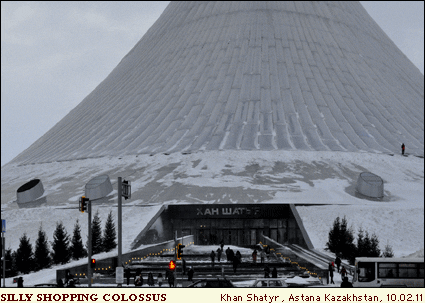
That visit was also my first opportunity to see the recently completed, Norman Foster-designed Khan Shatyr. This is basically a shopping centre located about a kilometre beyond the far end of Astana’s main boulevard – so no big deal, you might reasonably think – but I’m betting that most people reading this have never seen a shopping centre of quite this kind.

Modelled after a ‘royal yurt’ typical of those used by the Khans, shatyr’s exterior combines the sterile futurism of post-2001 spaceship design with the somewhat comical form of a partly-erected circus tent, its central supporting pole leaning heavily to one side. It squats on the steppe like a stubborn mirage, determined to make you believe that it's real despite your brain’s insistence that nothing so preposterous could actually be loitering out here in a place like this.

Inside you’ve got three floors of predictably overpriced boutiques, some game arcades and similar amusements … and then you’ve got the upper floors, where thankfully things get a little less run-of-the-mill. The highlight is a beach about 50m long, hermetically sealed and temperature controlled, with real beachfront sand trucked in from Turkey (if I remember correctly) and palm trees from somewhere that has lots of spare palm trees. If you qualify for V.I.P. status, you can buy a membership card which entitles you to do the following:

- hurry indoors out of the frigid cold, in your super jacket
  and your big woolly hat that ties at the chin
- take a lift up four floors
- strip off to your underwear 
- relax among the trees or simply luxuriate on the sand,
  in partial view of shoppers
- take a dip whenever you like
- repeat steps 4-5

The premiere weirdness here: Khan Shatyr’s inward-sloping walls are all glass, so as you sip your tropical cocktail and adjust your speedos, you can survey the ice- and snow-covered expanses of the Central Asian steppe.

Of course, not being vippy* enough, I didn’t go to the indoor beach. I did, however, let two minimum-wagers strap me into a chair, send me up to the roof of Khan Shatyr, then drop me like a stone through five storeys. I’m sure many of you have seen a ride at fairgrounds (if you can even call it a ride) which is basically a tall metal pole with hydraulics inside and chairs attached. The chairs are lifted slowly up to the top of the pole, and then the hydraulics are released and anyone foolish enough to be in one of the chairs comes free-falling back to Earth. It’s pointless and terrifying, and I had to do it.

In fact, I was voluntarily sent into freefall seven times inside a Temple of Retail shaped to resemble a giant tent, in the absolute centre of nowhere … which frankly, looking back, makes me wonder whether I’m really playing with a full set of marbles. Feel free to join me in doubting this if you’d like to )))

With that little adventure over, it was back to the absurdly opulent hotel (previously some kind of theatre, now a virtually deserted fiesta of lavish carpentry, statuary and plasterwork) to enjoy sweet tea and lemon while the weather continued violently arguing with itself outside.

So yeah, that’s Astana: an architectural fun park, largely unknown to the world, where the most whimsical demons of Lord Foster’s imagination are allowed to physically manifest. (Foster has collaborated with President Nursultan Nazarbayev on several architectural behemoths, all of which seemingly bear witness to Pressie N’s wish to be remembered as a kind of ‘New Sun King’ of the East.) It manages to be both fascinating and abhorrent, admirably bold and mildly obscene** at the same time. But still, it’s definitely nowhere as difficult to leave as Almaty is.

See, in addition to being home to quite a few of my favourite humans, Almaty has the undeniably impressive Zailiskiy Alatau mountain range towering over it like a chain of huge mountains over a medium-sized city.*** They’re unbelievably tall, wild-looking, fearsome rock massifs that are terrifying to walk on at night, and require a serious commitment to climb at any time of day, in any weather, at any time of year. Or, if you prefer your descriptive prose short and sharp, they’re freakin’ big, freakin’ tough and freakin’ goddam cool.

My personal favourite thing about the Zailiskiy Alatau is their noticeable mood swings. A little over three years ago, I moved into a top-floor flat on Zharokova street, from which I had a frankly stunning panoramic mountain view, and this is when I got acquainted with the many moods of the Zailiskiy. They could be bright, cheery and cogent one morning, sketchy and vague the next, and then turn positively dark and Mordory the morning after that.

What all of this means, in relation to the present entry, is twofold: first, the Zailiskiy Alatau have always contributed to my feeling that Almaty is “a great city to come back to”. (I stuck that in quote marks because I’ve said it so often.) Every time I return there, whether from another country or another part of KZ, the mountains give me a fresh thrill on my way into town. And secondly, they make leaving Almaty a somewhat fretful experience. As you look over your shoulder at the receding peaks, you think “What the heck am I doing, travelling away from those ridiculously cool things, instead of towards them?” And then “If only I'd spent more of my weekends up there in the Zailiskiy”. And so on.

On this particular morning – my last in Almaty – the mountains were in stunning form. There was a low cover of cloud blanketing the city, so they were invisible at street level, but in the air you could see them soaring majestically  skyward, their sunny sides a brilliant white and their shaded sides a deep, mystic blue. From where I was looking, they actually seemed to be sitting on top of the cloud bank, slowly floating across the sky in a way that somehow reminded me of a Terry Gilliam animation. And I thought what I usually think: "Well, bye guys. Prob'ly see you before too long."

And then we were over the horizon, and I was heading in the general direction of a funny, lop-sided circus tent with a thermally heated beach inside.

Funny old thing, life.


* A word I made up specially for this occasion – it’s an adjective, and it means “possessing the qualities of a V.I.P.”.

** (Because these building projects have cost SO many billions of dollars, which could have been used to improve conditions in other parts of the country.)

*** This is a new literary device I’ve invented called “zero simile”. It’s easy to master: just describe something performing an action, and say that it performs the action “like xxxxx”, where “xxxx” is the thing itself. (Example; “The Desert Sun, which had been punishing us so mercilessly since early morning, finally disappeared in the West like a fierce red celestial orb dipping below the horizon of a vast sandy plain”.) I think this is definitely gonna catch on … don’t you?

first and final moments #1

V Aeroporte, Almaty Kazakhstan, circa 9am (GMT +6)

So, this is it. One chapter ends, another begins. One door slams shut, another yawns open. One discoloured, exhausted-looking lemon slice gets a lift back to the bar at the bottom of an empty martini glass, another arrives floating gaily atop the next round of delicious vermouthy fun*.

Or, y’know, something like that.

In case you’re wondering what has motivated this sudden outburst of “best of times, worst of times, times when really opposite things were happening”** metaphors, they've been occasioned by my arrival at Almaty International Airport this morning. And as always, it’s an incalculable pleasure to be here.

*a-khe a-khem!*

(That's the official transliteration for "sarcastic clearing of the throat", recognised by international treaty.)

Ahhh, the airport … where so many great journeys begin, so many plans reach fruition, and so many life decisions transform from abstract thought into concrete action – and all this against an aesthetic backdrop that makes the average hospital waiting room appear thoughtfully decorated and charmingly rustic by comparison. A huge, over-lit building filled with parting loved ones ready to cry, taxi drivers ready to mercilessly rip you off, and dreadful, pre-wrapped food ready to unfairly diminish your roll of recently-exchanged currency, and leave you with a vague feeling of disappointment. What a place.

Sorry. Enough of the endless, aimless blah – it’s getting-to-the-point time. I’m here today because I’m leaving Kazakhstan to go and live elsewhere … and for the third time, no less! This time, though, it seems pretty final. And as with the previous two departures, if I could sum up the feeling of the event in one word, the word would be “conflicted”.

On the one hand, my wife left KZ some time ago, and is waiting for me with ‘Timurchik’ (our yet-to-be-born son, coming soon to an operating theatre near you) in a warm cosy flat in Ukraine. So obviously that’s a sizeable incentive to get on my figurative bike and leave this great ‘stan in the metaphorical dust. Also, between now and the point in time when I see them both, I’ll be taking the ‘long road home’ – visiting some unvisited bits of Eastern Europe, calling on a couple of old friends, and generally indulging my appetite for being on the road, which has been eating away at me all year. So while this morning brings the final moments of one adventure, it also ushers in the first moments of another. Which is both fun for me, and a nice link to my hastily-thought-up title for this series of entries ;-)

Moving now to the contents of the other hand: on that hand, there’s Almaty. It's the only city in this hemisphere where I have more than one or two good friends, and it has effectively become my ‘home’. For all their faults (mostly driving-related), I love the local people here, and they’ve graciously returned the sentiment over the last few years. And I also love quite a few of the foreigners who end up on Kazakhstan’s south-eastern border. For some reason, Almaty attracts a rather interesting crowd, and I regularly meet ‘new’ people who I like / get along with / have stuff in common with.

(I mean, I guess you have to be somewhat interesting and/or unusual to think “I know what I’ll do: I’ll leave my safe, comfortable life in Britain, Europe, the US, Canada or wherever, and go to Kazakhstan. Yeah, that seems like a logical step.”)

So this week has been a ‘typical last week’: a million things to do in an impossibly short time-frame, from visiting consulates to get visas for the next place to posting things you can’t carry with you, through to farewells and work handovers and a hundred taxi rides to fulfil a hundred errands.

This, btw, is exactly when I'm most susceptible to the odd charms of Almaty: when I move around the city, enjoying the fabulously mismatched clutter of its architecture, and being chauffeured by outgoing, friendly, quirky and occasionally insane folks who drive as though they were just one in a vast herd of wildebeest, thrusting boldly forward and trusting their horns to prevent them from being crushed in the general melee.

I realise it’s perverse, but I just can’t help being tickled when I climb into the passenger seat of a rusty old Mercedes, and an elderly moustachioed gentleman bellows at me “Tebye ne kholodno?” (“Aren’t you cold?”), then pulls a traditional Kazakh hat out of his glovebox and rams it onto my head before I have time to answer.

He adds to the general amusement by laughing raucously at how ridiculous I look in his little round hat, throwing his head back as he does so – and all without taking his foot off the accelerator! I mean, whatever else happens on that day, you’ll never be able to mark it down in the diary as “Dyen kak dyen” (“a day like a day” – meaning one like any other, without anything special to distinguish it).

... right?

The unusual character of the last week can be largely attributed to what I'll call the ‘ryhthm of leaving'. I've experienced it before, and it goes sth like this: you run to the street carrying odd collections of things, you ride in taxis, you leave stuff and collect stuff and sign stuff, you run madly back, teach a lesson, run somewhere else, sign another thing, run back … then stop to drink champagne and listen to moving farewell toasts from people you’ve grown quite close to … then run again, jump in another taxi … and so the cycle repeats.

The thing is, this leaving rhythm is quite exciting in its own way, but it can also be rather sad and depressing. Obviously there's the "saying goodbye to good, valued people" issue, but there's also this: I know from experience that the level of acceptance I have among people in KZ isn't available just anywhere. You need to find a culture that’s a reasonable fit for you, so that you give out the “Hey, I dig this place” vibe and so that, as a result, people fully accept and embrace you. It’s an uncertain process, and it takes time, and it doesn’t happen that often. Hence the sad.

Meanwhile, the city has unexpectedly pulled out its first fresh and glistening snow-coat for the year, seeing me off in style but also cruelly implying that I’m missing another opportunity to plunge into a hardcore Kazakh winter, which I would love to do.

Evil little city!

Anyhow, the second boarding call has just sounded (the first always being my signal to run to the smoking room and breathe in a final dose of precious, sanity-enhancing nicotine before entrusting my life to a complete stranger who wears a silly hat to work every day). So I’ll continue these ramblings in a few hours, when I land in Astana.

Right now, it’s time to say another farewell – this time to some mountains …

Bye )))


* Unfeasible though it may sound, I only recently discovered martinis. Had my first one maybe three or four months ago … and gosh, was it great or what?


** A quote from an entry in the Edward Bulwer-Lytton Awards for "writing the introduction to the worst of all possible novels". It’s a contest that happens every year somewhere in San Jose, California. Cool idea, no?