Sunday, 4 August 2013

day four: as seen through a mist of fatigue

EPILOGUE: 
ruminating word nerd

As much as I enjoy the actual 'trip' parts of road tripping (at least some of the time), this one-day stopover in Vilnius was the part I'd been looking forward to most.

I actually have a long emotional connection to this city, though I've never been here before. Some time around the millennium I was in a band, and we decided to release a CD of poetry set to music. We found a beautiful poem called Frozen Forests, written by a Lithuanian poet and translated into English. Having contacted him and got his permission to use his words, I asked a little bit about his home town and did some looking on the internet. The immediate reaction was "Ooooh, so pretty!", repeated about a hundred times ... and of course I resolved that, whatever else happened in my life, I would go there.

I'm quite proud of my part in writing that song (it's unique and beautiful), and when I hear it, I often think of Vilnius. But that little songwriting escapade was over a decade ago.

Sometimes takes a while to follow through on these far-fetched schemes :-)


= = = = = = = = = = = = = = = = = = = = = = = = = = = = = = = = 


PART 1: FATIGUEABLES

So yeah ... I woke up yesterday in a 'city of dreams'. Or at least a city of my dreams. Have to say, though, it wasn't one of my all-time best wake-ups. I felt mentally sluggish and physically exhausted, and my feet looked as though they'd been stricken with plague; the impressively painful blisters I'd developed had for some reason turned black and yellow. Walking more than a few metres on them was a real trial.

This was not the enthusiastic spring-out-of-bed which befits such an occasion.

Rather enjoyably, though, my hostel is one of those forlorn- and weary-looking tower blocks with which ex-Soviet Republics are packed silly. The room is spartan but has everything I need; the eighth-floor balcony is another matter. Held onto the side of the building with a combination of concrete and rusty iron brackets, it's missing a bit between the vertical 'wall' and the horizontal 'floor'. Every time I go out there for a cigarette, I can't help glancing through the gap and seeing the street far below. To halt the sickening swoon of vertigo that invariably results, I then sit down hurriedly on a tiny metal chair, trying not to look anywhere else but at my shoes.

Anyway ... by around 11am, I'd worked out what was wrong: basically, the summer had chosen today to catch up with me. I'd spent ten intensely enjoyable but extremely gruelling weeks in summer camp, sleeping far too little and working far too much. There had to be some kind of reckoning ... and here it was, apparently.

It was mid-afternoon by the time I managed to coax myself out of the room and into the slightly creepy wood-panelled lift. I pressed the black plastic button marked '1' (the ground floor is level 1 in most countries – this "G" thing seems to something of an English-speaking anomaly), and the button buried itself firmly in the wall panel as per usual. When I reached the ground floor (sorry, the first level), it popped back into its original position with an unbelievably loud "crack!".

It does that every time. Never fails to scare the shit out of me.

Out of the hotel, I headed towards the Old Town. According to the little itinerary I'd laid out for myself, I was meant to be leaving Vilnius tomorrow. So I would have basically this afternoon and this evening to see what I could see before moving on. Trudging along on two sets of blisters (the left set and the right set), I found myself thinking "Well, maybe it won't be that great. I mean, maybe a couple of hours' walking around will be all the Vilnius I need."

Yeah right, Anthony. That's exactly what will happen.

Idiot.


= = = = = = = = = = = = = = = = = = = = = = = = = = = = = = = = 


PART 2: INTRIGUEABLES

It turns out that, in fact, Vilnius' Old Town is not only rather fabulous but also rather large.

The fabulousness comes partly from that classic Euro-mix of sunny, open squares and shaded little alleyways, with cafes and beer gardens tucked away down side streets and in leafy courtyards. Also, it's one of those wonderfully laid out cities where you can be walking down an ordinary road and suddenly spot the tower of a medieval citadel standing on a hilltop at the end of it. Soviet occupation has endowed the city with its fair share of brutalist statuary (my favourite kind), and from the look of things, the grand neo-classicism which dominated Eastern Europe and western Russia in late 19th/early 20thC must have flourished here too at around the same time.


Exiting at one end of the Old Town, the atmosphere changes immediately. The transition is marked by a red/brown block shaded by vines, with sunflowers at the entrance. If you head down the left side of that block, you find yourself in an alley next to a surviving section of the medieval wall.

Walking along outside the wall (as opposed to inside, where everything is well painted and pretty), you see an entirely different Vilnius. It's gritty and it's ancient, with crumbling facades and silent courtyards that you'd be more than a little nervous to enter. It's also well-nigh deserted – while the city's most lavishly-painted churches and grandest civic buildings stand literally metres away, there are more alley cats to be seen on this side of the wall than there are tourists.

Not sure how I always end up discovering the dingiest, most unkempt parts of the cities I visit. Occasionally I wonder if something in my personality compels me to seek them out ... but for what reason I don't know.

So I followed the wall around for about half a kilometre, where I came to a succession of crowded cobbled streets on one side, and vast open squares on the other.

In this part of town, people were generally doing the thing which distinguishes European cities from most others: they were having coffee, beer and ice cream outdoors. More specifically, they were doing this on large expanses of precious urban land that would be devoted to motor transport or zoned for retail development almost anywhere else in the world.

This, incidentally, is one reason why I will never, ever be 'over' Europe. On this continent, even urban planners (who often seem to be the biggest morons working in any field outside of national government or the software industry) are aware that the basic unit of society is neither the car nor the retail chain: it's the individual. To put that a slightly different way, Europeans nearly all seem to understand that an outdoor cafe brings far more to a city than a motorway or a shopping mall ever could. This is how it should work everywhere, and if it doesn't work that way where you are, you should be rioting right now instead of reading this.

Oops! Sorry for the off-topic rant there. Let's get back to Vilnius.

So yeah ... putting all these first impressions together, Vilnius struck me at first glance the way most of my favourite European cities tend to do. On the one hand, there were definite similarities to other places, and interesting comparisons to be made. On the other, there seemed to be a distinct atmosphere here, specific to this town, which had me feeling intrigued and excited as I wandered around.

Clearly, I was going to need an extra day ...


= = = = = = = = = = = = = = = = = = = = = = = = = = = = = = = = 


EPILOGUE:
the word nerd is off again ... this time about langauge
(surprise!)


Something else that's always intrigued me is the way that countries, cities and peoples get different names in other languages. For example, the country known to its own people as Zhong Guo becomes "China" in English, "Ilestri" in Welsh, and so on. Likewise, Deutschland becomes Allemagne in French, from which I guess English somehow derived Germany, while the Finns call it Saksa. And speaking of the Finns, how the heck did Suomi (the actual name of the country) morph into 'Finland' ? And why do they call Russia Venäjä ?

Those are just a few random examples. Of course, I could go on about many others ... like the history of word 'njemets', which is fascinating. In Russian and several other Slavic languages, it means "German man", though its literal meaning is "man who has been struck dumb". The meaning change happened over centuries, and incorporated a stage where every foreigner in Russia was called 'njemets' ... because, not being able to speak Russian, they were for all intents and purposes without speech.

Sorry, I know this is an utterly off-topic ramble. I just think it's hilarious (and more than a little insulting) that in Russian, if you're talking to a guy who you think may be from Germany, and you want to check, you effectively ask "So, are you a man who has been struck dumb?". And if your guess is correct, the guy will answer "yes".

Blah blah.

The one I actually wanted to mention, though, was the word 'Lietuva'. This refers to an object which, in English, we call Lithuania. But the question is: why do we do that? Well, the standard answer is that all languages have processes of making foreign words 'fit', and English is no exception. I can see that in some instances ... but other times I think it's just lazy and/or silly.

So let me teach you how to say this word. There are just a few things you need to know.

To start with, the stress is on the first syllable.

Also, the i and e run together to form a sound very typical of Slavic languages. It sounds like "yes" without the s ... so 'ye', basically. (If you know Russian, just use an ordinary Russian 'e', and if you know Polish, use an ordinary 'ie'.) That gives you something like 'LYE'.

When you get to the 'u', make it short and round, like the oo in 'good'.

LYEtu.

Now the v. You need to soften this, so that it takes on some of the qualities of an /f/ sound and some of the qualities of a /w/. Try that. Then add the final a, which sounds like the last letter in umbrella.

Put that all together, and you've got LYEtu[w/v/f]a.

Now tell me ... isn't that a far lovelier word than 'Lithuania' ?

certainly think so )))

Saturday, 3 August 2013

day three: shao-lei and the smiling latvians


PART 1: GUANTANAMO, LATVIA

Day three of the road trip was a fairly intense one, involving some false starts and a bit of back-tracking as some of the transport connections I was relying on turned out to be fictitious. Those Baltic travel schedules turned out to be every bit as unreliable as I'd thought. In fact, there were times  when the only things that kept me going were the wonderfully warm smiles of Latvian women.

These, I have to say, are among Latvia's greatest natural assets ... and when I say that, I'm comparing said smiles to some other pretty darn impressive stuff.

Exampleoceros: it’s a little known fact that Latvia has recently been named the greenest country in Europe. Or at least, I think it's little-known – mainly because no-one has ever come up to me and said "Hey Anthony, did you hear that Latvia is Europe's greenest country?" So either nobody knows this, or nobody is telling me. I'm not sure which.

Either way, it's quite an accolade. Consider some of the competition: Finland is basically a few tens of thousands of lakes hidden inside a big forest, with only a handful of folk living in it, separating their recycling meticulously; Slovenia is 70% trees and about 15% mountains, with a population of around 40; Germany was so freaked out when it nearly lost the Black Forest to acid rain in the 1970s that it has entirely re-invented itself as a Green Society par excellence; and in Iceland, the buses run on hydrogen and nearly everything else is powered by moving water. So I don't know whether Latvians are proud of their 'green status' ... but if they aren't, then they freaking well should be :-)

Certainly flying over the country (as I did in May), the greenness of it was both extremely striking and extremely inviting. I had a powerful urge to get hold of a bicycle right away, and see this country properly, instead of transiting through Latvia as I always seem to do. I've promised myself that one day I will do that, hopefully with my family (and with Scott – we've been talking about it for ages). But not today, sadly.

The smiles, though ... well, they're absolutely world-class. I mean, forget London: if you're tired of being smiled at by Latvian women, you really are tired of life.

The early part of the day was also marked by a cavalcade of annoyances, which reached a deafening crescendo at around 8:30am. I was still in the waking-up process, and after asking for help from the staff and being met with utter indifference, I was sitting in the bar of my hostel and trying to make the wi-fi work. There were five guys in the bar dressed in faux medieval costume – tights, velvety waistcoats and so forth. I'd previously seen them on the steps outside when I went for a cigarette, drinking their 'breakfast beers'. (It's a common Eastern European thing to get tipsy at breakfast time. If you're Ukrainian or Russian, you do it on the way to work.)

Now they were inside, and on to their second round ... when all of a sudden, the beers were placed on coasters, musical instruments were produced from under tables, and latches were being loudly flipped open. A few seconds later they were tuning a bunch of guitars and lute-like things, before launching into a rendition of Guantanamera at ear-splitting volume … just as one expects first thing in the morning at a vaguely Irish-themed hostel in Latvia.

Like any sane person, I reacted by fleeing. No-one deserves Guantanamera* before 9am!  


= = = = = = = = = = = = = = = = = = = = = = = = = = = = = = = = = 


PART 2: 'SHAO-LEI'

At around 5:30 this afternoon, I rolled into Šiauliai in northern Lithuania. First impressions: drier than the other Baltics, more heavily cultivated, and a good deal more 'Soviet'. There were broken footpaths, shabby tower blocks, Moskvich cars and many other reminders that I'd arrived in one of the 15 former republics. But there were also cycle paths (very un-Soviet) and credit card machines that actually worked.

Being the 'language tourist' I am, I also noticed that the Lithuanian language is super weird and interesting. There are almost no prepositions (words like in, at, with, for, by, from etc.), and the pronunciation struck me as quite uncharacteristic of European languages. For example, the city I mentioned is spelled as you see it on the right, but pronounced 'shao-lei' ... which to me sounds more like a province in China than a town in Europe. So that was fun )))

I found the railway station without too much trouble, my wheelie bag bouncing over concrete blocks that had assumed all kinds of funny poses and angles. And a bit over an hour later, I boarded a train to Vilnius, and arrived there (sorry, here) a little after 10pm.

So ... success :-) I'm now approximately 1,045km into the journey, with about 1,200km to go. And I'm in Vilnius, of all places! How cool is that?

I'm also completely exhausted, so without further ado or adon't ...
good night :-)


('Guantanamera' = that horrible Cuban song that you've heard way more often than you should. It translates as 'woman from Guantanamo', and it's about unrequited love. According to one version of the story, the songwriter was at work one day when the woman he loved brought him a steak sandwich, and that little act of kindness inspired the song. Which is kind of cute I s'pose ... but why do we have to hear it over and over again, even in frikkin' Latvia?!?)


Friday, 2 August 2013

day two: straight on to the sketchy bits


PART 1: SETTING OUT

So … this is where it could all go wrong.

I’ve just boarded a 9am coach from Tallinn (which has lost none of its charm) to Tartu, Estonia’s biggest student town. From there, after a little wander around, I’ll bus it again to a place called Valga,
on the Latvian border. The Latvian railway website confidently informs me that there’s a train service from Valga to Riga, leaving at 5:30pm this afternoon.

The problem here is with this word “train”. The Baltics have never fully got it together rail-wise, and trains in this part of the world are notoriously sketchy and unreliable. Routes are often changed or discontinued, and information about the changes takes a while to propagate across the internet. So you can easily find yourself standing on a deserted railway station in an obscure town, with no choice but to stay the night. 

If you’re really lucky, you may be able to ‘coach hop’ to somewhere that’s vaguely on the map, because what these countries lack in train services, they almost make up for with long-distance coaches. But you still need some good fortune and a lot of patience. Oh, and even when the trains do run at the advertised time, anything that goes more than about 100kms on rails comes along incredibly infrequently. The Riga-Vilnius service, for example, only runs once in two days.

For all of the above-stated reasons, I'm skeptical about anything I read on a timetable in this part of the world. I guess we'll find out whether or not, and to what extent, that skepticism is justified.

Meanwhile, the coach I’m on now is super-modern and groovy, with in-seat displays that show you where you are on a map that updates itself every few seconds ... like the ones you get on aeroplanes. Admittedly, it's slightly disturbing that the picture of the bus is not to scale and can't change direction, 'cause it means that quite often you seem to be in an enormous 'superbus' that's heading straight into the sea! But I'll forgive this little technical detail.

The main thing is that the bus actually arrived, so I can get 160km closer to my final destination ... and see some lovely Estonian countryside along the way =)

I'll write more soon.

Bye )))


= = = = = = = = = = = = = = = = = = = = = = = = = = = = = = = = 


PART 2: PEAR-SHAPING

So … as I mentioned, if something was going to go wrong on this trip, today is one of the days when it was most likely to happen.

All was going well until I hit Valga and saw the railway station there. That’s when I had to start drawing up a Plan B.

I’ve seen some pretty closed-looking railway stations in my time, but this definitely came across as one of the closedest. The whole building was covered in scaffolds, construction of the ticket counters hadn’t been finished, and the only humans around were a few workmen (unless you count the token town drunk and the two gossiping grannies in the park opposite).

I walked around behind the station and onto the platform, and couldn’t find a place to buy tickets. There was a train, though. Unfortunately it said “Tallinn” on the front, and looked more like a museum exhibit than a functioning means of transport. Inside one carriage, I could see a tangle of copper pipes, as if an alchemist had set up his laboratory in there.

Not looking good. 

Four hours earlier I'd arrived in Tartu during a heavy rain shower, but once that cleared up I found the town quite pleasant to explore. Nothing spectacular, but good to see, since while I was living in Tallinn several people had recommended it to me as a nice place to go for a weekend, and I'd never quite got there. 

Tartu was pretty quiet, but there were definite touches of that characteristic Baltic quirkiness. I enjoyed the 'Monument To The Meeting of Two Wildes', which depicts Oscar Wilde having tea and chit-chat with the Estonian poet Eduard Vilde. The odd thing about this is that it commemorates a meeting that never actually happened ... though it "easily could have" according to the Tourist Information brochure. In Tartu, that's apparently sufficient justification to warrant a monument.

I also liked the sign above the two Wildes that said area of wireless internet. Obviously wi-fi zones are hardly a rarity nowadays, but they're especially common in 'e-stonia'. They've gone all-out with the "e" stuff here; in fact Estonia is the second most online society in the world, after South Korea. 

(Short aside: some years back the Estonian govt. also invented a way of filling out your tax return online which takes less than ten minutes and involves zero stress, which ought to have every employee of the Australian Tax Office hanging themselves in their garage out of pure shame and embarrassment. Even Finland is still catching up with Estonian innovations in this area. Just thought someone out there might like to know :-)

Much better than Tartu, though, was the countryside of Central Southern Estonia. I'd never been to this part of the country before, and it was a treat for the eyes. Much hillier than the northern parts; forested ridges and steeply rolling farmlands were the dominant features. At one point, I saw a woman in a bridesmaid's dress leap out of a Land Rover and run into a field of wheat. (Now there's a moment when I wish I'd had my camera ready!) It was odd ... but then, its oddness is one of the things I like about Estonia. And the Baltics in general, come to that.

A little further on we entered a region of lakes which were dramatically studded with islands, some of them rising vertically out of the water. I was surprised, impressed ... and sadly, once again far too slow on the draw with my camera :-(

So yeah ... Estonia arguably had no need to confirm its rockingness, but it went ahead and did so anyway. 

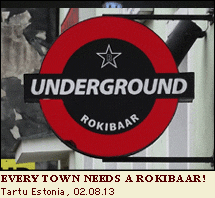
Also, the Estonian language continues to bring on the cute words, my favourite for today being "Rokibaar" (Rock Bar). Maybe it's just me, but I love it )))

As I said, though, the fun turned not-so-fun in Valga ... which is not, incidentally, one of Estonia's prettier corners. A quick walk into town (dragging my 20kg wheelie bag behind me along crappy footpaths, since no railway station means no luggage lockers) was enough to establish why this town is not on the 'tourist route'. 

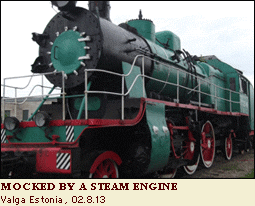
The only remotely interesting thing I found was this 'Locomotive Monument', commemorating the opening of the Pskov-Valga-Riga railway line in nineteen-something-or-other. And yes ... the mocking irony of it did annoy me.

I came back to the station at around 5pm, to find that the decrepit-looking train had gone. In its place was a much nicer one with Riga written on the front. Success!

I then made a little discovery: the station was not completely closed after all. At one side of the building there was a small sign above a door that said "Cargo Bus", and when I pushed the door, it opened.

Inside was a corridor, a toilet (yay!) and a small courier's office. My train was scheduled to leave at 5:29pm, and it was raining quite heavily outside, so I asked the courier lady if I could wait in the corridor until twenty past. (I set my alarm so that I wouldn’t miss it.) As soon as the alarm went off, I packed up my stuff and went outside. It was 5.22pm when I reached the gate leading directly to the platform – seven minutes till departure. You can imagine, then, how shocked I was when I saw the train pulling out and leaving!  

After standing pathetically at the gate for a minute or so, watching the train disappear, I went back inside to the courier's office.

“Excuse me. Something very strange just happened. Can train drivers leave early if they want to?”

“Yes, sometimes.”

“Ummm …”. I bashed around in my brain for words, in a 'wasp at a window pane' kind of way. For a period of time somewhere between five and ten seconds, the pane remained impenetrable.

I mean, delays I expect. Cancellations … well ok, they happen. But a train leaving almost ten minutes early, when it’s one of only three trains per day that can get people out of a dull-as-eggs little shithole like this one?

I just couldn’t believe it.

The woman behind the counter must have seen the disappointment written on my face (probably in arterial purple). I’d already paid a deposit for my accommodation in Riga, and the hostel had my credit card details, so if I was a ‘no-show’ they would just take the balance. And more importantly, I'd had pretty much all the Valga I could handle without becoming impolite.

Then she said “I can sell you a ticket on a coach from St Petersburg to Riga. It stops here at 7pm.”

Wow … amazing! I hadn 't even realised that this place was a booking office for coaches (there was no sign to indicate that), let alone that there would be one leaving in an hour and a half.  It was three times as expensive as the train, but obviously at that point, cost was more or less irrelevant. I paid up, and after a brief trip to a smelly little corner shop to buy ‘dinner’, I went to wait in the park right next to the bus stop. Rain or no rain, I was taking no chances with my ride-to-be.

But I still had one more trial to get through. I was passing the time semi-productively, writing up a blog entry, when the token drunk accosted me … and he was an elderly, filthy, and rather stinky one :-(

At first he asked me something in Estonian, and when I made 'don't understand' motions, used the word "tourist" (which seems nearly universal) and said "Ei osta eesti keelt" (I don't speak Estonian), he didn’t seem to get it.

A few attempts later, it finally sank in that this foreign traveller probably wasn't going to understand his Estonian, regardless of how loud he shouted. (I hate that ‘speak louder and the foreigner will understand’ thing.) So then he switched to Russian … which, thanks to the slurring, was only slightly more understandable.

“Where are you from?” he asked.

I should’ve said somewhere nearby like Riga or Poland. Instead, I stupidly said Australia.

I then heard the word “Australia” posed as an incredulous question about half a dozen times, getting a little louder and more ‘Oh my god, how unbelievable!’ with each repetition. Suddenly a thought (or half a thought, or the foggiest, most whisky-soaked outline of a thought) occurred to him:

“How do you know Russian?”

“I used to live in Kazakhstan.”

“In KAZAKHSTAN?!?”

And that was the next few minutes gone:

AuSTRAlia … KAZakhstan?”
  [short pause]
AuSTRAlia … KazakhSTAN?”

  [longer pause
  punctuated by some chuckling]

AUSTRALIAKAZAKHSTAN?”
... and so on.

A thought bubble appeared above my head, containing the following text:

"Yes, brains trust, that is what I said. And look, I’ll admit that I do quite like having a slightly unusual biography, but would you please get over it now? Oh, and it would also be great if you could just GO THE HELL AWAY. Do you think you could manage that?"

But despite my best attempts to communicate the contents of said bubble using facial expressions and body language, the drunk decided to persist in bothering this curious Australia/Kazakhstan man.

(Don't they always?)

After listening to some more of his slurring and dodging a little more spittle, I decide to venture a question:

“Do you live in Valga?”

"Frmblgrdlhrrrruuuu fuck-brrnnarrl ... huh?" 

“I said, do you live in Valga?”

"Wrdlyschvrrnvek Moscow-vrrr-grrr ... again?" 

On the third attempt he finally seemed to understand, and nodded “yes”.

“Is your house far from here?”

“No, not far. Not far. Not far.” 

For some reason, the second and third “not far”s were uttered with a slight air of melancholy. Ignoring that (because I couldn't care less whether or not he was melancholy, or indeed why), I then asked

“So why don’t you go home and rest for a while?”

Instead of answering verbally, the drunk reached into a shopping bag, pulled out a second bottle of whisky and brandished it at me, as if to say “Herein lie my evening plans” (except far less eloquently than that). Clearly he was settled in … and he was getting more shouty with every passing minute.

So again, back to the courier’s office I went, this time to get away from Spitface – except that when I tried to get in, I found it had closed. Arrgghh!!! The woman there had basically sold me a ticket and then buggered off, which is generally not a good sign :-(

There was a cleaner in the corridor, though, and she spoke great English. I asked if I could hide in the stairwell until my coach arrived, and she allowed it.

When 7pm finally rolled around, no coach arrived. The drunk was still ranting in the park, now with a fellow whisky-drinking bum for company. I was thinking “Oh my gods, I am stuck here after all … and this place sucks!” But about 15 minutes later the coach turned up, and I gratefully threw my bag into the luggage lockers underneath the cabin, then boarded. I was saved!

And that's really it. Everything else went off without incident. The ride through the Latvian countryside was picturesque, and the room at the hostel (or rather, the closet with a bed stuffed into it) was still available. I’d made it through Day Two.

Incidentally, that means 710kms down, 1,540 to go. 

Tomorrow I hit Lithuania. It’s the only Baltic country I haven’t visited before … pretty excited about that!

Good night )))


Thursday, 1 August 2013

rationale for a road trip


As I think I’ve mentioned before on these pages, one of the major drawbacks of being an English teacher is that it involves saying “goodbye” to an awful lot of people. And I mean a lot.

Seriously … I was doing some mental calculations earlier today, trying to estimate how many students I’ve taught since I started, and I stopped at around the 1,000 mark – well short of the total. At the risk of stressing the obvious, the point is that precisely none of those people are my students now. Add to that the amazing colleagues I’ve worked with in various countries, and you get ... well, quite a bit of waving and hugging and wishing people well, knowing that you'll probably never see them again.

Of course, not every “goodbye” is painful. Some actually come as a huge relief, like my high-school students in Viet Nam (by far the worst classes I've ever had – they were evil little monsters!). And there are also classes towards whom you feel kind of ambivalent; they're ok, but you won't miss them when the course is over. So you just say “Well, guys, this is our last lesson together, so good luck in the future”, your students say similar things back to you, and you walk out of the classroom and get on with your day as usual.

Most of the time, though, there's at least a little bit of sadness involved in farewelling a class. It’s often seemed to me that learning must bring out the best in people, because in one way or another, I’ve really enjoyed teaching the majority of groups I've had.

And then, maybe once or twice a year, you get 'that' class. It's either an entire group of people who create something remarkable when they come together, or it's several individuals within a group who are extraordinary in themselves.

In those cases, you more than just like these people; you actually start to love them. They become an essential part of your daily reality – so much so that the idea of not seeing them anymore is quite unimaginable.

Something else to note about the 'wonder classes': if you feel that intensely about them, then there's a very high chance that they feel similarly about you. It's especially true of teenaged students, since people in that age group tend to be either the most disinterested or the most devoted. So in those cases, the “goodbye” can be heart-wrenching.

Oh, and if you leave a class you love because you’re departing from a place you love, that intensifies things even more. Put those ingredients all together, and you start wondering what kind of twisted masochist you must be to even contemplate what you're about to do. But that’s part of the weirdness of English teaching … these things sometimes happen.

In Finland this year, I had not one but two teenaged classes containing people who belong in the 'wonder student' category. And one of those was my class at the final camp. So I knew beforehand that saying "goodbye" on the last day, and then walking out of the college to leave it behind possibly forever, was going to be tough. And hey, guess what? I was right. Sitting under a cloud of unhappiness on Kouvola railway station this afternoon, utterly exhausted and slightly hung over, I must have looked like a man recently diagnosed with cancer of the funny bone.

That's the main reason why I’m in my current situation. That, along with a growing dislike of flying and airlines.

See, a few years ago I worked out that one way to soften a painful goodbye is to follow it with an adventure. That way, you’re distracted from all the negative feelings by the prospect of what’s ahead … and by the need to get organised!

I therefore decided not to book any flights back to Ukraine after Finland. Instead, I’m going the whole way (about 2,250kms) over land and sea. The end of summer will be the beginning of a ‘road trip’ ... and hence, not quite so depressing as it would be otherwise )))

The route I've chosen will take me through six countries, and involve a multitude of travel connections – hence plenty of possibilities for things to go horribly wrong, stranding me in some tiny Baltic town and forcing a bit of improvisation. It also incorporates two ‘stopovers’, in Vilnius (a city I’ve long dreamed of visiting) and Warsaw. So, in summary, I think it’s gonna be awesome!

The journey started today with the horrifyingly expensive train to Helsinki (but hey, they had wi-fi on the train – a first for me, and kind of novel.) Now I’m crossing the Baltic Sea to spend the night in my former home town of Tallinn.

The sea is rough today, and we’re bobbing wildly up and down as our speedy little catamaran streaks past huge white ferries, which are plying the same route at a more stately pace. It’s wavy, bouncy fun!

I’ve actually done this trip several times before in both directions. Notably, I once jumped straight on the ferry in Tallinn and crossed over to Helsinki after an all-night drinking session with a beautiful Moldovan woman who I was chasing at the time. I can’t say that it was a memorable crossing – we hadn’t even made it out of the dock when I lost consciousness – but “notable” for sure, since it was one of the few times I’ve shown my passport and had no doubt that I looked worse in person than I did in the photo!

In any case, though, it’s been a while since I was on the Baltic Sea, and four years since I've visited Tallinn. I know I’ll experience a tingle when the saddam comes into view. (By a curious linguistic coincidence, saddam is Estonian for 'port'.) Behind the dock will be the uncompromisingly brutalist and fabulously ugly Olympic Sailing Centre, built for the 1980 Olympics (when Estonia was part of the USSR) and widely considered the greatest eyesore in the Baltics. Behind that, a few of Tallinn’s tallest spires will be visible from the harbour. I'll see those spires, and that will be it ... tingle time :-)

*sigh*

Heading to Tallinn tonight was a good choice, I think. It's sure to chase away a few of the post-camp doldrums.

No doubt I'll feel the urge to write more stuff along the way – this kind of travelling always seems to make me ramble at great length. So … more soon!

Take care )))
Anthony.


Monday, 20 May 2013

Extreme Pramming


Let me tell you my theory about how Ukraine could increase its medal tally at the next Olympics.


MEDIUM INTENSITY ROADWORK MATRIX
Lviv, Ukraine, 05.07.12
To achieve this, all they'd have to do is argue successfully for the inclusion of a new and rather unconventional sport. Judging by some of the sports that are already contested at the Olympics, I'd say they've got a fair chance.

The sport in question is called 'Extreme Pramming'.

Extreme Pramming has much to recommend it. First of all, the women's competition would be much fiercer and more well-paid than the men's, redressing current gender imbalances in professional sport. Second, it would probably appeal to a young, 'cool' demographic for whom traditional sports hold little appeal.

And third ...
well, third, it would just rock.

INTERMEDIATE LEVEL SNOW CHALLENGE
Lviv, Ukraine, 16.03.13
But why am I so confident that Ukraine would take home the lion's share of medals in this exciting new competitive event? Well, because I've seen the obstacles which pram-pushing mothers in Lviv deal with on a regular basis.

These (sometimes disturbingly) young athletes-in-training routinely take on terrain that would send mothers in cushy Western countries screaming indignantly to their local councils. And yet, invariably they emerge as victors.

In other words: if you're Ukrainian, and a woman over the age of, say, 22, there's a damn good possibility that you can push a pram over just about frikkin' anything.

So here's what I think they should do:

First, build Extreme Pramming courses in several major cities and 'off-beat sporting capitals' around the world. (I'm thinking of Queenstown, for example, in the second category.) A typical course would feature most or all of the following

: streets with huge holes in them
: streets that are completely dug up (with no roadwork signs
  of course)
: 40cm walls of snow
: ice-covered staircases that have effectively turned into slides
: manholes that sit about 10cm higher than the rest of the pavement
: other manholes that collapse if you step on them
: trenches dug by road workers and left open
: mysterious mounds of Earth which, with the passage of time,
  have become lightly grassed over
: tram lines with no special crossings for prams/wheelchairs/anyone
: wire fences everywhere, separating patches of nothing-in-particular
  from other patches of nothing-in-particular
: occasional tank traps
: cobble stones that have subsided, achieving an eye-catching
  multi-level effect (though they were probably replaced no more
  than a year ago)
: a lovely collection of sharp pieces of twisted metal, sticking up out
  of the ground at random intervals.

Each course would have about five tonnes of dust and gravel dumped on it, and would be patrolled by hungry-eyed street dogs and angry grandmas dispensing unsolicited advice. Drivers would tear around the roads in ridiculous penis-mobiles, too phenomenally dim to understand the basic principles governing the use of traffic lights, roundabouts and pedestrian crossings (or too goddam self-absorbed to care).

POSITIVE GRADIENT GRAVEL RUN
Slavs'ko Ukraine, 12.05.13
Then, of course, you'd need some industrial-strength prams for competitors to use on the courses. To accurately replicate Ukrainian conditions, each pram should ideally resemble a small, gaily-coloured tank (see the snow pic above).

Once the set-up phase is complete, promote the Hell out of the new venture as the latest in wacky extreme sports. At the very least, it should attract some Finns and Scandinavians (when you consider that the world wife-carrying championships are nearly always held in, and dominated by, those countries), a good number of New Zealanders (up for anything that combines physical exercise with the potential for serious injury) and fans of similarly silly sporting pursuits, like the wonderful and incomparable 'Extreme Ironing'.

Having achieved worldwide cult status, the next (and trickiest) part will be to convince the International Olympic Committee. But you know, I think there's one word in the English language which, to me, expresses all that needs to be expressed about why the IOC and the Ukrainian authorities may well be a perfect match for each other. That word is "bribe". A few million hryvnia* applied here and there, in just the right places, and I think there's a pretty decent chance that in 2016, we'll see Extreme Pramming in Rio.

And then ... well, for Ukraine it will be "goodbye" to its current over-reliance on boxers, and "hello" to a medal count that any country could be proud of.

So then ... is that a cunning plan, or what?

Yep, I thought you'd agree.

Bye :-)


* Ukrainian currency.


Monday, 13 August 2012

day fourteen: lessons


Hello!

Well, the holiday didn't end quite as I imagined. I was supposed to be back in L'viv tonight, but instead I'm staying here in Przemysl, 'cause all the buses have gone and Ukrainian trains refuse to take bicycles. You can buy your ticket and gamble on the possibility that the conductor might accept a bribe, but if he won't, you've just blown your fare. So I'm spending one more night in Poland.

(At this point, I'm furiously resisting the urge to rant about how this no-bicycles-on-trains thing just underscores the degree to which Ukraine is not mentally/culturally ready to join Europe. If I were to give in to these urges, I'd probably go on to specify – family reunions aside how much I'm not looking forward to rejoining a culture which is so thoroughly geared towards making sure that anything a person may wish to do is against the rules and/or practically impossible. I may also mention how, as a result, contact with said culture makes many of those unfortunate enough to have it feel miserable, frustrated, and ready to kick things and swear at people.

But you see, I'm just far too controlled and restrained to mention any of that ;-)

In the end, though, I guess it's not a big problem. It gives me some time to reflect on the journey. I've learned a lot in the last two weeks, and in a few cases, it's been the kind of learning that may actually have concrete, life-enhancing results. Which can hardly be a bad thing, I reck'n.

Before I elaborate on that, however, there are threads to be tied up.

First of all, I mentioned in the previous entry that Scott and I were heading to Wrocław (which, in case I'm not the only one who's always wondered, is pronounced "Vrotswav"). It was actually my second visit, the first having been a week earlier, while I was on my way to the German border. And yet, so far I've failed to give it even a passing review.

Of course this trip hasn't primarily been about taking pics of cities I haven't visited before and commenting on them. Even so, Wrocław is such an impressive place that I feel I should say something.

I still know virtually nothing about how these Polish cities came into being and at whose behest. Whatever the history may be, though, it's clear that early Polish urban planners really knew how to lay out a central square. Even the German woman I met in Krakow last week commented on the grandness and spaciousness of the Polish rynek. (I say "even" because her country can definitely hold its own in this regard I mean, aside from anything else, it contains the fabulous Erfurt, whose town square is the largest in Europe.)

A common planning strategy for Polish cities and towns is to put the town hall dead centre, with the rynek / main square around it. In Wrocław's case, the hall is so huge that it has three streets running through the middle of it! And the vast area around that is packed with exquisite architectural detail.

Of course the rynek is wall-to-wall cafes and restaurants, and not the place to go if you want to eat lunch at bargain basement prices (though Germany is at least three or four times as expensive, if not more so). But it's also strangely lacking in swarms of tourists – unlike Krakow's Old Town at the height of summer – and those who are there mostly seem to be Polish. So that's kind of a bonus.

Can't say that I really got any insights into the 'soul' of Wrocław at all ... I basically just walked around the touristy bits going "wow". But still, the "wow"s were frequent and heartfelt :-)

Getting back to our 'mission', though: by the time Scott and I got to Wrocław's rynek on the night in question, it was after 1am. This had already compromised his plan – which, you may remember, was to find a Polish woman who was prepared to participate in a 'screen kiss' with him. The ideal version of the plan had him kissing the Polish lass at midnight on his last full day in the country ... but y'know, sometimes one's dreams are unavoidably subject to the vagaries of rail timetables. So 1am or later would have to do.

I must admit that this little sortee did raise a couple of questions in my mind. Specifically, I wondered where exactly one draws the line between the innocent schemes of a couple of silly travellers and the parasitic behaviour of sleazy old men chasing younger women through Eastern Europe. But y'know, it was only a kiss that Scott was after, so I decided that it was innocent enough :-)

And so we set about finding the girl.

It didn't take long, either. She was ideal – friendly and chatty, attractive, no doubt rather photogenic. The only problem is that she had followed us down the street because she'd confused us with two other English-speakers who'd threatened to beat up one of her friends a few minutes earlier. Why had they done this? Well, apparently their explanation was quite simple: they had decided to attack him upon noticing that he was black.

Delightful.

This bizarre little occurrence got the conversation off on an awkward note, and the first part of it mainly consisted of us dissociating ourselves from the wish to hurt people whose melanin production was superior to our own. From there, as charming as our interlocutor was, it was rather difficult to move the conversation in the direction we needed.

(The road from "I thought you two were the racist fuckheads who came by earlier" to "Would you mind just kissing my friend while I film you?" is a long and difficult road indeed.)

The next woman we met also seemed like the 'right' one. We had her almost undivided attention (even though she was working), and again, she was open, chatty and attractive. The only problem was, she was also our waitress at the pub where we had settled in for the night.

It isn't that she was too busy to spend time with us – in fact we chatted for a couple of hours. It was just that ... well, between 'real drinks' (beer for Scott, red wine for me), we were having wisniowka shots. Wisniowka is a delicious cherry-flavoured vodka which I indulge in at least once on every visit to Poland, and since this was our last night, I bought numerous rounds of it.

The inherent difficulty here is that wisniowka is in fact evil. It's one of those drinks with the power to lull you into thinking you're completely fine, concealing under its veneer of fruity sweetness a 40%-proof kick. It's like sangria squared, then squared again.

So yes ... a long chat and five or six wisniowkas later, the moment had well and truly come for Scott to explain the mission to this woman and lean in for the kiss ... except that by this time, the whole idea had completely slipped our minds!

So that's how the mission ended: killed by several shots to the stomach. Damn that Polish firewater!

The following morning we stumbled out of bed, rode rather sluggishly to the rynek for strong coffee and dumplings, then parted in the square. I rushed for my train to Krakow, while Scott stayed behind and sought out the best, most eye-catching place to park his bike (which he was planning to sell before flying back to England).

And now, here I am a day later, back in the town where I started.

So what, if anything, have I learned from all this? Well, quite a few things, actually.

Firstly, I've learned that my suspicions about Poland were right, and that it is a really, really great country. I'm looking forward to deepening my acquaintance with it in the future.

I've also picked up a few ideas about cycling holidays, and about how the next one can be better. There's a bunch of stuff in my head now about what to do, what to take, how to plan and so on.

More importantly, I know that there will be a next one. 'Cause this has been, without a doubt, one of the most enjoyable holidays of my life.

I think I mentioned once before on The Manor that, in 2000, I spent three months travelling with Natalie (my ex-partner and one of my favourite humans) through Germany and Western Scandinavia. We started and ended that trip in Koblenz – an elegant and quite romantic German city, brilliantly located at the confluence of the Rhein and Mosel rivers.

Our initial arrival in Koblenz was in the first week of September, and from there we struck out in pretty much all directions, staying in a couple of dozen different places from big capitals like Berlin and Stockholm to obscure villages, arctic settlements and log cabins in the Norwegian fjords. In every way, it was just an incredible holiday.

By the time we got back to Koblenz in the dying days of November, it was difficult to remember what either of us actually did with our lives before the trip had started. And that, I have to tell you, is one of the best feelings I've ever had. The sensation that you've been on the road forever, that the earliest days of your journey are distant memories, and that everything beforehand seems a lifetime removed from where you are now, is just amazing. I think everyone should experience it at least once in their lifetimes if possible.

I'm telling you this because I got some of the same feeling from this holiday, even though it was only two weeks long. As the train took me back through south-eastern Poland towards Przemysl, it passed through a lot of towns that I'd cycled through ten days or a fortnight earlier. And it seemed like an age had passed since then. Finally, back at my starting point, it was as if I was seeing Przemysl for the first time in months or years, and I'd been on the road  for that whole intervening period. For me, this = major, major result.

So the next cycling holiday will

a) undoubtedly happen, and
b) be planned and executed better than this one.
 
On a less positive note, this trip was kind of the 'culmination' of a habit I've developed over the last few years of taking work and study with me on holiday. Up till now it had been unconscious or only semi-deliberate – I'd just pack some uni notes or whatever, so that if I had downtime, I could make use of it. Or I'd go on holidays near exam time, and therefore find it necessary to book an exam in one of the countries which I was passing through. (My university, unlikely though it may seem, allows you to do that.)

This time, as you might remember, I knowingly set out to combine the exploration of a physical place with the exploration of an academic subject – my 'On the road with Muhammad' idea.

I now understand that this was a mistake. Once you start allowing the non-travelling part of your life to impinge on the travelling part, it gets worse every time, until you wind up looking for places where you can conduct lessons and submit essays instead of doing what you should do, i.e. letting go and committing yourself to the journey.

So next time I'll do whatever's academically or professionally necessary first, then close all books, cancel all lessons and disappear, immersing completely in the travel experience (which, after all, is one of my main reasons for being). No other approach makes sense.

I think that's all I wanted to say. Hope you enjoyed this series of rants. Thanks to those who commented ... I always savour reading what people have to say about my little wanderings and ramblings.


I'm leaving you with my pic of a lake in far southwestern Poland, somewhere between Jelenia Gora and Karpacz. It's taken through a bus window at dusk, hence dark, blurry and a little indistinct. But it's still one of my favourite images from the trip, and it seems to me a nicely atmospheric 'parting wave' from the country I'm about to leave. Hope you like it.

Bye :-)

Saturday, 11 August 2012

day twelve: fun with anomalies


So our bus did eventually pull out of the field, and after winding along some excruciatingly narrow streets through a series of excruciatingly cute villages, it deposited us at a decaying railway station about half-way to Jelenia Gora. We went the rest of the way on a super-modern Silesian* train. We then went off to find our accommodation, which you can see below.

Yep, that's right: with Scott's assent/ encouragement, I booked us a trailer outside of town. It was awesome – kinda fun for its novelty value, comfier than some of the hotels I'd stayed in, and at 35 złoty (a little less than nine Euros) each, a fabulous bargain.

I said right at the start of this journey that Poland is a country full of pleasant surprises, and today held two of them. The first was the city of Jelenia Gora itself. We certainly hadn't come here because of the city's reputation for being a great tourist destination – I mean, as far as I know it doesn't have one. We came solely because it's the closest regional centre to a place called Karpacz, which I've begun to fixate on over the past four or five days. That was our real destination, about which I'll say more later.

Having said all that, we obviously couldn't leave without having a look around – and besides, we needed coffee and breakfast! So we headed into the centre, where we found a very elegant stare miasto (old town). The main square was dotted with craft stalls, cafes radiated out in every direction, and in the centre was a sound stage where people were learning to folk dance. It was the whole nine yards, basically and, of course, the kind of 'unexpected bonus' which Poland excels at.

Looking beyond breakfast and the joys of źurek (the soup I mentioned a while ago, made on a fermented rye flour base), the plan for the day was basically this:

1. Ride 20kms to Karpacz and back.
2. Get a train to Wrocław, to fulfil our last mission for the journey.

Actually point two was Scott's mission, and I was just meant to be the cameraman/wingman. He's been making a little documentary about his/our trip, and since the book he's reading now is called Emotional Intelligence, this has sort of become the theme. Somehow, he's taken these ingredients – cycling through Poland, Emotional Intelligence, making an amateur film – and concluded that the best way for his doco to end would be with a big romantic 'screen kiss'. So the mission: find a friendly and charming Polish woman (not difficult to do), explain the project to her, ask her if she would mind kissing Scott for the big finale, and film it – preferably on the rynek in Wrocław, since it's both quite a romantic place and an ideal 'symbolic end point' for the journey.

First, though, we had a mountain to climb ... which was the other surprise for the day. See, we'd been told in Zgorzelec that the road to Karpacz was "not so flat", but that was all. I don't know whether Polish people are considered to have a talent for understatement, but if the comment about not-so-flatness was at all typical, then they really ought to be famous for this.

And so, we went there. And it was hard, let me tell you. I mean, 20kms is not such a long way to cycle when you're on relatively flat territory, but when the last 8 or 9kms are up a mountain, it becomes quite a different undertaking. On the way up, we were passed by two groups of mountain bikers, fitted out with all the latest equipment and looking like this was no effort for them at all. For us ... well, put it this way: I didn't shoot any dirty looks at the mountain bikers, or make any obscene gestures at them, but only because it would've required more energy than I had at that point!

But why make all the effort to get to Karpacz? Why had I become so fixated on this place? Well, you'll be relieved to know that I can answer that using just two words two Polish words, in fact. The answer is "Anomalia Grawitacji".

Turns out there are certain places on Earth where the force of gravity doesn't behave in quite the same way as it does everywhere else, and odd things happen as a result. At least, that's what some people believe. Others say it's bunk, and that the strange phenomena observed in these places can be explained as optical illusions.

In the case of Karpacz, the town (a lively ski / outdoor adventure resort, and also a surprisingly picturesque place to put a natural mystery) snakes most of the way up one side of the mountain, and just above it you reach a gentle peak. Slightly beyond that, going down the other side, there's a short stretch of road where the weirdness is concentrated. Here things appear to go into reverse: water flows upwards rather than downwards, and if you stop your car on the hillside (as many drivers do), it will roll up towards the top.

The real nature of what's going on in Karpacz is disputed; you've got your 'gravitational anomalists' on one side of the argument, and your 'optical illusionists' on the other. So obviously, as soon as I heard that such a place existed in southwestern Poland – towards which I was headed at the time there was no question at all of not going there to check it out for myself. It simply had to be done.

We reached the top of the mountain cold, wet and exhausted, and found the location of the alleged anomaly. Visually, it was definitely one of the weirder places I've been. From the 'top end' of the road (nearest to the peak), it looks unquestionably like a downhill stretch, but as you go along, you notice that the gradient seems to change. If you go to the bottom end and look back, it looks as though you've just come up a hill, whereas before you started moving it seemed that you were at the top and going down. And in the middle, it looks downhill in both directions.

Is this just an optical illusion, though? Well, the visual oddities tend to support that theory, but they don't explain the other stuff that happens on this road. Rolling uphill on a bicycle is a bizarre feeling, and watching cars do the same is quite captivating. The cars always roll towards the peak, no matter what point they start from, forcing your brain to try and reconcile previously learned facts about the world with new information that doesn't 'fit'.


(Btw, the driver of this car says "pięć złoty"  five złoty, 
indicating that he wanted me to pay for filming. 
He was just kidding.)

And there's one more thing I should mention: the physiological effects that I experienced in this place were very unusual. Every time I crossed the road at the point where the 'anomaly' seems to be centred, my head would go a bit scrambled-eggs. Either it would start spinning, or it would tell my body to go right for no apparent reason, and I'd start turning and walking up the road before 'catching' myself. There was also an occasional sensation somewhere between 'lightness' and a feeling of disconnection from the world. And lastly, if I turned my head suddenly or bent down on the spot, I would immediately feel nauseous.

Scott had none of these effects – in fact, he had great fun filming me while I experienced them, and hamming it up for the documentary.

So, then ... what the Hell is happening up there on that mountain?

"D'know", is the short answer. After subjecting the theory to various carefully designed and rigorously scientific tests (see photo), we formed no conclusions either way. But in the end, it really didn't matter. The point was to savour being in a place like that and having the chance to 'investigate' such an oddity in person. If Fox Mulder had suddenly leapt out of the woods with an oversized torch (or "flashlight", as he would call it) and an alien abduction theory, I wouldn't have been overly surprised. At least, not much more than Poland already surprises me on a regular basis =)

Our encounter with the gravitational anomaly concluded, we rushed back to Jelenia Gora and boarded a train. We're now on our way to Wrocław, to see if we can find a young lady who will kiss Scott on camera. I'll let you know how that turns out.

Wish us luck!
Anthony.


* Silesia = the south and southwestern part of Poland.